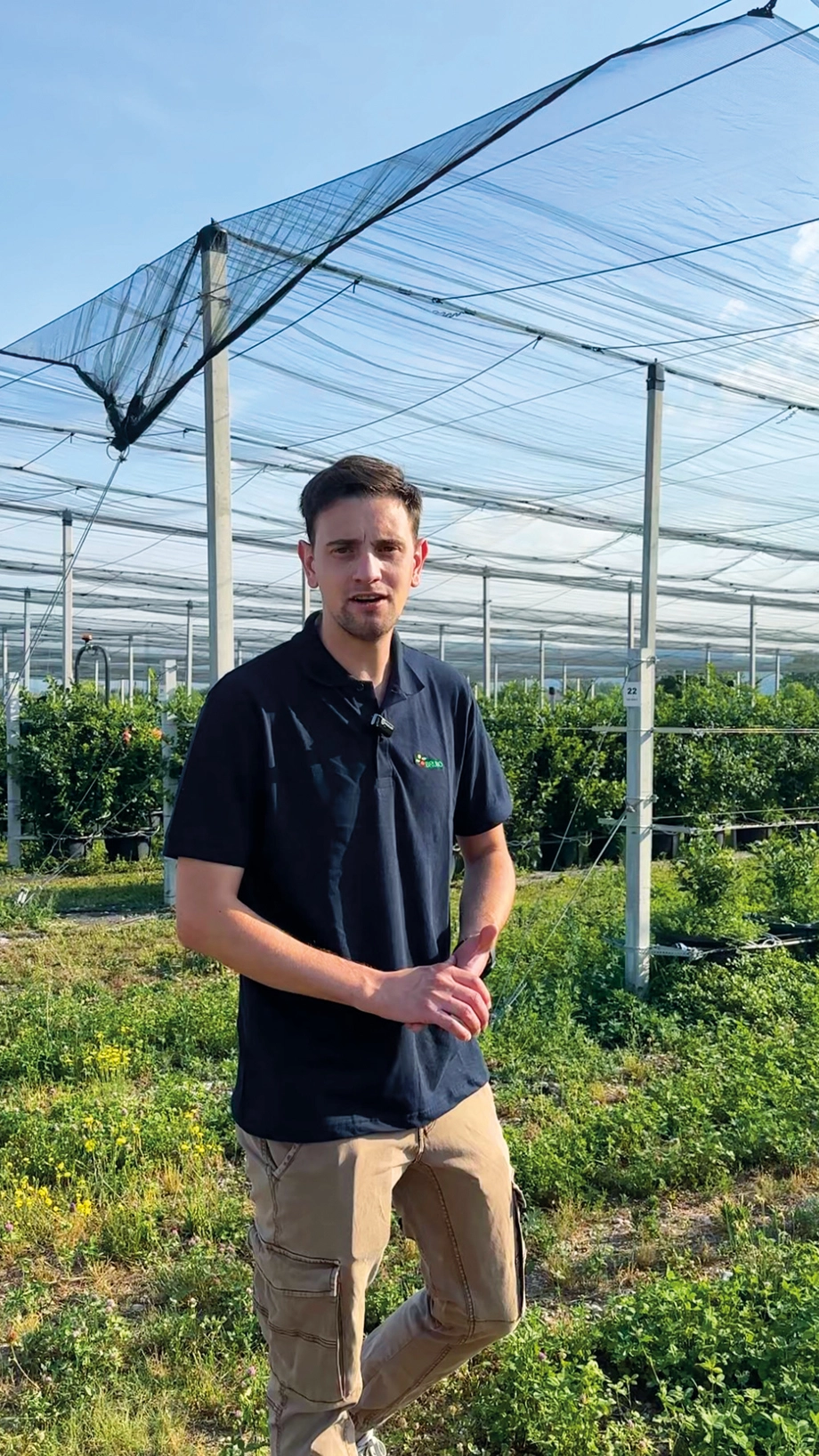










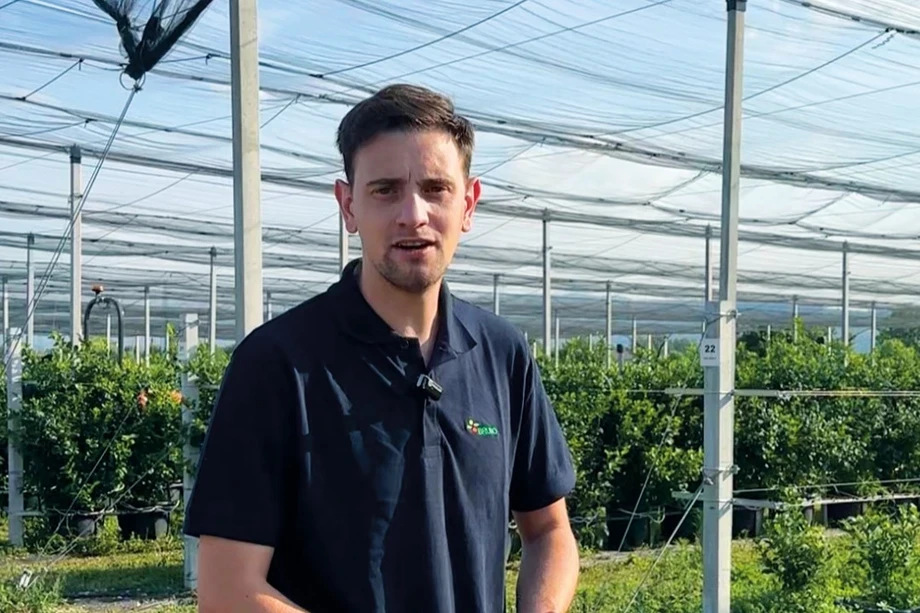
Marco Antolini has been growing berries in Verona (Northern Italy) since 2012. Ten years later, as part of an expansion project, he and his brother Riccardo decided to design and develop a farm layout suitable for the mechanical harvesting of blueberries.
In this exclusive interview with Italian Berry, Marco Antolini discusses his direct experience with harvest mechanisation, a practice that is still uncommon in Italy but already accounts for 50% of the crop in other producing countries, such as the United States.
Mechanical blueberry harvesting: the prerequisites
How was the farm established, and how did you decide to introduce mechanical harvesting?
I established the farm in 2012, initially growing berries—particularly raspberries, blackberries, blueberries and currants—across a total area of approximately 1.5 hectares.
In 2022, management of the farm was transferred to Relais al Dosso di Antolini Riccardo. During this new phase, my brother and I decided to expand production by devoting approximately 4 hectares to blueberries, with the aim of developing an innovative farm layout designed for mechanical harvesting.
What difficulties did you initially encounter?
Developing a farm layout capable of ensuring good mechanical harvesting efficiency was not easy. We had to address several technical, organisational and financial challenges, but our determination to believe in the project and our continuous improvement efforts enabled us to achieve a significant initial result.
What role did product marketing and technical management play in this process?
Throughout this process, we have received support from Bruno Srl, which mainly assists us with marketing and the development of supply-chain strategies.
One of the company’s distinguishing features is its constant focus on identifying the best solutions for the farms with which it works. Bruno Srl’s technicians continuously analyse production requirements and develop innovative approaches, with the aim of helping growers improve their crops.
The company provides a comprehensive service that includes specialist technical assistance, support for the varietal development of all the main berry crops and a well-structured commercial department that works closely with growers.
It also plays an important role in managing the certifications required to work with the leading large-scale retail (GDO) customers, ensuring a controlled and transparent supply chain that complies with current regulations and the quality standards required by the market.
Working with qualified partners is therefore essential for addressing the sector’s future challenges, enabling farms to develop through a model based on innovation, quality and safety throughout the supply chain.
Choosing mechanical harvesting
Taking a step back, what were the main reasons that led you to introduce mechanical blueberry harvesting on your farm?
The first reason was undoubtedly the need to reduce labour costs. However, the main challenge is the constant decline in the prices paid to growers, a trend that becomes more pronounced every year.
This situation is also influenced by the significant differences in labour costs across European countries, where economic and regulatory conditions make workers more competitive in some regions than in others.
The second reason, which is no less important, is my belief that farms need to embark on a path of technological innovation. Adopting advanced solutions represents a tangible opportunity to improve operational efficiency, optimise resource use and increase the sector’s competitiveness.
The labour factor
In an Italian context characterised by high costs and growing difficulty in finding workers, was mechanical harvesting a strategic choice or a necessity?
In recent years, in light of market developments, mechanical harvesting has become an increasingly necessary choice for ensuring the financial sustainability of farms.
However, from a technical and production standpoint, I believe that a proportion of manual harvesting will remain essential for many years to come.
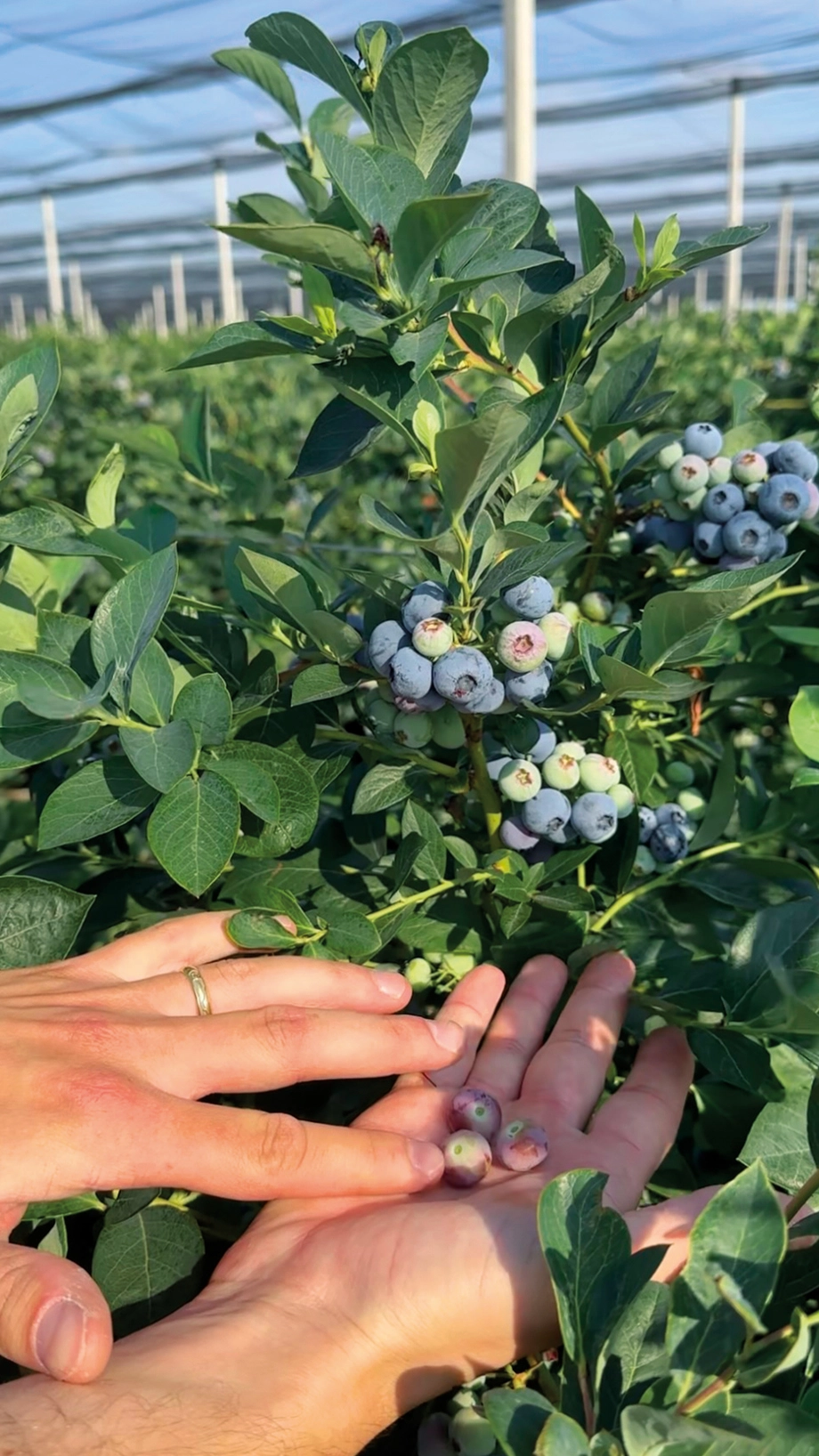
The first consideration concerns fruit ripening. The fruit does not reach full maturity uniformly, meaning that multiple harvesting passes are required.
Not all of these can be carried out mechanically, as doing so could cause greater damage to the plants and increase the percentage of unripe blueberries harvested, with inevitable consequences for product quality.
A second consideration is the current level of technological development. Although today’s machines have achieved very promising results and are continuing to evolve, they are not yet capable of completely replacing manual harvesting. Progress has been significant, but there is still a long way to go in terms of technological development.
Finally, the effect of harvesting conditions on fruit quality must be considered. Manually harvested fruit tends to retain better firmness even during the hottest hours of the day.
Mechanical harvesting, by contrast, must be carried out during the coolest hours of the day to preserve blueberry quality and reduce stress on the fruit during harvesting.
For this reason, mechanical harvesting on our farm takes place in the early morning, generally from 4:30 am to 8:30 am. Operations then continue with manual harvesting, which makes it possible to complete the work more selectively and maintain high quality standards.
Investments and structural requirements
What investments and crop adaptations were required, and what minimum area do you consider necessary to make this technology financially sustainable?
A minimum area of at least 4-5 hectares is required to introduce mechanical harvesting, as the blueberry harvesters currently available on the market are very expensive.
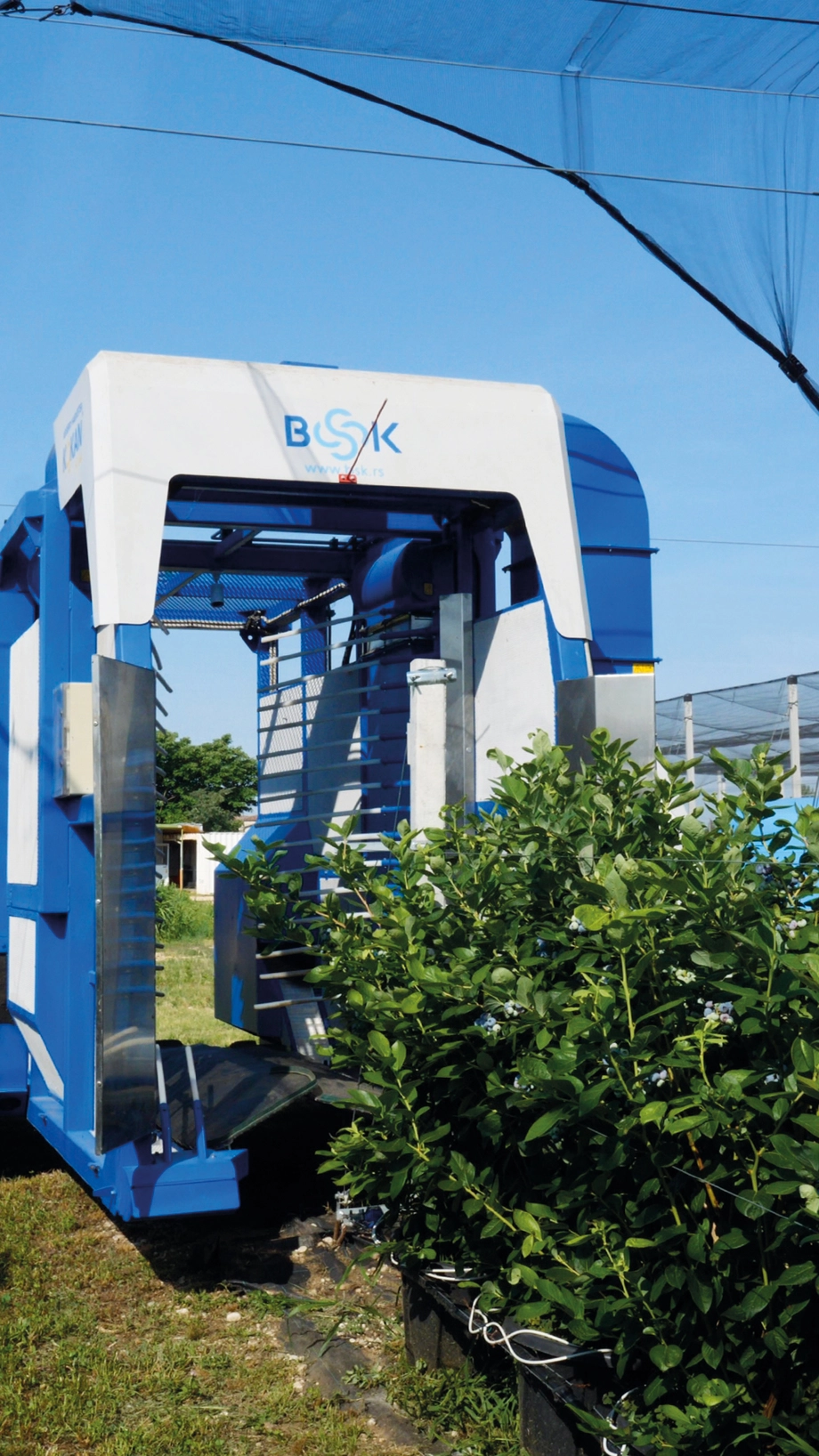
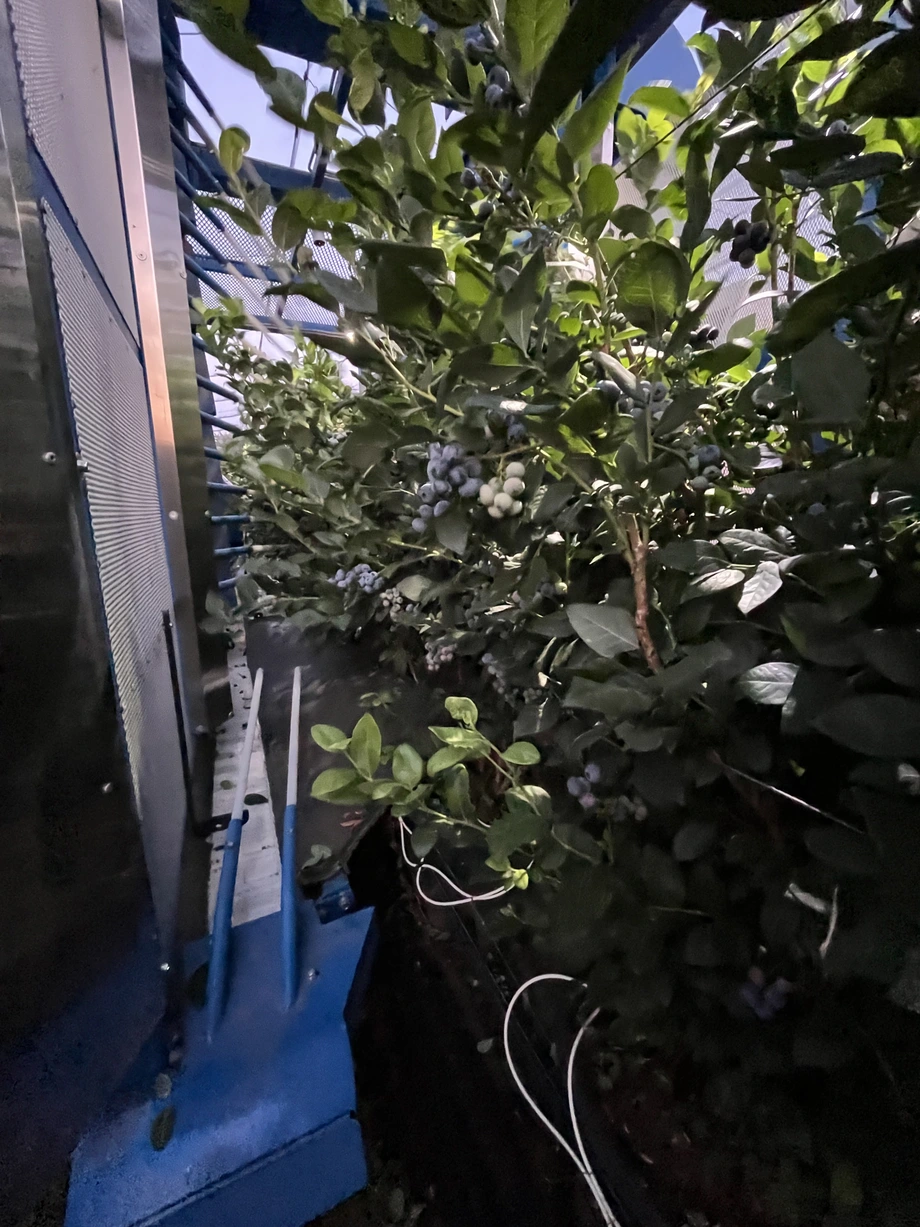
Mechanical harvesting also requires careful planning, starting with the plant support and covering structure, which must not be too low because the machine straddles the row.
We opted for a very high covering structure: the posts reach 4.80 metres above ground, with a spacing of 3 metres between posts along the row and 10 metres between rows of posts. A conventional hail net was installed above the structure.
Within this structure, we planted three rows of blueberries with their corresponding support posts. We used several support wires for mechanical harvesting, but the most important component consists of three heavy-gauge wires that keep the plants as narrow as possible within the first 30 centimetres. Each pot was secured so that it would not move as the machine passed.
All this was also made possible with the assistance of Vario System, which supported us during the design of the farm layout.
Costs and return on investment
Compared with manual harvesting, how much does the harvesting cost per kilogram change, and how long does it take to recoup the investment?
The difference between the cost of manual harvesting and that of mechanical harvesting is extremely significant. To understand its scale, an experienced worker can harvest an average of 7-8 kg of blueberries per hour.
This is accompanied by a reject rate estimated at approximately 2%, resulting from fruit that is not fully ripe, is overripe or falls to the ground during harvesting.
Under suitable operating conditions, a mechanical harvester can achieve a harvesting capacity of 250-300 kg per hour.
To achieve this performance, however, it is essential to harvest at the optimum stage of fruit maturity. This means maintaining harvesting intervals similar to those used for manual picking, postponing a pass by no more than one or two days if necessary.
Leaving excessively long intervals between one harvest and the next would compromise both product quality and mechanical harvesting efficiency.
From a financial perspective, the benefits are particularly clear. Based on our farm’s experience, the investment in the harvesting machine can be recouped in approximately three years thanks to the substantial reduction in labour costs.
Manual harvesting currently costs an average of approximately €2.50/kg, while mechanical harvesting costs about €0.95/kg, including depreciation of the machine. This represents a saving of approximately 62% compared with harvesting exclusively by hand.
It is important to emphasise that, at the current stage of technological development, mechanical harvesting cannot yet completely replace manual harvesting.
The first two picks often show uneven fruit maturity and still require the selectivity provided by manual workers.
The most effective approach is therefore to combine the two techniques: manual harvesting is used during the early stages of the season, while mechanical harvesting is introduced later, when fruit maturity is more uniform.
This organisational model makes it possible to maintain high quality standards while achieving an overall reduction in harvesting costs of approximately 42%. It therefore represents one of the most sustainable strategies currently available from both a financial and production standpoint.
In the second part of the article, “Mechanical blueberry harvesting: quality, rejects, and agronomic and varietal choices”, Marco Antolini explores the more practical aspects of mechanical blueberry harvesting.
.