









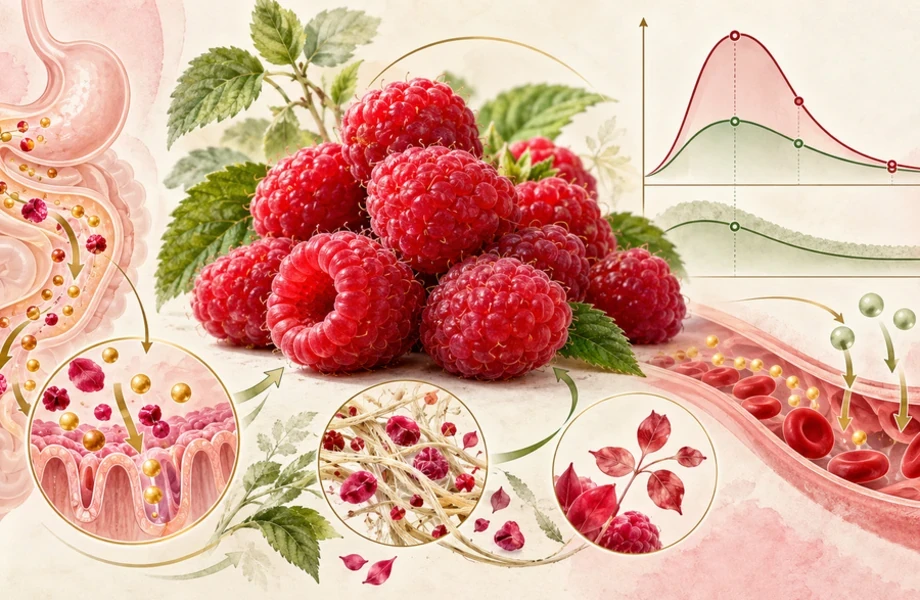
Raspberries are rich in fiber and polyphenolic compounds, plant substances that have attracted increasing scientific attention in recent years because of their potential effects on metabolism.
One of the most extensively studied areas is the relationship between raspberries and blood sugar, namely the concentration of glucose in the blood, a key parameter of metabolic health.
But what actually happens to blood sugar levels after eating raspberries? Some human clinical studies have observed favorable responses in blood glucose and insulin levels in the hours following consumption.
Other studies conducted over several weeks have produced less encouraging results, raising an important question: does an immediate improvement necessarily translate into a lasting benefit?
Why blood sugar levels rise after meals
When we consume foods containing digestible carbohydrates, some of these carbohydrates are broken down into glucose, which enters the bloodstream and causes blood sugar levels to rise.
The body responds by producing insulin, a hormone that helps tissues use and store glucose.
This is a normal physiological process. However, in people with insulin resistance, cells respond less effectively to insulin, and the body may need to produce larger amounts of the hormone to keep blood glucose levels within a certain range.
Insulin resistance is frequently associated with prediabetes, a condition characterized by blood glucose levels that are higher than normal but not high enough to meet the diagnostic criteria for diabetes.
Nutritional research therefore focuses not only on fasting blood glucose but also on the postprandial glycemic response, meaning the changes in blood sugar levels in the hours following a meal.
It is precisely in this context that red raspberries (Rubus idaeus) have been studied.
Raspberries and blood sugar: the study involving 32 adults with and without prediabetes
A randomized clinical trial published in 2019 in the journal Obesity evaluated the effects of raspberry consumption on the metabolic response following a meal.
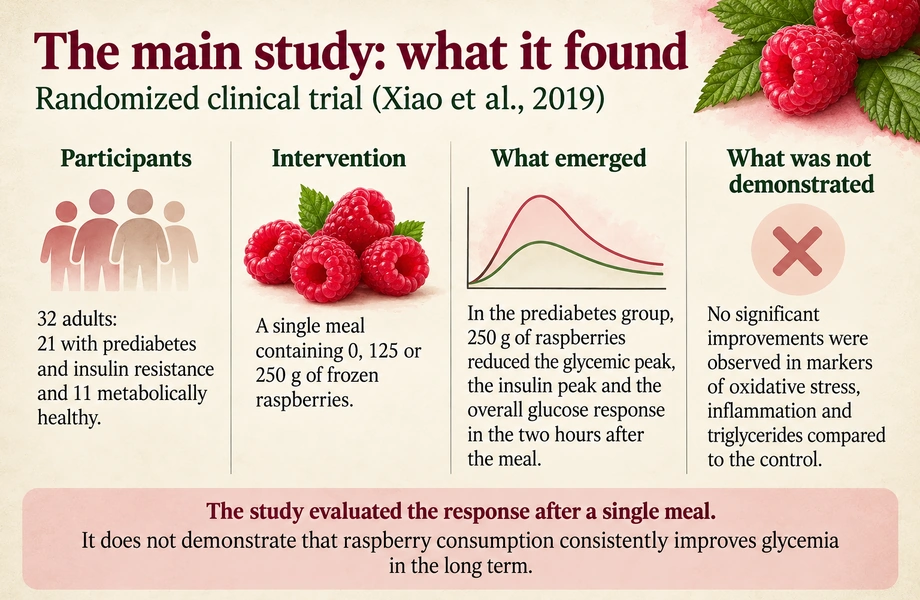
The study, led by Di Xiao and colleagues, involved 32 adults, divided into two groups: 21 individuals with overweight or obesity, prediabetes and insulin resistance, and 11 metabolically healthy individuals who served as a reference group.
The study used a crossover design: each participant consumed, on three separate days, a high-carbohydrate breakfast with a moderate fat content, accompanied by different amounts of frozen red raspberries.
The three conditions were:
- 0 grams of raspberries, serving as the control;
- 125 grams of raspberries, equivalent to approximately one cup;
- 250 grams of raspberries, equivalent to approximately two cups.
The researchers collected repeated blood samples for up to eight hours after breakfast, with an additional measurement at 24 hours, to assess blood glucose, insulin and other metabolic indicators.
The aim was to determine whether including raspberries in the meal could alter the body's response to the nutrients consumed.
What happens to blood sugar after eating 125 or 250 grams of raspberries?
The results revealed particularly interesting differences among participants with prediabetes and insulin resistance.
Compared with the control breakfast, both raspberry portions, 125 and 250 grams, were associated with a significant reduction in the overall insulin response during the first two hours.
With 250 grams of raspberries, the researchers also observed a significant reduction in peak blood glucose, peak insulin and overall glucose exposure during the first two hours after the meal.
The latter parameter is measured using the area under the blood glucose curve, an indicator describing changes in blood glucose concentration over time.
In other words, among participants with metabolic abnormalities, the meal containing the larger raspberry portion produced a more moderate glycemic response, accompanied by a lower insulin requirement.
However, not all indicators improved. The study found no significant differences compared with the control in the measured markers of oxidative stress and inflammation.
Changes in triglyceride levels also showed no significant improvement compared with the breakfast without raspberries.
These findings suggest a possible beneficial effect on postprandial glucose regulation, but they do not demonstrate that raspberry consumption can prevent diabetes or produce lasting improvements in insulin resistance.
Promising results have also been observed in people with type 2 diabetes
Another randomized study, published in 2019 in Annals of Nutrition and Metabolism, examined the effects of raspberries in adults with obesity and type 2 diabetes.
The research, conducted by Jace Schell and colleagues, included a phase focusing on the postprandial response, involving 25 participants, followed by a repeated-consumption phase completed by 22 individuals.
During the acute phase, participants consumed 250 grams of frozen raspberries, compared with a control breakfast. The researchers observed significantly lower glucose concentrations two and four hours after the meal compared with the control condition.
Reductions were also observed in certain inflammatory markers, including interleukin-6 and TNF-alpha, proteins involved in regulating inflammatory responses.
However, during the subsequent phase, which involved four weeks of daily raspberry consumption, no significant improvements were found in fasting blood glucose or the lipid profile.
Comparing the two phases highlights an essential distinction: changing the glycemic response to a particular meal does not necessarily mean altering long-term glucose metabolism.
Does eating raspberries every day improve blood sugar control?
To investigate this question further, a study published in 2020 in the journal Nutrients evaluated the effects of regular raspberry consumption in individuals with metabolic risk factors.
The trial, led by Maximilien Franck and colleagues at Université Laval in Canada, involved 59 adults with overweight or abdominal obesity and mild abnormalities in insulin or triglyceride levels.
Participants were randomly assigned to two groups. The first group was instructed to consume 280 grams of frozen raspberries per day for eight weeks, while the second group continued following its usual diet.
Unlike the previous studies, this research investigated the effects of daily consumption over an extended period.
The results showed no significant changes in plasma glucose, insulin, inflammatory markers or blood pressure compared with the control group.
The researchers identified changes in the expression of certain genes and in the concentrations of specific metabolites, potentially associated with immune function and lipid metabolism.
However, these biological changes did not translate into clinically meaningful improvements in the main metabolic parameters assessed.
The 2024 meta-analysis: what does the overall evidence show?
A broader perspective comes from a systematic review and meta-analysis published in 2024 in the journal Current Developments in Nutrition.
The authors analyzed randomized clinical trials investigating raspberry consumption and its effects on key indicators of glucose metabolism and inflammation.
Overall, the meta-analysis found no statistically significant improvements in fasting blood glucose, glycated hemoglobin (HbA1c) or HOMA-IR, an index used to estimate insulin resistance.
For fasting blood glucose, the mean difference compared with control groups was -1.29 mg/dL, a result that was not statistically significant.
The analysis did, however, identify a mean increase in insulin levels across the pooled comparisons and a reduction in TNF-alpha, with no significant effects on other inflammatory markers.
These findings should be interpreted cautiously, as the studies included differed in terms of participant populations, duration, raspberry varieties and the forms of raspberry products used.
Some trials also investigated black raspberries or raspberry-derived preparations, which are not directly comparable with the regular consumption of fresh red raspberries.
The authors concluded that the available evidence is still insufficient to attribute a sustained effect on glycemic control to raspberry consumption.
Fiber, anthocyanins and polyphenols: how might they work?
Scientific interest in raspberries stems partly from their nutritional composition.
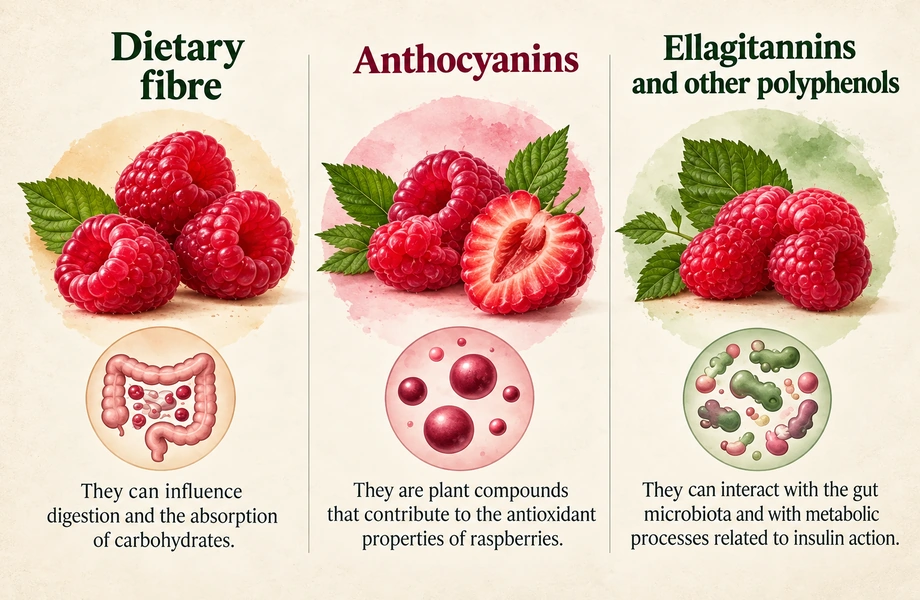
These fruits provide dietary fiber, including components that may influence nutrient digestion and absorption, as well as a variety of polyphenols, plant compounds studied for their interactions with metabolic processes.
Among their characteristic compounds are anthocyanins, which contribute to their red color, and ellagitannins.
One hypothesis concerns the ability of certain berry compounds to interact with enzymes involved in carbohydrate digestion, potentially helping to modify the rate at which glucose becomes available.
Another possibility involves the effects of polyphenols on cellular signaling pathways associated with insulin action and their interactions with the gut microbiota.
However, it is important to distinguish between hypothesized biological mechanisms and effects actually observed in humans.
Clinical studies on raspberries suggest that these processes may contribute to the postprandial response, but they do not yet establish which component is primarily responsible for the observed effects or how relevant these effects are in the context of a normal diet.
How many raspberries should you eat to benefit blood sugar levels?
The amounts used in clinical trials generally range from 125 to 280 grams, but these quantities should not be interpreted as recommended doses for blood sugar control.
In the 2019 study, the most pronounced postprandial effects were observed with 250 grams of frozen raspberries. However, these findings were obtained in a specific population under controlled experimental conditions.
It would therefore be incorrect to assume that eating 250 grams of raspberries every day will necessarily produce the same effects, or that smaller amounts have no nutritional value.
Whether fresh or frozen, raspberries can be included in a varied diet as a source of fiber and plant compounds.
Their impact on the glycemic response also depends on the overall composition of the meal, the amount of carbohydrates consumed and individual metabolic characteristics.
For people with prediabetes or diabetes, raspberry consumption should be considered within the context of their individual dietary plan, without replacing medical treatments or professional healthcare advice.
Raspberries and blood sugar: what can we conclude?
Available research shows that consuming raspberries with a meal may help moderate certain increases in blood glucose and insulin levels in the following hours, particularly in individuals with prediabetes, insulin resistance or type 2 diabetes.
However, findings from longer-term studies are less convincing: consistent improvements in fasting blood glucose, glycated hemoglobin or insulin resistance have not been demonstrated.
The relationship between raspberries and blood sugar therefore remains a promising area of research, but one that requires further investigation through larger trials conducted over longer periods.
The most robust conclusion is that raspberries can contribute to the variety and nutritional quality of the diet, without the need to attribute therapeutic properties to them.
Research findings provide a starting point for better understanding the role of berries in metabolic health, rather than a reason to consider them a treatment for diabetes.
This article is intended for informational purposes only and does not replace the advice of physicians, dietitians or nutritionists.
References:
1. Xiao D, Zhu L, Edirisinghe I, Fareed J, Brailovsky Y, Burton-Freeman B. Attenuation of postmeal metabolic indices with red raspberries in individuals at risk for diabetes: a randomized controlled trial. Obesity (Silver Spring). 2019;27(4):542-550. doi: 10.1002/oby.22406
2. Schell J, Betts NM, Lyons TJ, Basu A. Raspberries improve postprandial glucose and acute and chronic inflammation in adults with type 2 diabetes. Ann Nutr Metab. 2019;74(2):165-174. doi: 10.1159/000497226
3. Franck M, de Toro-Martín J, Garneau V, et al. Effects of daily raspberry consumption on immune-metabolic health in subjects at risk of metabolic syndrome: a randomized controlled trial. Nutrients. 2020;12(12):3858. doi: 10.3390/nu12123858
4. Shahraki Jazinaki M, Nosrati M, Chambari M, Jamialahmadi T, Sahebkar A. The effects of raspberry consumption on glycemic control and inflammation markers in adults: a systematic review and meta-analysis of randomized controlled trials. Curr Dev Nutr. 2024;8(6):102161. doi: 10.1016/j.cdnut.2024.102161
Italian Berry - All rights reserved
🫐 Well-being & Health with Berries 🍓This article is part of the editorial series Wellness & Health with Berries, which brings scientific research closer to everyday life, promoting berries as allies for well-being. The series offers clear, up-to-date, and evidence-based content designed to inform consumers and support all operators in the berry supply chain. |