






How a country with 60% of Mexico's blueberry acreage manages to produce higher volumes, becoming the new benchmark for the EMEA region.
In the global fruit and vegetable industry, the rise of Morocco represents one of the most interesting case studies in agronomic efficiency and rapid expansion. According to official data from the IBO Global Blueberry Report 2026, the North African country achieved a historic double overtake in 2025: it surpassed Spain in total production volumes and climbed to fifth place among the world's largest blueberry producers, also overtaking Mexico.
The report (294 pages - English) can be downloaded free of charge from the IBO website.
The most striking aspect of this achievement lies in the remarkable productivity of Morocco's production system: with 6,800 hectares under cultivation — approximately 60% of Mexico's blueberry acreage (10,800 hectares) — Morocco generated a total production of over 84,900 tonnes, demonstrating productivity and commercial competitiveness that make it a true international benchmark.
Overtaking Spain: the figures behind the Mediterranean race
In the Mediterranean basin (encompassing the Southern Europe and North Africa macro-region), Morocco and Spain have long been the two leading players. However, the 2025 season marked a clear changing of the guard at the top of the production and export rankings:
- Morocco: In 2025, it reached 6,800 planted hectares, recording total production of 84,940 tonnes (including 80,690 tonnes destined for the fresh market) and fresh export volumes of 82,590 tonnes.
- Spain: It recorded 6,180 planted hectares, with total production of 82,700 tonnes (74,900 tonnes for the fresh market) and 71,600 tonnes of fresh exports.
Morocco therefore moved ahead of Spain in both overall volume and its ability to penetrate European markets, shipping substantial volumes to Spain itself (which serves as a distribution and packing hub, importing 43,110 tonnes from Morocco), the United Kingdom (20,180 t), France (8,250 t), Norway (3,040 t) and the Netherlands (2,310 t).
Looking ahead, IBO projections for 2029 for the Southern Europe and North Africa sub-region (expected to exceed 279,000 tonnes) indicate a widening gap: Moroccan production will grow by almost 70% compared with current levels, while Spanish production will increase at a much more moderate pace towards 96,000 tonnes.
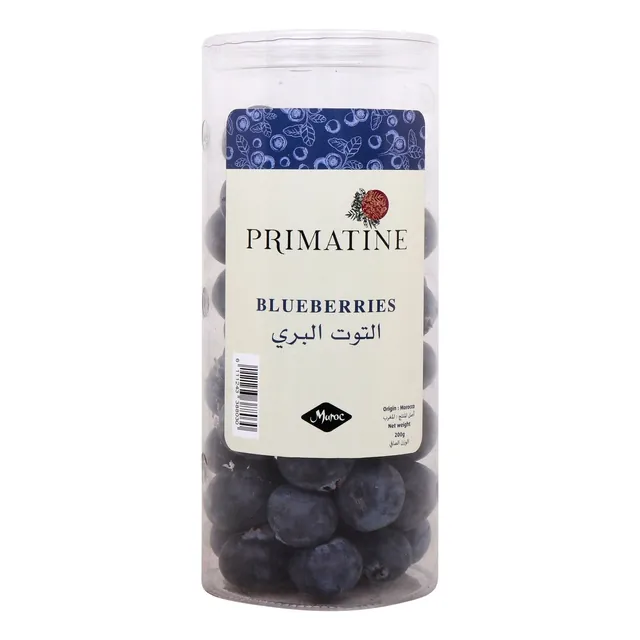 Premium blueberries from Morocco on offer at Lulu Hypermarkets (UAE)
The efficiency equation: Morocco vs Mexico
A comparison with the Mexican model clearly highlights the highly intensive, technology-driven nature of Morocco's blueberry industry:
| Indicator (IBO 2025 data) | Morocco | Mexico |
|---|---|---|
| Area under cultivation | 6,800 ha | 10,800 ha |
| Total production | 84.94 thousand t | 77.95 thousand t |
| Fresh production | 80.69 thousand t | 76.43 thousand t |
| Fresh exports | 82.59 thousand t | 76.46 thousand t |
How can Morocco, with almost 4,000 fewer hectares than Mexico, produce and export higher volumes of fresh blueberries? The answer lies in the convergence of three key factors: high yields per hectare, widespread adoption of soilless cultivation in substrates and a clearly defined quality-focused strategy.
Premium genetics, "Jumbo" size and seasonal continuity
Morocco's blueberry industry is characterised by stringent varietal selection. Local growers show a marked aversion not only to older, freely available varieties, but even to cultivars introduced just four or five years ago that fail to meet the standards required by international buyers.
The distinctive characteristics of Moroccan blueberries include:
- Size and firmness: The market recognises Morocco as a leading supplier of "Jumbo"-sized fruit with high firmness and a superior sensory profile.
- Extended market window: The country's geography allows the season to begin as early as October with ultra-early harvests in the Dakhla region, in the far south, before continuing through winter and spring in the major northern production areas (Kenitra, Larache and Souss-Massa), ensuring continuity until May.
- Strategic proximity: Geographical proximity to Western Europe helps reduce sea and road transport times and costs compared with overseas competitors.
The new benchmark for the EMEA region
Within the EMEA (Europe, Middle East and Africa) macro-region, projected to exceed 607,000 tonnes by 2029, Morocco has therefore become the production model to emulate. After recording a 27% increase in exports in a single year, the country is now positioning itself to challenge even Chile's fourth place in the global rankings.
For grocery retailers and European buyers, Moroccan blueberries are no longer simply a seasonal supplement covering the winter months, but a structural pillar of supply, capable of setting new standards for the category in terms of both volume and value.
Italian Berry - All rights reserved