








In the United States, the Department of Commerce has preliminarily found dumping margins of up to 5.28% on winter strawberries from Mexico. At the heart of the case is the overlap between Florida’s production season and the peak period for Mexican imports.
A trade case is unfolding in the United States that is likely to be closely watched by the entire international strawberry industry. On 18 August 2026, the Department of Commerce announced an affirmative preliminary determination in the antidumping investigation into fresh winter strawberries imported from Mexico, finding dumping margins ranging from 3.37% to 5.28%.
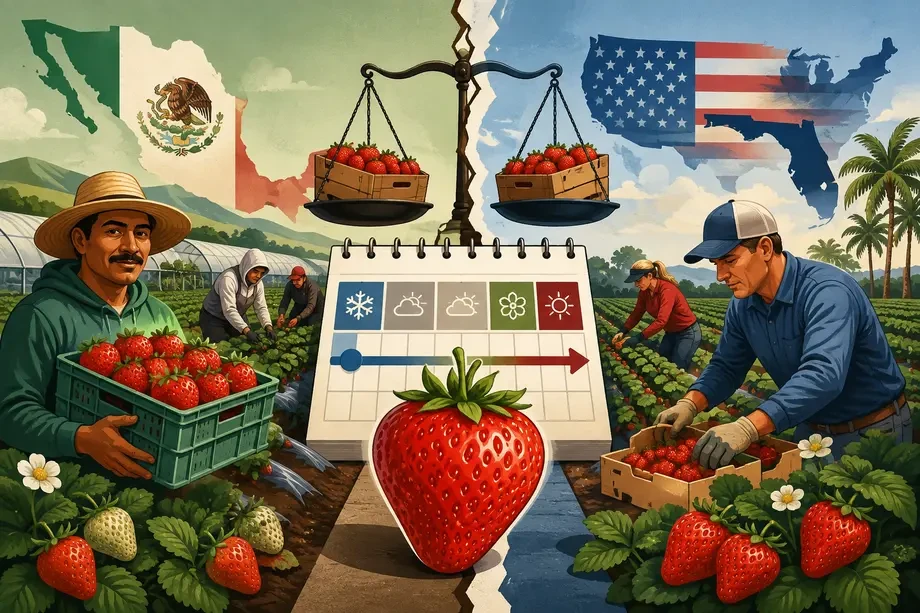
The issue was also highlighted by Lorena Sanchez, agronomist and fresh produce strategist, with more than 20 years of experience across export, import, quality assurance and retail. In a recent LinkedIn post, she pointed to one key factor for understanding the dispute: Florida’s strawberry season almost perfectly overlaps with Mexico’s main export window to the United States.
“Florida’s entire strawberry season is winter, from November through March. That single fact is why this trade case is written around a calendar,” Sanchez notes in her post.
The issue, therefore, is not only where the fruit comes from or the absolute level of imports, but above all when those strawberries arrive on the US market.
Florida and Mexico compete in the same months
Florida represents a relatively small share of total annual US strawberry production compared with California, but it plays a strategic role during the winter months.
It is precisely between November and March that California’s production declines and Florida enters its main commercial window. During those same months, however, Mexico also ships large volumes of strawberries to the United States.
As Sanchez points out, for American consumers, seeing fully stocked strawberry displays in the middle of winter has become normal. Behind that continuity of supply, however, lies a complex balance between domestic production and imports.
Data from the Department of Commerce show just how significant Mexican shipments are. Between November 2024 and March 2025, the United States imported around 200.6 million kg of strawberries from Mexico, worth more than US$933 million. In the November 2022-March 2023 season, volumes were around 188.5 million kg, rising to almost 194 million kg the following season.
This means that over three consecutive seasons, Mexican availability during the winter window increased by more than 12 million kg.
The allegations from US growers
The investigation stems from a petition filed on 31 December 2025 by the Strawberry Growers for Fair Trade coalition, which brings together several Florida growers and the Florida Strawberry Growers Association. Documentation relating to the proceedings is available from the U.S. International Trade Commission.
According to the petitioners, Mexican strawberries were sold in the United States at less than “fair value”, causing economic injury to domestic producers.
The Department of Commerce formally initiated the investigation in February 2026, initially citing an alleged dumping margin of 18.32%.
This point is also relevant in relation to Sanchez’s post, which refers to a requested rate of 116.69%. The official documentation published by the Department of Commerce at the launch of the investigation instead cites an alleged margin of 18.32%. The 116.69% figure may refer to a specific calculation contained in the petition or to a different stage of the proceedings, but it does not match the margin officially stated by Commerce when the investigation was initiated.
Preliminary margins are much lower
The preliminary determination announced on 18 August nevertheless confirmed the existence of dumping, but at significantly lower rates.
According to the Department of Commerce’s preliminary determination, the margins are:
- Driscoll’s Operaciones S.A. de C.V.: 5.28%
- Mainland Farms S.A. de C.V.: 3.37%
- all other producers and exporters: 4.83%
In her post, Sanchez summarizes the result by citing a figure of 4.83%. Technically, this percentage is the rate assigned to the “All Others” category, while the two individually examined companies received different rates.
The gap between the percentages initially alleged and those resulting from the preliminary analysis highlights how complex the calculation of an antidumping margin can be.
Proving dumping is not enough
In the United States, the procedure involves two separate authorities.
The Department of Commerce must determine whether imports are being sold at less than fair value and calculate the corresponding antidumping margin.
The U.S. International Trade Commission (USITC), on the other hand, must determine whether those imports are causing material injury to the US industry.
On 27 February 2026, the Commission preliminarily determined that there was a “reasonable indication” that the US industry may be materially injured by the Mexican imports under investigation. That decision allowed the case to proceed.
However, this is still only a preliminary finding.
Provisional duties, but the case is not over
Commerce’s affirmative determination triggers the measures provided for under the antidumping procedure, including the requirement for cash deposits corresponding to the preliminary margins on the imports concerned.
But, as Sanchez stresses, “nothing is final”.
The Department of Commerce currently expects to issue its final determination around 8 January 2027. In parallel, the ITC will also have to reach its final determination on whether the US industry has suffered injury, according to the case timetable.
For definitive antidumping duties to be imposed, both conditions must therefore be met: Commerce must confirm dumping and the ITC must confirm injury.
The real issue is continuity of supply
Lorena Sanchez’s analysis, however, highlights an issue that goes beyond the legal dispute.
The modern US retail sector has become accustomed to having strawberries available 12 months a year. In the middle of winter, when California supply is more limited, that availability is provided mainly through the combination of Florida and Mexico.
For retailers and consumers, imports therefore ensure continuity of assortment and greater product availability.
From the perspective of Florida growers, however, the same dynamic means competing with significant imported volumes during the exact few months in which their own production is concentrated.
It is this seasonal overlap that turns what might otherwise look like complementarity between origins into direct competition.
Sanchez closes her post with a position that sums up the dilemma well: she likes seeing full strawberry displays in February, but believes it is equally important that “growers on both sides have the opportunity to be heard fairly”.
A case that also matters for Europe
The US dispute is also an interesting case for the European berry market.
Retail demand is increasingly oriented towards continuous supply programmes, while domestic production inevitably remains tied to specific seasonal windows. Imports make it possible to extend availability, support consumption and maintain a stable presence for the category on shelves.
However, when import windows begin to overlap with domestic production, the balance between complementarity and competition can change rapidly.
The Florida-Mexico case therefore illustrates one of the key strategic issues the berry sector will have to address in the coming years: how to guarantee 12-month availability without undermining the economic sustainability of domestic production during the periods when it reaches the market.
Italian Berry – All rights reserved