












How much further can berry sales grow in Italian supermarkets? In his presentation at the Berry Trend 2026 webinar, organised by myfruit.it, Thomas Drahorad of Italian Berry addresses the question through three dimensions: quantities purchased, continuity of supply throughout the year and assortment depth.
The starting point is category growth. In the text prepared for his presentation, Drahorad reports a 35% increase in berries in 2025 compared with 2024 and places berries, including strawberries, fourth by sales value in the fruit department of Italian supermarkets (source: Italian Berry – YouGov).
Consumption: the comparison with the United Kingdom
The presentation compares household spending in Italy and the United Kingdom on three products, using Italian Berry analyses of YouGov and Worldpanel by Numerator data. For 2025, it reports €243 million in Italy and €809 million in the United Kingdom for blueberries; €43 million and €532 million for raspberries; and €15 million and €105 million for blackberries.
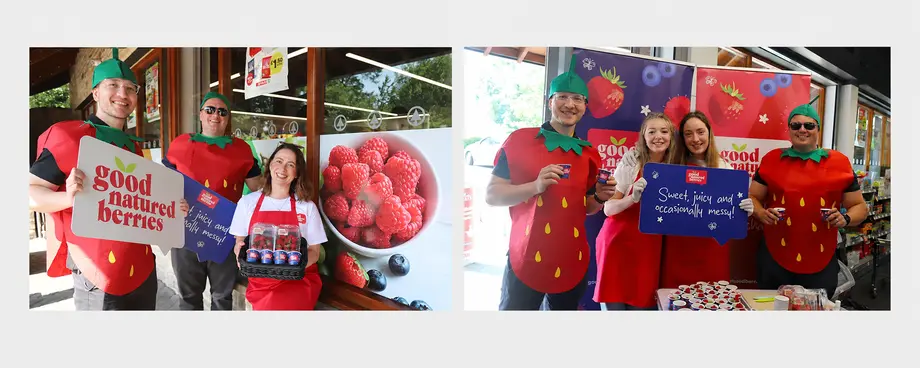 Berry promotion – June 2026 – Spar North of England
For Italian blueberries, the same series shows €95 million in 2021 and €140 million in 2023, before reaching €243 million in 2025. The comparison with the United Kingdom reveals a gap in total spending, but does not by itself establish how much the Italian market could grow: population, prices, purchasing habits and measurement methods must be considered before estimating its potential.
This gap frames the first question of the presentation: which factors currently limit growth in berry consumption and household penetration in Italy?
Download the presentation
Strawberries: an assortment that changes with the season
The second dimension is time. According to the Italian Berry Observatory, 70% of Italian strawberry production is concentrated between February and May. During the period of greatest availability, the presentation shows an increase in the number of listings observed, with more pack sizes and segments, including standard, premium and organic. At other times of year, the range shown in the example narrows to a single listing.
Year-round strawberry availability therefore does not necessarily translate into a consistent assortment. Drahorad proposes examining why consumers often find less choice in pack size and price tier outside the main season. The presentation identifies premium products, entry-level pricing and better calendar management as possible areas for development.
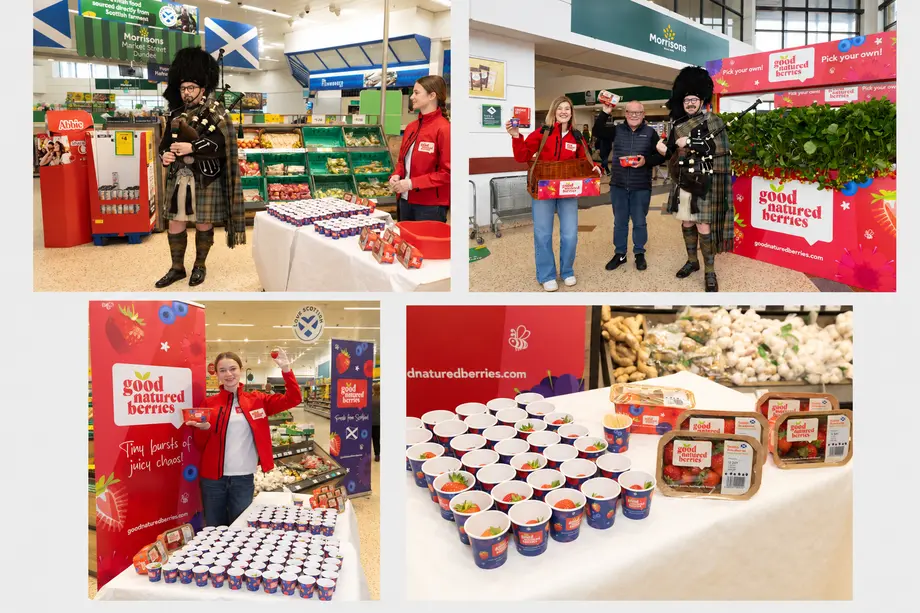 Berry promotion in the United Kingdom – Morrisons, 2025
Segmentation: what the Tesco example shows
The third dimension is assortment depth. Moving beyond the 125 g punnet as the sole format has expanded the pack sizes available in Italy. In Drahorad’s assessment, however, weight, price and positioning could be combined more precisely to serve different purchasing needs.
As an example, the presentation shows a Tesco assortment recorded on 14 September 2026. For blueberries, it distinguishes standard packs of 150, 250 and 500 g, a premium and an entry-level 150 g pack, and a 90 g snack pot. For strawberries, it shows standard 400 and 600 g packs, premium 300 and 600 g packs, and an entry-level 227 g pack. These are characteristics of the assortment recorded for the illustrated example, not a representative measure of all Tesco stores.
The presentation thus raises three questions for Italian retailers: how to broaden the customer base, how to maintain a consistent strawberry offer and how to build an assortment in which pack sizes and segments serve clear purposes for consumers.
Italian Berry – All rights reserved