




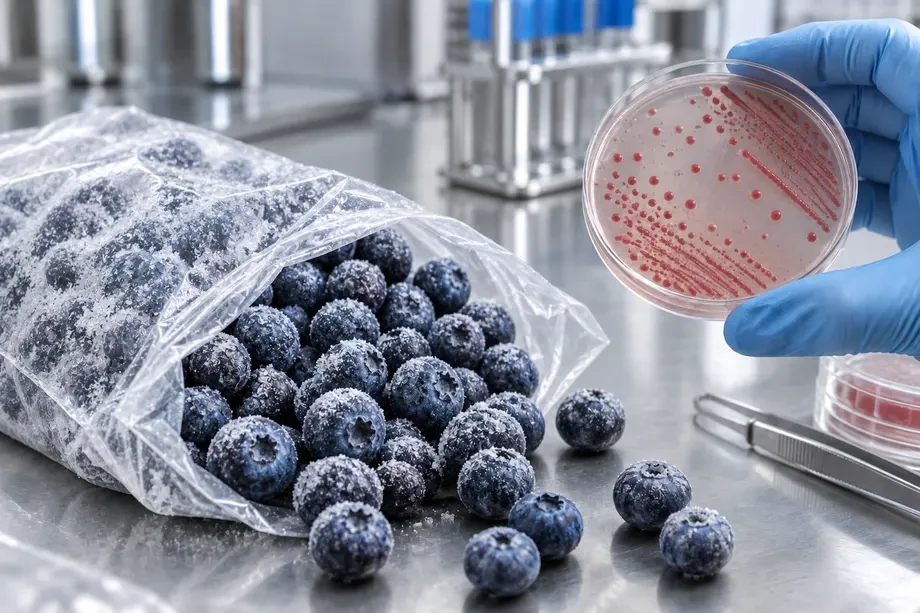
The U.S. outbreak of E. coli O145:H28 associated with frozen organic blueberries has reached 17 cases and six hospitalizations. The September update extended the recall to a Great Value frozen berry blend sold by Walmart in 16 states.
A food safety incident involving frozen organic blueberries from Chile is expanding in the United States. According to the latest update published on September 3 by the Centers for Disease Control and Prevention (CDC), 17 cases of E. coli O145:H28 infection have been identified in two states, Florida and Georgia.
Six patients, representing 35% of the confirmed cases, have been hospitalized. No deaths have been reported. The people affected range in age from 2 to 88, while the infections began between May and early August 2026.
The figures mark a worsening compared with the first update issued in July, when health authorities reported 12 cases and four hospitalizations. According to the CDC, the actual number of people affected could be higher because many patients recover without seeking medical care or undergoing specific tests.
The link to frozen blueberries
The epidemiological investigation identified a significant association with the consumption of frozen blueberries. Of the 13 people interviewed, 11, or 85%, reported consuming the product during the week before their symptoms began.
This percentage is considerably higher than the 24% of consumers reporting frozen berry consumption in the FoodNet reference survey used by the U.S. authorities. Whole genome sequencing also showed that the bacteria isolated from patients were closely related genetically, pointing to a common source of infection.
The supply-chain traceback conducted by the Food and Drug Administration (FDA) identified Frutas y Hortalizas del Sur S.A., based in San Carlos, Chile, as the supplier of the frozen organic blueberries. The investigation remains open, however, and the authorities are still working to determine the precise source of the contamination.
Recall reaches Walmart in September
The main development in September was the extension of the recall to one lot of Great Value Organic Triple Berry Blend, a frozen blend containing strawberries, blackberries and blueberries sold by Walmart.
The measure concerns 10-ounce packages, equivalent to approximately 283 grams, with lot code 6040 01-6 and a best-by date of February 9, 2028. The product was distributed to Walmart stores in 16 U.S. states.
According to the announcement published by the FDA, no illnesses had been specifically associated with the Great Value blend when the recall was expanded. The product was withdrawn as a precaution based on information obtained through the traceback of the blueberries used in the blend.
Walmart’s involvement considerably increases the commercial reach of the incident. The initial recall had primarily affected the regional supermarket chain Publix, while Great Value is one of Walmart’s leading private-label brands.
The recall began in July
The first measure was announced on July 3 and concerned one lot of GreenWise Organic IQF Blueberries in 10-ounce packages, distributed to Publix supermarkets in eight states.
On July 29, Publix independently expanded the recall to all lots of four GreenWise products: organic whole blueberries and organic frozen berry blends in 10- and 48-ounce formats. The measure therefore went beyond the single lot initially identified by the producer.
During a remote regulatory assessment of the Chilean facility, the FDA also raised concerns about at least one additional lot of blueberries used in other GreenWise products. The U.S. authority also added products from the Chilean company to Import Alert 99-35: future shipments of frozen blueberries offered for entry into the United States may be detained without physical examination until the company demonstrates that the underlying issues have been resolved.
An incident confined to frozen products in the United States
It is important to define the scope of the alert accurately. The outbreak involves specific frozen organic products marketed in the United States. The FDA and CDC notices do not indicate any involvement of fresh blueberries, the European market or products sold through Italian retailers.
The reference to organic identifies the commercial category of the recalled products, but does not demonstrate that organic production methods caused the contamination. At present, the authorities have not announced a definitive cause.
The incident nevertheless draws attention to a particular feature of the frozen sector: the long shelf life of these products means that packages can remain in household freezers for many months. For this reason, the FDA and CDC are urging U.S. consumers to check the brand, package size, lot code and date printed on their packages carefully, even when the products are no longer available in stores.
Implications for the supply chain
For industry operators, the incident highlights above all the importance of traceability extending to every ingredient used in berry blends. The inclusion of a product containing strawberries, blackberries and blueberries demonstrates how an issue associated with a single raw material can affect additional products, retailers and distribution areas.
Lot segregation, supplier verification, management of long-shelf-life products and the ability to determine rapidly where each shipment was used therefore become essential. The international nature of the supply chain also makes coordination between growers, processors, retailers and authorities in different countries necessary.
As of September 9, the U.S. investigation remains ongoing. The latest developments do not change the limited scope of the incident, but they increase its relevance to the industry as a whole: five additional cases, two further hospitalizations and the involvement of one of the world’s largest retailers have transformed an initially limited recall into a test of prevention and traceability systems across the frozen berry supply chain.
Italian Berry - All rights reserved