











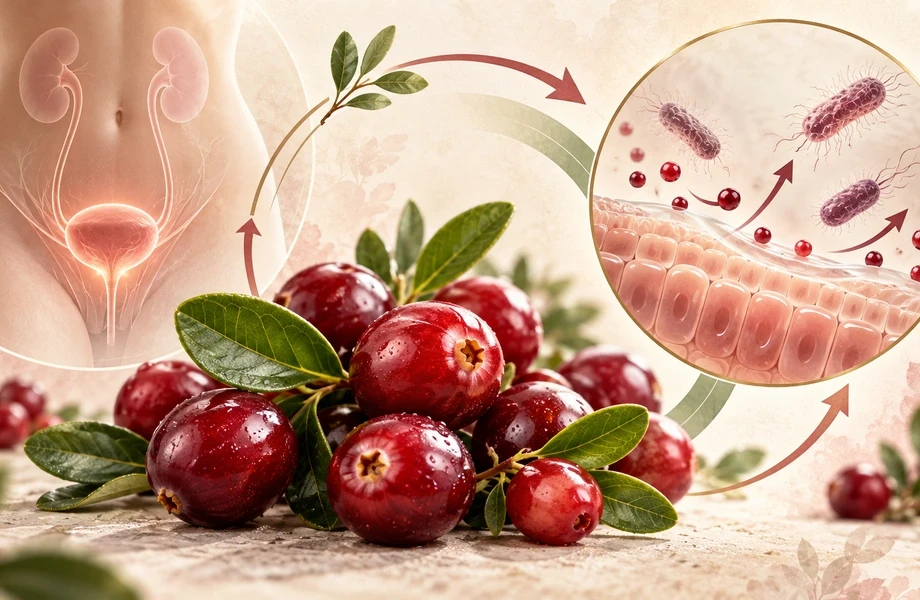
Cranberry, or American cranberry (Vaccinium macrocarpon), has long been associated with urinary tract health.
But when it comes to cranberry and recurrent cystitis, the scientifically correct question is not whether this small fruit can “cure” an infection, but whether certain cranberry products may help reduce the risk of new episodes in people who are predisposed to them.
The distinction is important. Cystitis affects the lower urinary tract, particularly the bladder, while the term urinary tract infection, or UTI, encompasses different conditions. The strongest available evidence mainly concerns the prevention of recurrences, not the treatment of an infection that is already underway.
Why recurrent cystitis is an important issue
Urinary tract infections can recur several times over the course of a year, and this tendency toward recurrence has fuelled interest in non-antibiotic strategies for prevention.
Cranberry is among the most extensively studied, but the scientific literature includes very different products: juices, concentrates, capsules and fruit powders.
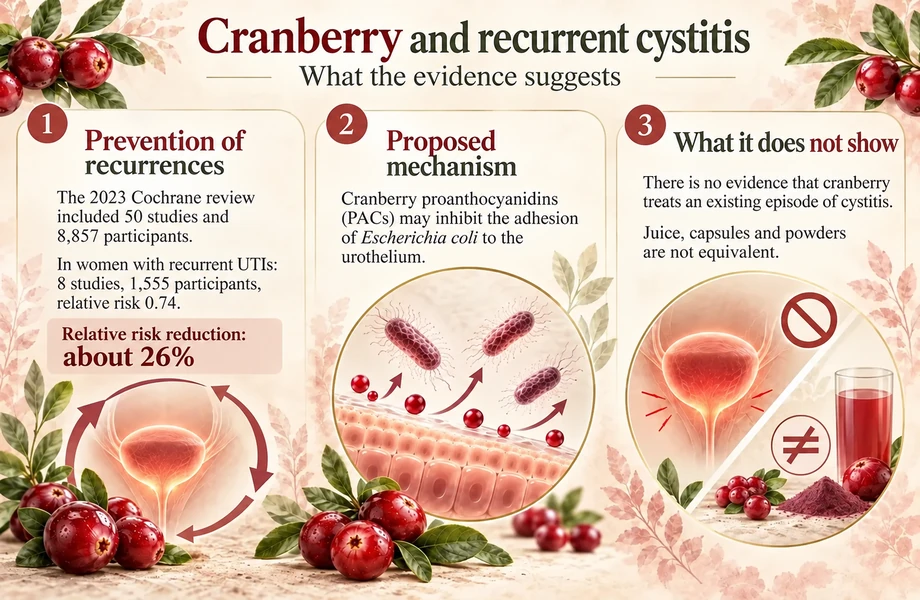
The Cochrane review updated in 2023 included 50 studies and 8,857 participants belonging to different at-risk populations.
Among women with recurrent urinary tract infections, the analysis of eight studies involving 1,555 participants found a relative risk of 0.74 for symptomatic, culture-confirmed infections: a relative risk reduction of approximately 26% compared with controls.
The certainty of the evidence was rated as moderate, and the results showed some variability between studies.
Not all groups achieved the same results. The review found no clear benefit in pregnant women, institutionalised older adults, or adults with neurological bladder-emptying disorders.
Speaking generically about “cranberry against cystitis” therefore oversimplifies a more complex picture.
Cranberry and recurrent cystitis: what the 2025 study found
One of the most recent findings comes from a multicentre, randomised, double-blind, placebo-controlled study published in 2025 in The American Journal of Clinical Nutrition.
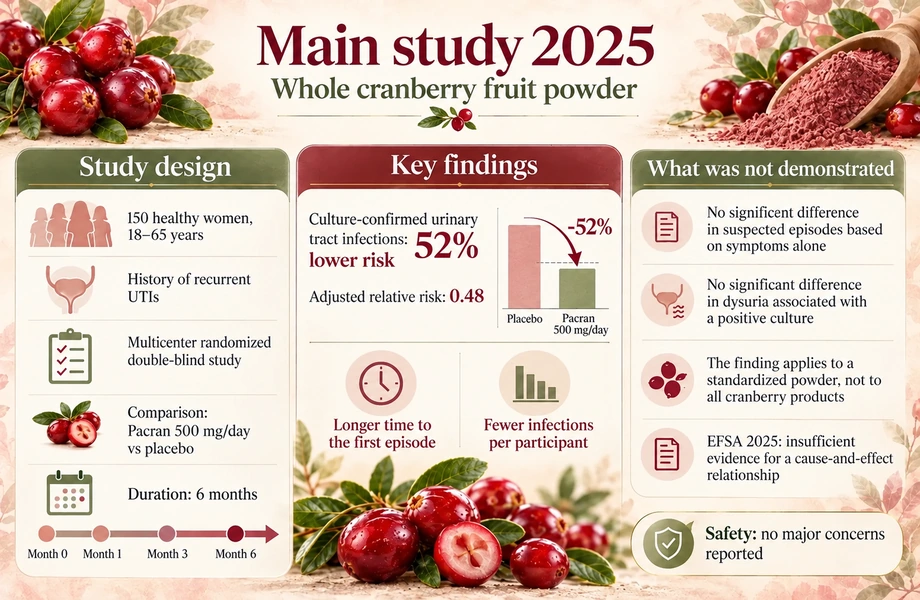
The researchers enrolled 150 healthy women aged between 18 and 65 years with a history of recurrent urinary tract infections.
For six months, participants took one capsule per day containing 500 mg of standardised whole cranberry fruit powder, marketed as Pacran, or a placebo.
This was therefore not fresh cranberry or cranberry juice: an essential detail when interpreting the results.
The primary outcome was the incidence of urinary tract infections confirmed by culture.
In the cranberry group, the risk was 52% lower than in the placebo group, with an adjusted relative risk of 0.48. The study also found a longer time before the first episode and a lower average number of infections per participant.
However, not all outcomes improved. No statistically significant differences were found for suspected episodes based on symptoms alone or for dysuria, meaning pain or burning during urination, associated with a positive culture.
No significant safety concerns were reported.
The study was funded by Swisse Wellness through the Australian CSIRO.
The authors declared that they had no conflicts of interest; the manuscript was reviewed by the sponsor and the raw material supplier before publication, although, according to the authors, they did not influence its content.
A promising result does not amount to definitive proof
The 2025 trial strengthens the hypothesis of a preventive effect, but it does not settle the question.
In 2025, the European Food Safety Authority, EFSA, assessed an application for a health claim concerning the same Pacran powder and concluded that the available evidence was insufficient to establish a cause-and-effect relationship between consumption of the product and defence against bacterial infections of the lower urinary tract.
EFSA considered the result of the recent study favourable, but noted that another intervention conducted under similar conditions had not shown an equally consistent effect. It also considered the evidence on the biological mechanism in humans to be limited.
A single well-designed study can therefore strengthen a signal, but scientific certainty requires reproducible results.
How cranberry might act on the urinary tract
The most widely studied biological hypothesis concerns proanthocyanidins, or PACs, polyphenolic compounds found in cranberries. Experimental studies indicate that some PACs may hinder the adhesion of strains of Escherichia coli to the cells lining the urinary tract.
The idea differs from that of an antibiotic action: cranberry would not be expected to directly “kill” bacteria, but could make it more difficult for them to adhere to the urothelium. However, an effect observed in the laboratory does not automatically demonstrate a clinical benefit in the human body.
EFSA has in fact considered the evidence linking this mechanism to a reduction in infections in practice to be limited.
Juice, capsules and powder are not the same thing
The Cochrane review includes juices, capsules, tablets and powders with different compositions and amounts of PACs. The authors concluded that there are insufficient data to determine with certainty whether tablets are more or less effective than juice, or what the optimal PAC dose might be.
For this reason, the 500 mg per day used in the 2025 study do not represent a universally applicable “cranberry dose”.
They refer to a specific standardised powder, and it is not correct to automatically convert them into an equivalent amount of fresh fruit or juice.
Likewise, results obtained with a concentrated formulation cannot automatically be attributed to the dietary consumption of the whole fruit.
Prevention does not mean treating an ongoing infection
This is where the most important distinction lies.
A Cochrane review specifically devoted to the treatment of urinary tract infections, updated in 2023, found no suitable randomised clinical trials demonstrating that cranberry is effective in treating an infection that is already present.
The evidence on the prevention of recurrences therefore cannot be transferred to the treatment of acute cystitis. In the presence of symptoms of a urinary tract infection, appropriate assessment is necessary: cranberry should not be considered a substitute for treatments recommended by a doctor.
What can we conclude today?
Overall, research on cranberry and recurrent cystitis provides an interesting but limited signal.
The Cochrane review suggests that cranberry products may reduce the risk of new symptomatic, culture-confirmed infections in women with recurrent episodes; the 2025 trial adds a favourable result obtained with a specific whole-fruit powder taken for six months.
Important questions remain open: which formulation is most effective, what amount of active compounds is required, which people may benefit the most, and how reproducible the effect is across different products.
There is also no scientific basis for using cranberry as a treatment for cystitis that is already underway.
The most robust message is therefore a cautious one: cranberry may have a role as a dietary support or preventive strategy in some people predisposed to recurrent infections, but it is not a treatment and there is no universal dose that can be recommended.
Like any single food, it should be included within the context of a varied and balanced diet.
This information is provided for educational purposes and does not replace the advice of doctors, dietitians or nutritionists.
🫐 Well-being & Health with Berries 🍓This article is part of the editorial series Wellness & Health with Berries, which brings scientific research closer to everyday life, promoting berries as allies for well-being. The series offers clear, up-to-date, and evidence-based content designed to inform consumers and support all operators in the berry supply chain. |
Sources:
Williams G, Stothart CI, Hahn D, Stephens JH, Craig JC, Hodson EM, “Cranberries for preventing urinary tract infections”, Cochrane Database of Systematic Reviews, 2023, 11(11). DOI: 10.1002/14651858.CD001321.pub7. PMID: 37947276.
Stonehouse W, Benassi-Evans B, Bednarz J, Vincent AD, “Whole cranberry fruit powder supplement reduces the incidence of culture-confirmed urinary tract infections in females with a history of recurrent urinary tract infection: A 6-month multicenter, randomized, double-blind, placebo-controlled trial”, The American Journal of Clinical Nutrition, 2025, 121(4):932-941. DOI: 10.1016/j.ajcnut.2025.01.022. PMID: 39863114.
Jepson RG, Mihaljevic L, Craig JC, “Cranberries for treating urinary tract infections”, Cochrane Database of Systematic Reviews, 2023, 12(12). DOI: 10.1002/14651858.CD001322.pub2. PMID: 38096261.
EFSA Panel on Nutrition, Novel Foods and Food Allergens (NDA), Turck D, Bohn T, Cámara M, Castenmiller J, de Henauw S, Hirsch-Ernst KI, Jos A, Maciuk A, Mangelsdorf I, McNulty B, Naska A, Pentieva K, Thies F, Craciun I, Fiolet T, Siani A, “Pacran®, a powder obtained from cranberries, and defence against bacterial pathogens in the lower urinary tract: Evaluation of a health claim pursuant to Article 13(5) of Regulation (EC) No 1924/2006”, EFSA Journal, 2025, 23(4). DOI: 10.2903/j.efsa.2025.9319. PMID: 40182009.
Italian Berry - All rights reserved