






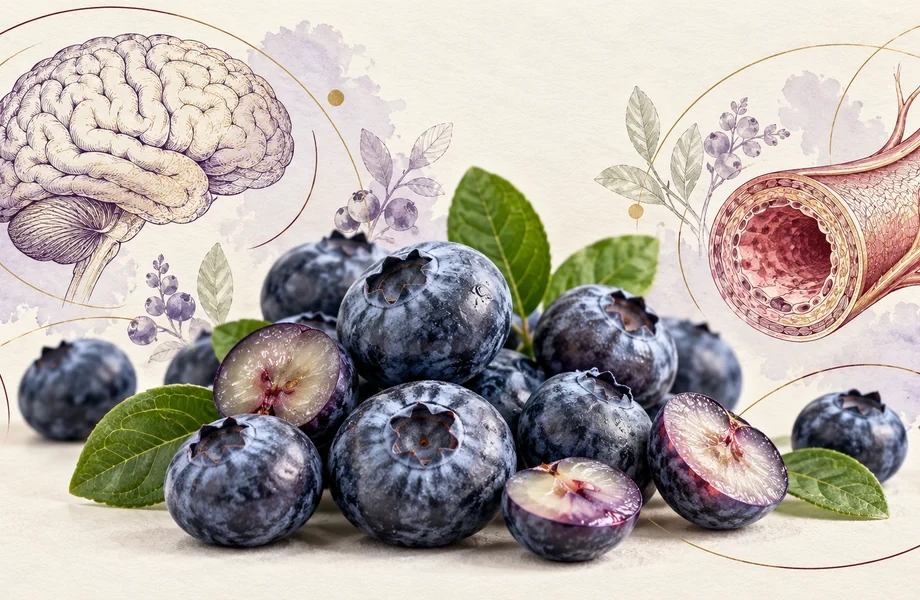
The relationship between blueberries and memory continues to attract attention in nutritional research. But how strong is the evidence in humans?
A study published in 2026 in Clinical Nutrition ESPEN adds a finding worth considering: under the conditions examined, daily consumption of freeze-dried blueberries did not improve cognitive performance compared with a placebo.
The research highlights the need to distinguish the fruit’s nutritional value from the possibility of achieving a measurable benefit for the brain.
This is an essential distinction when communicating about berries to consumers: an interesting hypothesis deserves further investigation, but does not amount to a guaranteed effect.
How to interpret the findings
When discussing memory, the word “benefit” can refer to very different outcomes. Remembering more words in a test, performing better on an attention task, and maintaining independence in everyday life are not interchangeable goals.
To interpret a study, it is therefore necessary to ask what was measured. A test may detect a narrowly defined change without establishing whether it has noticeable consequences in daily life.
Similarly, a change in a blood marker is not sufficient, on its own, to establish protection against a disease.
The comparison used also matters. Repeating a test can make someone better at completing it: to attribute an improvement to a dietary intervention, researchers must establish that it exceeds the improvement observed in the control group.
The comparison with placebo
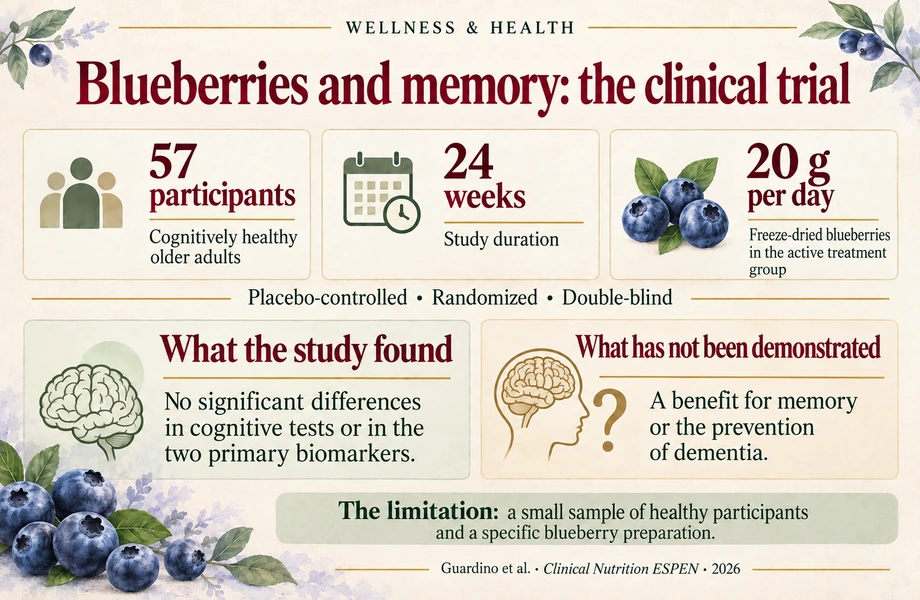
Eric T. Guardino and colleagues randomly assigned 57 cognitively healthy older adults to two groups: 28 received 20 grams of freeze-dried blueberry powder per day, while 29 received a matching placebo. Their average age was approximately 73.
The intervention lasted 24 weeks and was double-blind: participants and the researchers conducting the assessments did not know the group assignments. Visits, which included blood sampling and cognitive tests, took place at eight-week intervals.
The primary outcomes focused on two blood markers studied in neurological health: phosphorylated tau p-tau181 and neurofilament light chain, or NfL. No statistically significant differences in changes in these markers were found between the groups.
The cognitive tests also showed no effect of the intervention.
The study outcomes
Among the secondary outcomes, a reduction in diastolic blood pressure, the “bottom number”, was observed, while no effect was found on systolic pressure, the “top number”.
This blood pressure finding does not constitute evidence of a benefit for memory.
A useful comparison comes from the study by Eleanor Wood and colleagues, published in 2023 in the American Journal of Clinical Nutrition. The trial involved 61 healthy people aged between 65 and 80, who were assigned to receive freeze-dried wild blueberries or a placebo for 12 weeks.
The product provided 26 grams of powder per day, containing 302 milligrams of anthocyanins, the fruit’s characteristic pigments.
The 2023 research
The authors observed improvements in some tests, including immediate word recall and task-switching accuracy, alongside favourable results for vascular function.
However, no significant changes were found in cerebral blood flow or gut microbiota diversity.
The researchers themselves noted the small sample size and the risk of statistically significant results occurring by chance because of the numerous statistical comparisons.
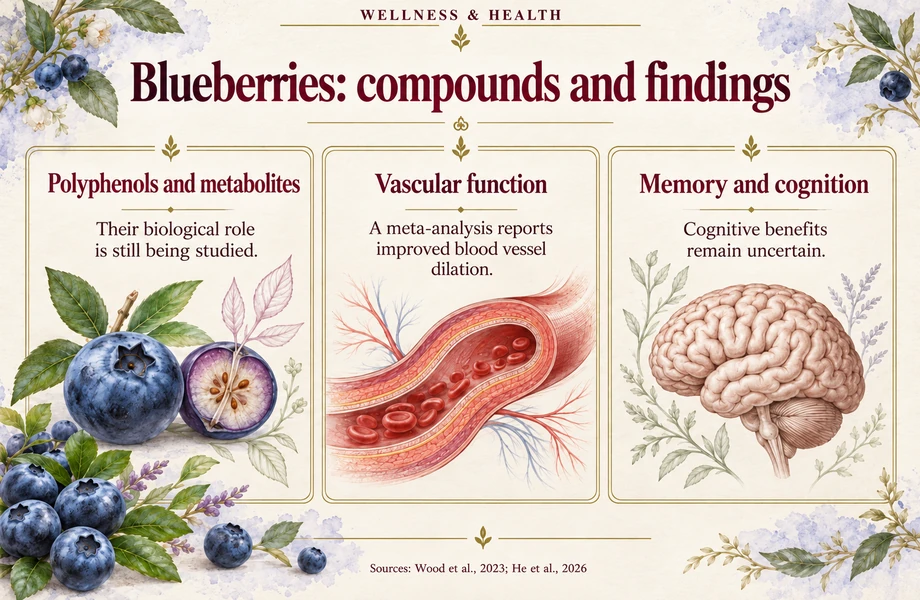
A systematic review and meta-analysis published in 2026 in Nutrition Research brought together 14 randomised studies, involving a total of 632 participants. This type of research compares and combines the results of available trials.
The available evidence
The analysis found an improvement in flow-mediated dilation, a measure of the ability of blood vessels to widen in response to increased blood flow.
However, no statistically significant effects were found on executive functions, meaning the abilities used to organise and control one’s actions, or on mood. The pooled changes in systolic and diastolic blood pressure were also not significant.
The studies differed in product, dose, duration, and participant age. The review therefore primarily supports further interest in vascular function, while the cognitive benefit remains uncertain.
The hypotheses being studied include the role of polyphenols and their metabolites, the substances formed as they are processed in the body.
The meta-analysis findings
In the 2023 study, some associations between metabolites and vascular and cognitive outcomes suggested avenues for further investigation, without identifying a definitive causal mechanism.
The transition from a biological hypothesis to a tangible benefit requires further testing. Identifying an interesting substance does not mean knowing what dietary amount produces an effect, in which people, or for how long.
Furthermore, a favourable result for blood vessels does not automatically justify the same conclusion about memory.
The 2026 study concerns cognitively healthy older adults and a specific freeze-dried preparation. Its conclusions cannot be extended to people with dementia, nor can the same outcomes be attributed to every blueberry-based product.
Hypotheses and limitations
The authors declare no conflicts of interest; the publicly available abstract does not provide funding details.
The 2023 study was funded by the Wild Blueberry Association of North America, which also supplied the products. The authors state that the funder had no involvement in the design, conduct, analysis, or interpretation of the study.
This is an aspect of transparency to consider when reading the findings.
For consumers, the amounts used in trials do not constitute a prescription. Choosing to eat blueberries can be based on taste, dietary variety, and convenience, without depending on an expectation of improving mental performance.
Research transparency
The strongest message about blueberries and memory remains cautious: results in humans are mixed, and a benefit has not been established. A null finding helps define the limits of the claims, while leaving further research questions open.
Blueberries have a place in a varied, balanced diet alongside other foods. This article is for informational purposes and does not replace advice from doctors, dietitians, or nutritionists.
🫐 Well-being & Health with Berries 🍓This article is part of the editorial series Wellness & Health with Berries, which brings scientific research closer to everyday life, promoting berries as allies for well-being. The series offers clear, up-to-date, and evidence-based content designed to inform consumers and support all operators in the berry supply chain. |
Sources:
- Guardino ET, Gabriel O, Mukamal KJ, Djousse L. “Effects of a 24-week intervention with freeze-dried blueberries on brain health in older adults: A randomized double-blind, placebo-controlled trial”. Clinical Nutrition ESPEN, 2026;74:103377. DOI: 10.1016/j.clnesp.2026.103377. PMID: 42251891.
- Wood E, Hein S, Mesnage R, et al. “Wild blueberry (poly)phenols can improve vascular function and cognitive performance in healthy older individuals: a double-blind randomized controlled trial”. The American Journal of Clinical Nutrition, 2023;117(6):1306–1319. DOI: 10.1016/j.ajcnut.2023.03.017. PMID: 36972800.
- He Y, et al. “Blueberry consumption enhances vascular function but not cognitive abilities in healthy individuals: a systematic review and meta-analysis”. Nutrition Research, 2026;149:162–177. DOI: 10.1016/j.nutres.2026.03.007. PMID: 41974068.
Italian Berry - All rights reserved