





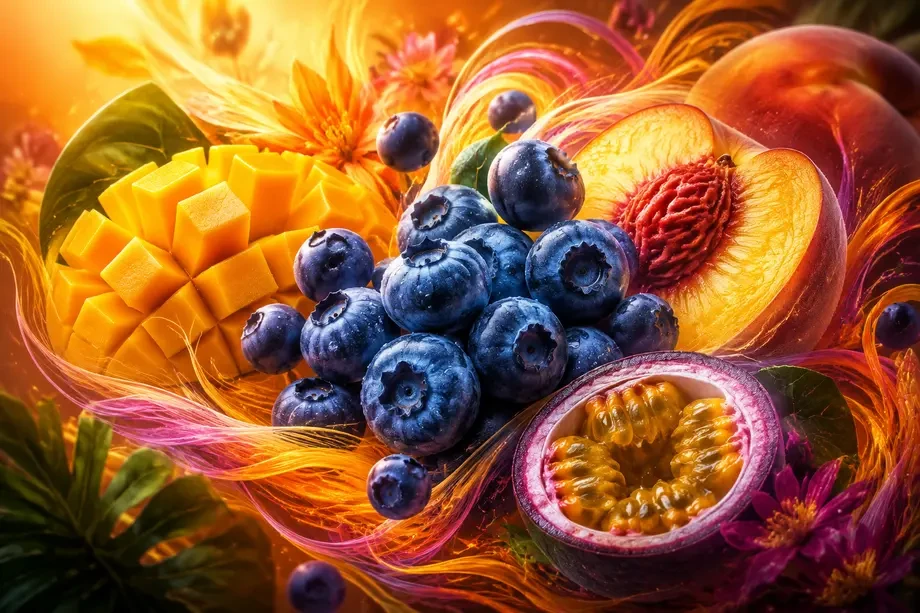
The Berry Blue breeding programme has produced selections with tropical, spicy and even popcorn-like notes. These are not yet new commercial varieties, but they send a clear signal: flavour is becoming a central objective in blueberry breeding.
Blueberries with aromatic notes of mango, peach, passion fruit and pineapple, as well as selections with more unusual notes associated with cinnamon or popcorn. These are some of the sensory profiles identified in the experimental material evaluated by the breeding programme linked to MBG Marketing and Naturipe Farms.
These are not flavoured fruits or varieties already available on the market. Their characteristics derive from the natural genetic diversity of blueberries and were identified during the tasting of selections obtained through crossbreeding. However, only a tiny proportion of this material will complete the entire agronomic and commercial evaluation process.
The development is particularly interesting because it shows how blueberry breeding is broadening its definition of quality. Size, firmness and shelf life remain essential, but the industry is seeking to combine them with a more distinctive flavour identity.
MBG Marketing’s Berry Blue programme
The work is being carried out by Berry Blue LLC, MBG Marketing’s proprietary breeding programme. MBG Marketing is a US grower-owned cooperative that markets its berries through Naturipe Farms.
The research is led by a team of breeders, geneticists, technicians and growers. They include Beth Alger, assistant plant breeder at Berry Blue and research and development leader for MBG Marketing and Naturipe.
Hundreds of crosses are made each year. Thousands of new plants are then observed and selected against a wide range of characteristics, including yield, harvest timing, vigour, disease resistance, climate adaptability, size, colour, firmness, storage performance and eating quality.
In 2025, Naturipe reported that 45,000 flowers had been hand-pollinated in a single season at the Berry Blue research facility in Michigan. The figure illustrates the scale of the work required to generate the genetic variability from which only a few genuinely promising candidates will emerge.
More than a decade can pass from seed to variety
An original flavour is not enough to turn a selection into a commercial variety.
According to Naturipe, the complete process can normally take seven to twelve years, from producing the seed to a possible commercial launch. Fewer than one in every 10,000 plants is expected to reach commercial status.
The selections are trialled in several US states and Canada, often without protection, to assess their performance under frost, heatwaves and different climatic conditions. A particularly aromatic fruit could be discarded if the plant proved low-yielding, susceptible to disease or unsuitable for harvesting and distribution.
Firmness and postharvest performance are also decisive. A blueberry with a pronounced tropical profile but unable to withstand storage and transport would be unlikely to enter major retail programmes.
For this reason, notes of mango, peach or passion fruit should, at least for now, be regarded as characteristics of experimental selections, rather than promises of an imminent commercial launch.
Flavour becomes a segmentation tool
The most significant aspect is the direction indicated by the programme. For many years, blueberry breeding has focused primarily on yield, adaptability, fruit size, firmness and shelf life. These objectives have helped extend production calendars and transport distances, but have not always delivered an eating experience that consumers can easily distinguish.
The search for specific aromatic profiles could open a new phase. A blueberry recognisable for its tropical, floral or spicy notes would offer retailers a more immediate means of differentiation than size and crunchiness alone.
Naturipe is already working on premium segmentation through ranges such as Sweet Selections and proprietary varieties including Envoy, Charisma and Keepsake. In 2026, the company reported that its premium sweet blueberry category had reached 15 million pounds by June, representing growth of 45%.
The move towards more distinctive flavours could therefore become part of a commercial strategy already designed to separate standard and premium offerings.
Measuring Brix is not enough
Sweetness remains an essential parameter, but it does not fully describe sensory quality. Two blueberries with similar Brix readings can deliver very different eating experiences because of their acidity, texture and, above all, volatile aromatic compounds.
A study published in Food Chemistry in 2026 analysed 147 blueberry cultivars, identifying 103 volatile compounds and five major aroma profiles: herbaceous-woody, sweet-fruity, cool-green, rich floral-fruity and light-fruity.
The study confirms that blueberry germplasm contains far greater aromatic diversity than is normally perceived in commercial products. It also identified 16 compounds that could be used as markers to distinguish between the different profiles.
The challenge for breeders is to transfer this sensory complexity into varieties that also maintain yield performance, uniformity and logistical reliability.
Towards blueberries marketed by eating experience?
If some of these experimental selections complete the entire development process, the result could also affect how blueberries are presented to consumers.
Today, commercial descriptions focus mainly on origin, organic certification, size, crunchiness or sweetness. In the future, descriptions similar to those used for apples, table grapes, wine or coffee could appear, referring to specific aromatic notes and consumption occasions.
Before this scenario can become a reality, however, at least three aspects will need to be assessed: the stability of the flavour across different environments and seasons, consumers’ ability to recognise and appreciate it, and their willingness to pay a higher price.
The presence of mango or passion fruit notes in a selection does not guarantee that they will remain identical when the production area, stage of ripeness or postharvest conditions change. The interaction between genetics, environment and crop management remains decisive.
The message emerging from the Naturipe programme is nevertheless clear: the future of premium blueberries may be defined not only by larger, firmer and longer-lasting fruit, but also by varieties capable of expressing a genuine aromatic identity.
Sources: Naturipe Farms – Beth Alger profile and the Berry Blue programme · Naturipe Farms – Michigan breeding facility · MBG Marketing – Berry Blue Breeding Program · Food Chemistry – classification of blueberry aroma profiles
Italian Berry - All rights reserved