








Growing early-ripening blueberries under high tunnels can bring harvest forward, increase yields and improve certain fruit quality characteristics. These findings come from a trial conducted by Auburn University in Tallassee, central Alabama, comparing 15 cultivars grown in open-field and high-tunnel systems.
The trial is particularly relevant because it was conducted in USDA Hardiness Zone 8b, which is characterized by mild winters and long, warm summers. These conditions are generally suitable for Rabbiteye and Southern Highbush varieties, although spring frost represents one of the main production risks, especially for early-flowering and early-ripening cultivars.
The results show that, when combined with suitable heating and ventilation systems, high tunnels can provide protection from cold and help growers advance the marketing window for blueberries.
Fifteen cultivars compared
The trial was conducted at the E.V. Smith Plant Breeding Unit in Tallassee. The research plots were prepared in January 2022, adjusting the soil to a pH of approximately 4.8 and amending it with pine bark. The plants were planted in March of the same year on raised beds covered with black landscape fabric.
Researchers James Spiers, Marlee Trandel-Hayse and Lucas Speer, from Auburn University’s Department of Horticulture, evaluated the Southern Highbush cultivars Arcadia, Avanti, Bluecrisp, Chickadee, Colossus, Farthing, Gumbo, Indigocrisp, Keecrisp, Legacy, Meadowlark, New Hanover and Optimus, together with the two Rabbiteye varieties Krewer and Titan.
Bluecrisp and Colossus were represented by younger and much smaller plants than the other cultivars, an important factor to consider when interpreting their yield results.
The trial included two production systems: open field and high tunnel. The tunnel measured 9.1 m wide, 29.3 m long and 4.3 m high. Each environment contained 120 plants, for a total of 240, arranged in a randomized complete block design with eight replications.
The high tunnel alone is not enough against frost
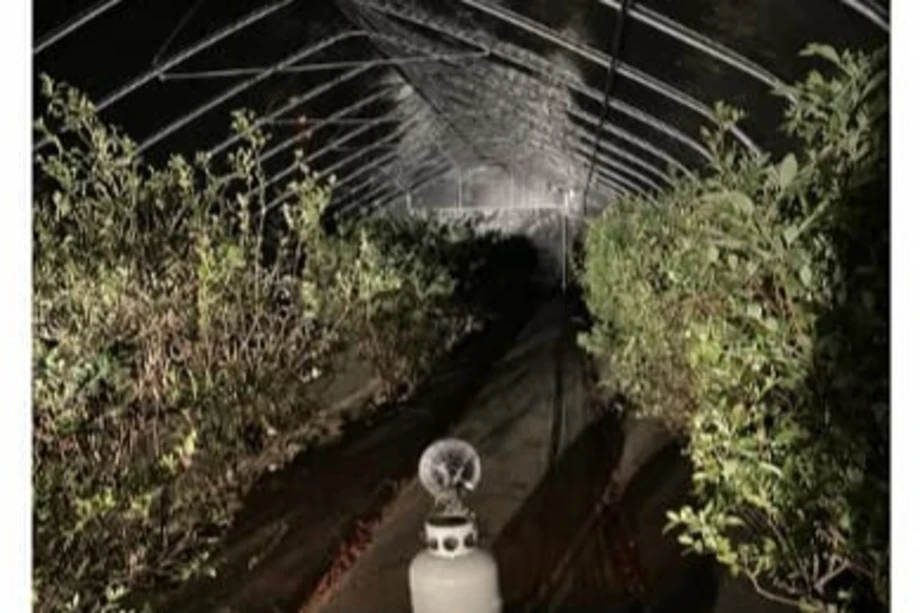
One of the first important findings concerned frost protection. During a freeze event on March 15, 2023, the high tunnel alone was unable to maintain temperatures high enough to prevent cold injury. For the subsequent freeze event on March 20, two portable propane heaters were therefore placed inside the tunnel, providing adequate protection.
In the following years, the system was further improved by positioning a fan behind each heater to promote warm-air circulation. The sides of the tunnel remained open throughout the year and were closed only during freeze events.
The trial therefore demonstrates that, under the climatic conditions of central Alabama, the covering alone does not automatically provide sufficient protection. Effective frost control requires an integrated system combining tunnel closure, heating and ventilation.
Yields 30% higher in 2024 and 15% higher in 2025
Air and soil temperatures inside the tunnel were generally 0.2-1.0 °C higher than in the field, while photosynthetically active radiation was lower. However, without heaters, minimum temperatures during freeze events were similar in the two environments.
Despite the early development of the cultivars included in the trial, severe spring frost injury did not occur in the field in 2024 or 2025. This made it possible to compare the two systems without the results being substantially affected by cold injury.
Overall yields were higher under the tunnel in both seasons: approximately 30% higher in 2024 and 15% higher in 2025. However, the effect was not uniform across all cultivars, confirming the importance of the interaction between genetics, environment and production system.
Optimus produced one of the clearest responses, increasing from 2,255 g per plant in the field to 3,508 g under the tunnel in 2024 and from 3,329 to 5,054 g per plant in 2025. Keecrisp also showed a consistent advantage, yielding 3,024 g under the tunnel compared with 1,937 g in the field in 2024 and 3,358 compared with 2,092 g in 2025.
Other cultivars that responded positively to high-tunnel production included Indigocrisp, Titan, Meadowlark, Chickadee, Bluecrisp and Farthing. Krewer reached 3,300 g per plant under the tunnel in 2024, compared with only 988 g in the field, although in 2025 it produced a higher yield in the field.
Table 1. Estimated season-total yield (g per plant) of 15 blueberry cultivars grown in field and high tunnel production systems during the 2024 and 2025 seasons. Cell values are least-squares means from a per-cultivar PROC GLIMMIX two-way (Year × Location) model fit to plant-level season totals (n = 8 plants per cell). Bold values within each year indicate the higher-yielding location. Type III p-values are from the per-cultivar mixed model.
| Cultivar | 2024 Field | 2024 High Tunnel | 2025 Field | 2025 High Tunnel |
|---|---|---|---|---|
| Gumbo | 2,727 | 3,362 | 3,975 | 4,222 |
| Optimus | 2,255 | 3,508 | 3,329 | 5,054 |
| Krewer | 988 | 3,300 | 4,503 | 4,030 |
| Arcadia | 2,698 | 2,019 | 3,763 | 3,724 |
| New Hanover | 2,393 | 2,525 | 4,253 | 2,969 |
| Indigocrisp | 1,941 | 2,260 | 2,417 | 3,812 |
| Keecrisp | 1,937 | 3,024 | 2,092 | 3,358 |
| Avanti | 1,758 | 3,112 | 2,214 | 2,344 |
| Legacy | 1,241 | 1,646 | 3,693 | 2,788 |
| Titan | 615 | 1,874 | 2,023 | 2,976 |
| Meadowlark | 923 | 1,458 | 1,859 | 2,745 |
| Chickadee | 1,512 | 2,164 | 1,085 | 1,488 |
| Bluecrisp | 757 | 1,449 | 1,582 | 2,090 |
| Farthing | 1,153 | 1,424 | 743 | 1,936 |
| Colossus | 460 | 161 | 791 | 556 |
Harvest moves from May to April
One of the most significant findings concerns the earlier phenological development. Both flowering and harvest began earlier under high-tunnel conditions. Arcadia, Avanti, Chickadee, Indigocrisp, Meadowlark and Optimus produced substantial yields as early as April in both seasons.
For the same cultivars, peak production in the field occurred in May, with very low yields, if any, in April. The high tunnel therefore produced a genuine shift in the harvest window, with potential advantages in markets that pay a premium for early-season fruit.
In 2024, Krewer, Gumbo, Avanti and Optimus were among the highest-yielding cultivars under the tunnel. In 2025, the highest yields in the same environment were recorded for Optimus, Gumbo, Indigocrisp, Arcadia and Krewer.
In the field, Gumbo, New Hanover, Optimus and Arcadia were among the highest-yielding cultivars in 2024. In 2025, the best results were recorded for Gumbo, Krewer, New Hanover, Legacy and Arcadia.
Larger berries and less splitting
Berry weight was generally higher under high-tunnel conditions for almost all cultivars in both seasons. Soluble solids content, used as an indicator of sugar concentration, remained broadly similar under the two environmental conditions.
Protection from rainfall also substantially reduced the occurrence of split berries compared with the field. According to the researchers, this effect may result in fewer culls and fewer fruit rot problems associated with rainfall.
The heat stress initially feared during the summer did not occur. Keeping the sides of the tunnel open for most of the year probably contributed to this outcome.
Optimus and Arcadia for early production, Gumbo for the field
Optimus and Arcadia stood out for their particularly early harvest and strong yields under both high-tunnel and field conditions in the years when severe spring frost did not occur.
Later-blooming cultivars generally showed better suitability for field production. Among these, the researchers identified Gumbo as the most promising choice for obtaining good yields in May.
Indigocrisp, Keecrisp and Bluecrisp stood out for their firm, “crunchy” texture, a characteristic considered attractive to both growers and consumers. According to the authors, this profile could also make them suitable for mechanical harvesting and extended postharvest life. All three performed well under the tunnel and also achieved average or above-average results under field conditions.
Economic feasibility depends on the market
The main question concerns the economic feasibility of the system. High tunnels require a significant upfront investment, in addition to the costs of heaters, fans and energy use during freeze events.
In return, the structure provides a form of crop insurance against frost and can deliver higher yields, larger fruit, fewer culls caused by splitting and fruit rot and, above all, earlier production.
Economic feasibility must therefore be assessed according to farm scale, the frequency of adverse weather events and the market’s ability to reward early-season fruit.
The results should be interpreted within the context of USDA Hardiness Zone 8b in Tallassee. This classification primarily describes minimum winter temperatures and does not capture every aspect of the local climate. Nevertheless, the combination of mild winters, long, warm summers and the risk of late frosts makes the trial particularly relevant to production regions where very early Southern Highbush cultivars may offer commercial opportunities but require reliable spring frost-protection systems.
Source: Southern Region Small Fruits Consortium