







In autumn and winter, when some berries may be harder to find fresh or more expensive, frozen ones are a practical choice. But does moving them from the refrigerated display to the freezer change their vitamins and plant compounds? And does the way they are thawed matter too?
Studies do not point to the same answer for every fruit and nutrient. In general, freezing can preserve a substantial share of the compounds measured, but results vary depending on the species, variety, processing and storage time.
And measuring nutrients in the fruit is not the same as demonstrating different effects on the health of people who eat it.
Fresh and frozen: the comparison depends on what is measured
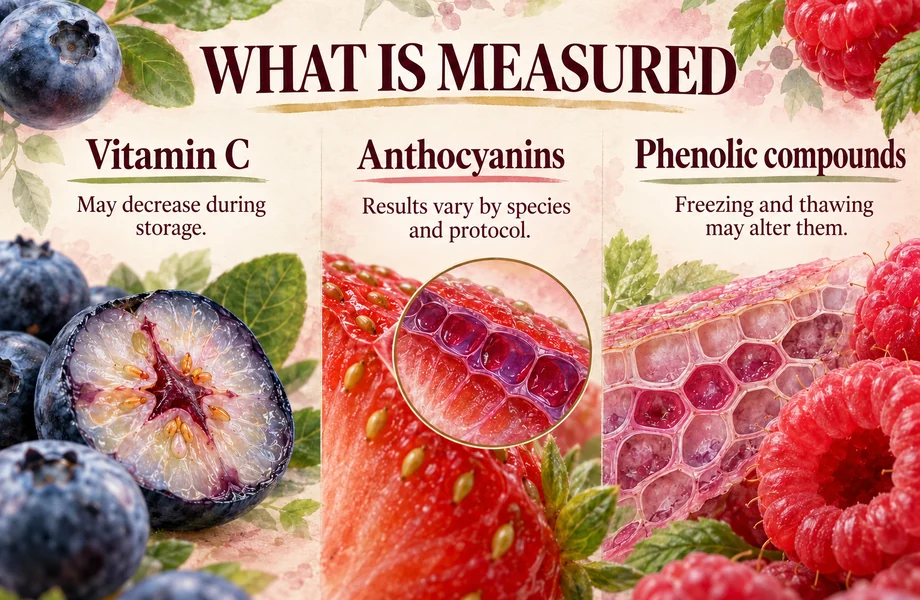
When discussing the nutritional quality of berries, researchers often look at vitamin C, anthocyanins and other phenolic compounds. Anthocyanins are plant pigments that contribute to the red, blue or purple colour of many berries.
Their presence is of interest to research, but the amount measured in a laboratory does not, by itself, tell us what effect the fruit will have in the body.
The comparison between fresh and frozen fruit also needs to be interpreted carefully. Fresh produce may have been picked, transported and stored for days before reaching the table. Frozen produce, by contrast, may be frozen soon after harvest.
So the result also depends on the product’s journey and the conditions used in the experiments: there is no single comparison that applies to every pack and season.
What studies on blueberries, strawberries and raspberries have found
A 2026 study analysed nine commercial blueberry products, fresh or frozen, measuring their anthocyanins, organic acids and volatile compounds. Some frozen samples had anthocyanin levels comparable to or higher than those in fresh samples.
The study offers a comparison close to products available on the market, but it involved only a small number of samples. It cannot establish that all frozen blueberries contain more anthocyanins, or that frozen fruit is always nutritionally superior.
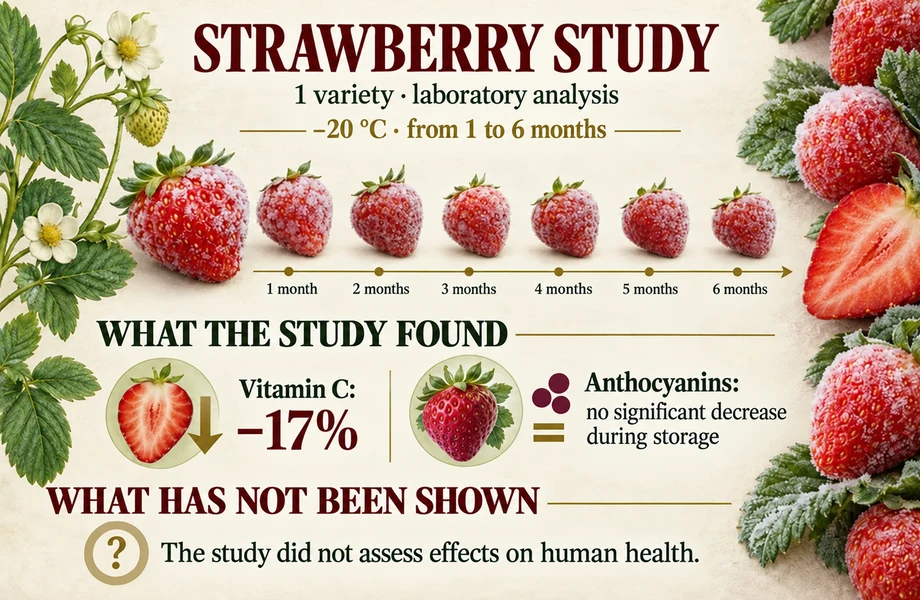
A 2024 study examined strawberries of a single variety, subjected to different freezing methods, stored for up to six months and then thawed under different conditions.
During storage at −20 °C, anthocyanin content did not show a significant decrease; vitamin C fell by 17% between the first and sixth month. In some samples, thawing was associated with more marked reductions in anthocyanins and other compounds.
Storage and thawing
These results describe that particular variety and experimental protocol; they cannot automatically be applied to all frozen strawberries.
A 2002 experiment on red raspberries found that freezing did not significantly change the levels of vitamin C and phenolic compounds in the fruit studied.
The authors also simulated the journey of fresh produce, with three days at 4 °C and one day at 18 °C. Under those conditions, vitamin C decreased, while anthocyanins showed no change.
This result is a useful reminder that the storage of fresh produce can also affect its composition.
Comparisons across species
Finally, a 2017 study compared five species of berries in fresh, frozen, freeze-dried or air-dried form. On average, the authors reported relatively small losses of anthocyanins and vitamin C after freezing compared with the declines observed after drying.
However, differences between species were substantial: an average does not necessarily describe an individual fruit.
Why the results differ
Freezing is not a uniform treatment. Temperature, how quickly the process takes place, storage time and thawing can all affect composition.
Different cultivars may also respond differently: a study of a single variety is not enough to predict what will happen to all strawberries or blueberries.
The analytical method also matters. Freezing can disrupt some of the plant-cell structure and make certain compounds easier to extract in the laboratory.
Composition and clinical evidence
A higher measured value after freezing does not necessarily mean that the product has gained nutrients or that the body uses them more effectively.
Finally, these studies mainly measure the chemical composition of the fruit. They do not compare, in clinical trials, the health effects on people who eat fresh berries with those on people who eat frozen ones.
They therefore do not show that either form prevents disease or provides greater clinical benefits.
How to choose and use frozen berries
Your choice may depend on the season, price, availability and how you plan to use them. Fresh berries are convenient to eat as they are; frozen berries can be kept on hand for longer and used in yoghurt, porridge, smoothies or cooked dishes.
From a nutritional perspective, the available studies do not support a general rule that one form is always better than the other.
For frozen berries, it is useful to follow the instructions on the packaging and limit the time they spend at room temperature.
Storing berries at home
If the fruit is thawed, the liquid released may contain some water-soluble compounds. In a home-prepared dish, you can mix the liquid in with the fruit instead of draining it away.
If you eat fresh berries, keeping them in the refrigerator and consuming them within a reasonable time can help limit deterioration.
In either case, it makes sense to choose the product you can use regularly and include berries as part of a varied diet, without attributing a therapeutic effect to a single serving.
Fresh or frozen: the clearest takeaway
Research suggests that freezing can preserve a substantial share of the nutrients and plant compounds in berries, but it does not provide a universal answer that applies to every species and product.
Storage and thawing are part of the comparison, along with variety and analytical method.
For consumers, fresh and frozen berries can both be sensible options. The choice can come down to taste, availability and convenience: there is currently insufficient clinical evidence to say that either form guarantees greater health benefits.
This information is intended for general educational purposes and does not replace advice from doctors, dietitians or nutritionists.
🫐 Well-being & Health with Berries 🍓This article is part of the editorial series Wellness & Health with Berries, which brings scientific research closer to everyday life, promoting berries as allies for well-being. The series offers clear, up-to-date, and evidence-based content designed to inform consumers and support all operators in the berry supply chain. |
References:
- Adhikari J., Singh J., Jha D. K., Patil B. S., “Does price reflect quality in fresh and frozen commercial blueberries?”, Journal of Agriculture and Food Research, 2026, 28:102936. DOI: 10.1016/j.jafr.2026.102936.
- Simkova K., Grohar M. C., Pelacci M., Veberic R., Jakopic J., Hudina M., “The Effect of Freezing, Frozen Storage and Thawing on the Strawberry Fruit Composition”, International Journal of Fruit Science, 2024, 24(1):186–199. DOI: 10.1080/15538362.2024.2355920.
- Mullen W., Stewart A. J., Lean M. E. J., Gardner P., Duthie G. G., Crozier A., “Effect of Freezing and Storage on the Phenolics, Ellagitannins, Flavonoids, and Antioxidant Capacity of Red Raspberries”, Journal of Agricultural and Food Chemistry, 2002, 50(18):5197–5201. DOI: 10.1021/jf020141f.
- Sadowska K., Andrzejewska J., Klóska Ł., “Influence of freezing, lyophilisation and air-drying on the total monomeric anthocyanins, vitamin C and antioxidant capacity of selected berries”, International Journal of Food Science & Technology, 2017, 52(5):1246–1251. DOI: 10.1111/ijfs.13391.
Italian Berry - All rights reserved