






Berries as ingredients represent a major opportunity for the food industry, beverages, nutraceuticals and cosmetics. But there is also a less virtuous side: products that use images, colours, names and suggestions linked to fruit to sell better, without fruit actually being present in significant quantities.
This is the “dark side” of Berries as ingredients: no longer the berry as a value-added ingredient, but the berry as a marketing shortcut. Strawberries, blueberries, raspberries, blackberries, cranberries and other berries are often used to communicate naturalness, freshness, taste and wellbeing. But there can be a very wide gap between communication and the real composition of the product.
The context: we still eat too little fruit and vegetables
The issue is particularly relevant at a time when fruit and vegetable consumption in Europe remains below the recommended nutritional targets. According to the latest edition of the Freshfel Europe Consumption Monitor, in 2024 the average consumption of fresh fruit and vegetables in the EU reached 355.71 grams per day per person, up 1.98% compared with 2023, but still below the minimum threshold of 400 grams per day indicated by the World Health Organization.
The positive figure is that consumption has increased slightly. The worrying aspect is that growth remains insufficient and that, according to Freshfel Europe, only a few European Union countries reach the minimum recommended level. In other words, fruit and vegetables continue to be recognised as essential for health and sustainability, but struggle to turn this reputation into daily consumption.
It is in this space that an increasingly evident contradiction emerges: while fresh produce consumption is stagnating, many processed products use fruit as a visual, linguistic or symbolic element to appear more natural, healthier or closer to the world of fresh produce.
Freshfel: “Where is the fruit?”
Freshfel Europe summarised the problem with a very simple question: “Where is the fruit?” The question comes from a survey conducted on 229 products in 8 European Union countries: Belgium, France, Germany, Italy, Lithuania, the Netherlands, Poland and Spain.
The selected products belonged to very different categories: biscuits, candy, cereals, chocolate, desserts, fizzy drinks, ice cream, jams, juices, yogurt and other processed products. The common criterion was the prominent use of fruit and vegetables as a communication element, especially through images, names, colours and graphic references on packaging.
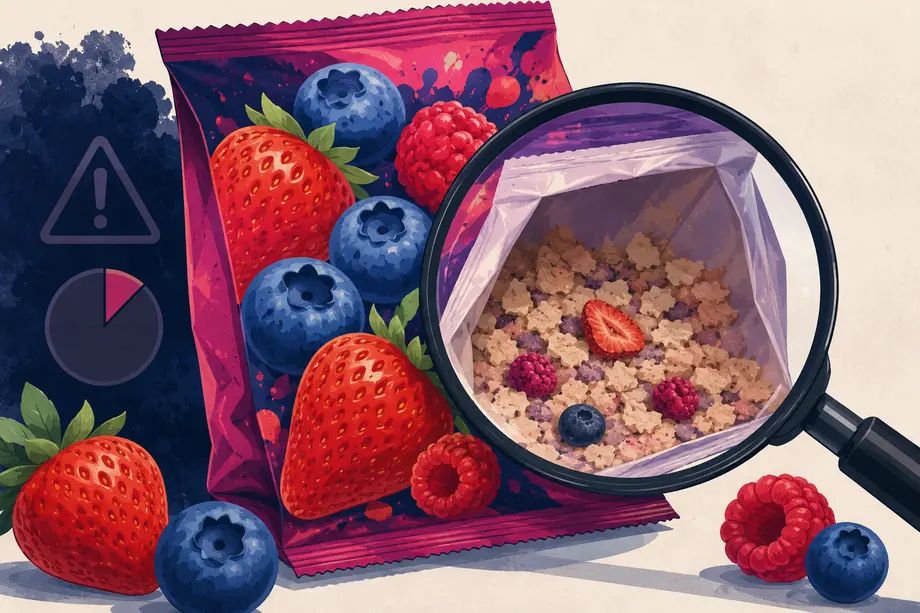
The result is significant: according to Freshfel, 10% of the products analysed contained no fruit at all, despite displaying fruit images on the packaging. A further 43% contained less than 10% fruit, while 22% contained between 10% and 50%. Only 25% of the products exceeded 50% fruit content.
The problem is not flavouring, but ambiguity
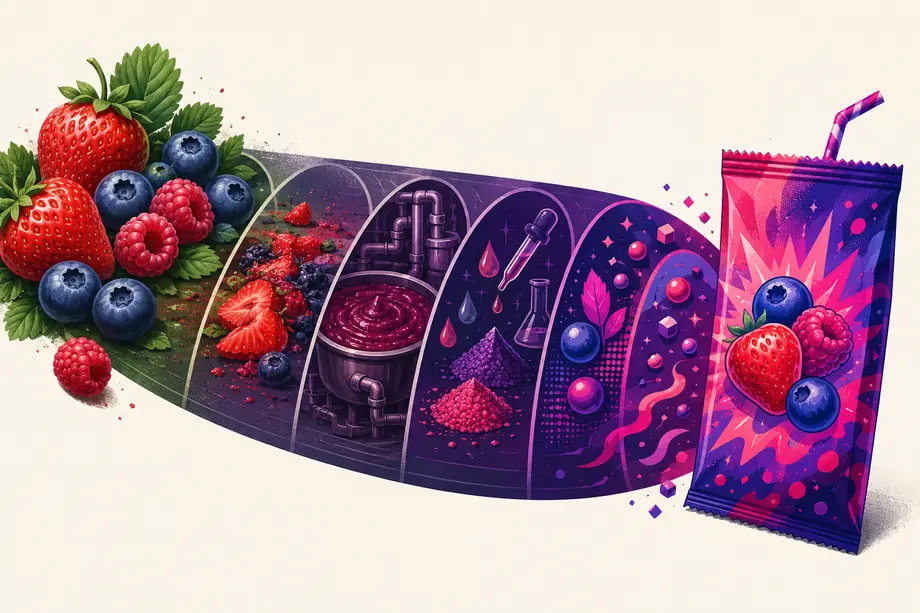
Using strawberry, blueberry or raspberry flavouring is not wrong in itself. The food industry has always worked with flavours, extracts, concentrated juices, purées, powders and processed ingredients. The problem arises when the product communicates to consumers an idea of fruit that is much stronger than its actual presence.
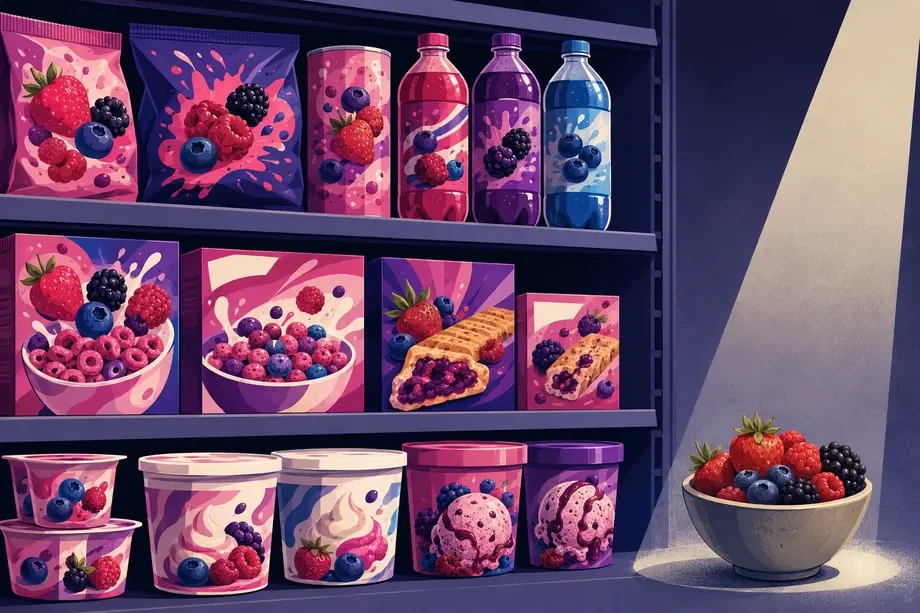
A package with large strawberry images can suggest naturalness, freshness and fruit content. An intense purple colour can evoke blueberries or blackcurrants. A claim such as “red fruits” or “berry flavour” can be perceived as closer to fresh produce than the ingredient list actually indicates. In many cases, however, the fruit component may be minimal, marginal or even absent.
The issue becomes even more delicate when these products compete, in the consumer’s mind, with the consumption of fresh fruit. Freshfel highlights a central point: eating products with fruit ingredients, flavours or images is not the same as eating fresh fruit. This distinction is essential, especially for younger consumers and families.
The risk for berries: borrowed value
For berries, this issue is particularly important. Berries are among the strongest categories from a symbolic point of view: they communicate health, colour, taste, pleasure, modernity, antioxidants, naturalness and premium positioning. For this very reason, they are often used as a marketing lever in products that do not always provide consumers with a real fruit intake.
Blueberry can become synonymous with antioxidants even when it is present only as a flavour. Strawberry can suggest freshness even in predominantly sugary products. Raspberry can give an artisanal or gourmet image to desserts and snacks in which fruit is marginal. Cranberry can evoke functionality even when its role in the recipe is mainly aromatic or chromatic.
In these cases, the processed product borrows the reputational capital of the berry, but does not necessarily help strengthen the real consumption of berries. On the contrary, it can generate a distorted perception: consumers think they are getting closer to fruit, while in reality they are buying an ultra-processed product or, in any case, something very far from fresh produce.
The comparison with ultra-processed foods
During the consumption webinar, Freshfel also referred to the growing influence of ultra-processed foods, which benefit from very powerful marketing, branding and consumer engagement strategies. These products are often more visible, more convenient, easier to consume and more aggressive in their communication than fresh fruit and vegetables.
The paradox is clear: while the fresh produce sector promotes health, sustainability and real quality, many processed products appropriate the same visual and narrative codes. Fresh fruit remains on the shelf, often communicated in a very basic way; its image, instead, travels on colourful packaging, snacks, beverages, desserts and children’s products.
This imbalance is not only about the correctness of information. It also concerns the competitive capacity of the fresh supply chain. If the symbolic value of fruit is used by other products in a more effective, more visible and more emotional way, the fresh produce sector risks losing part of its narrative strength.
Do not demonise, but distinguish
The answer cannot be to demonise all processed products that use berries. There are many serious and interesting applications: yogurt with real fruit content, beverages with purées or juices, snacks with freeze-dried fruit, supplements with standardised extracts, cosmetics with traceable botanical ingredients, and upcycled ingredients obtained from processing by-products.
The point is to distinguish between authentic use and evocative use. In the first case, the berry is a real ingredient, with a clear function in the recipe or formulation. In the second, the berry is mainly an image, a colour, a name or an implicit promise.
For a column such as Berries as ingredients, this distinction is essential. The aim should not be to celebrate every product that shows a blueberry or a strawberry on the package, but to understand whether that berry is truly part of the product’s value or merely a graphic signal designed to make it more desirable.
A critical grid for reading products
To correctly analyse future cases, Italian Berry could add some critical questions to its standard monitoring sheet:
- Is fruit actually present in the ingredient list?
- In what percentage?
- Is it present as fruit, purée, juice, concentrate, powder, extract, flavouring or only as an image?
- Does the packaging communicate more fruit than the product actually contains?
- Could the product create confusion with the consumption of fresh fruit?
- Is the health claim consistent with the overall composition?
- Does the berry add real value or only perceived value?
These questions make it possible to separate virtuous cases from ambiguous ones. Above all, they allow the phenomenon to be interpreted not only as product innovation, but also as an issue of transparency, food education and supply chain responsibility.
Fresh First: putting fresh produce back at the centre
For the 2026-2030 period, Freshfel Europe proposes a “Fresh First” approach, placing fruit and vegetables at the centre of food, health and environmental policies. This is a particularly relevant message for the berry sector as well.
If berries are powerful enough to be used to sell beverages, snacks, desserts, cosmetics and supplements, then the fresh supply chain must learn to better valorise those same assets: taste, colour, health, naturalness, pleasure, convenience and sustainability.
The sector cannot limit itself to denouncing the opportunistic use of fruit by other industries. It must also ask why those same communication codes work so well elsewhere and how they can be brought back to serve the fresh product.
Thomas Drahorad, Editor of Italian Berry
Italian Berry - All rights reserved