







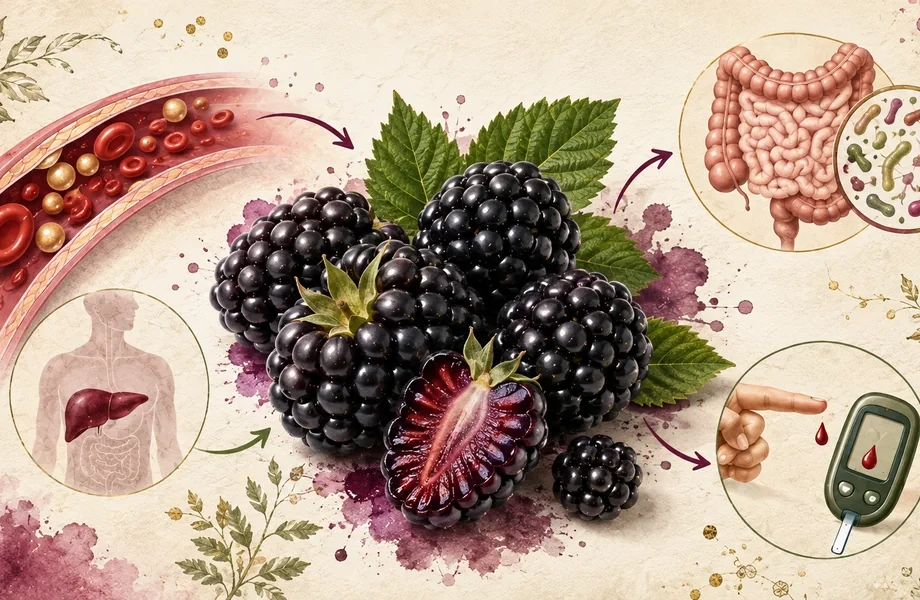
Sweet, juicy and characterized by the dark color of anthocyanins, blackberries are among the berries attracting the attention of nutritional research. The reason is not limited to their nutritional profile: some varieties are particularly rich in polyphenols, plant compounds studied for their potential interactions with several processes in the human body.
A clinical study published in the Journal of Berry Research provided particularly interesting findings on the relationship between blackberries and health. In a group of healthy adults, regular consumption of a beverage made from tropical highland blackberries was accompanied by lower levels of total cholesterol, triglycerides and blood glucose. This positive result strengthens interest in this fruit, although some important clarifications are required.
Why blackberries are attracting health research
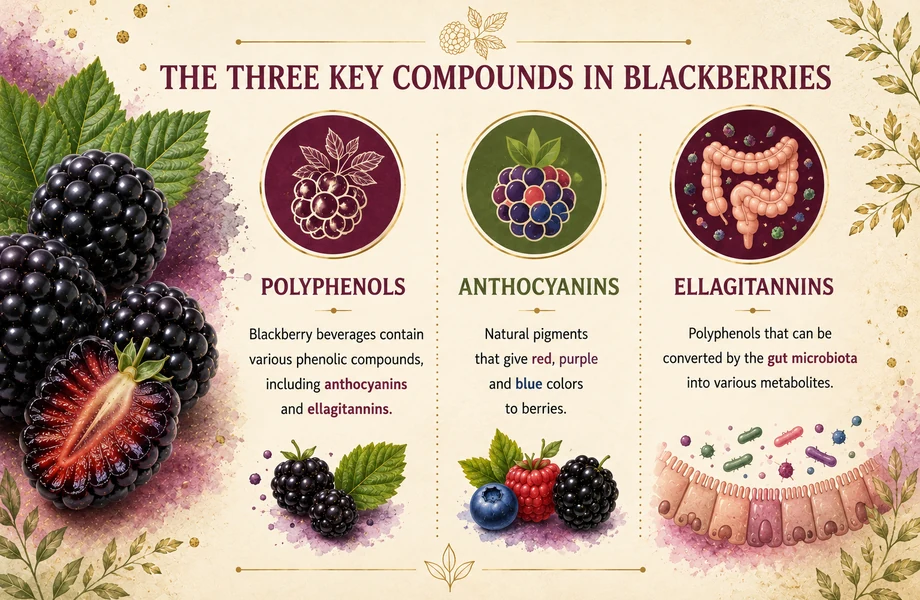
The blackberry studied by the researchers was Rubus adenotrichos Schltdl., a tropical highland species grown in Latin America. The fruit used in the study came from Costa Rica and was harvested at full ripeness. According to the analyses conducted by the authors, the beverage contained several phenolic compounds, including anthocyanins and ellagitannins.
Anthocyanins are the pigments that contribute to the red, purple and blue shades of many berries. Ellagitannins, meanwhile, belong to another family of polyphenols and can be transformed into various metabolites by the body and the gut microbiota.
It was precisely this abundance of bioactive substances that prompted the researchers to investigate what might happen in humans, moving beyond experiments conducted exclusively in laboratories or on animals.
The study is also interesting because it simultaneously analyzed three parameters that are very familiar to consumers: cholesterol, triglycerides and blood glucose.
The blackberry study: what the researchers did
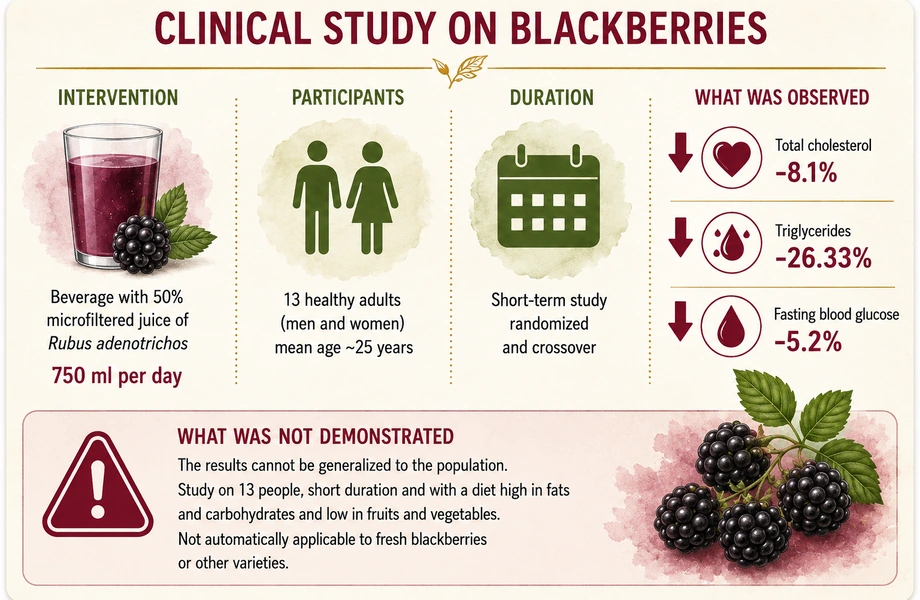
The study involved 13 healthy adults, both men and women, with an average age of approximately 25 years and an average body mass index within the normal range. All participants completed the two phases included in the protocol.
The study had a randomized, crossover design. This means that the same participants experienced both the blackberry beverage condition and the control condition at different times.
During the intervention, participants were given a diet particularly rich in fat and carbohydrates and low in fruit and vegetables. At each meal, the volunteers consumed 250 milliliters of blackberry beverage, for a total of 750 milliliters per day. The beverage consisted of 50% microfiltered Rubus adenotrichos juice.
Therefore, the study did not involve fresh blackberries eaten directly, but a product obtained from the fruit through pressing and microfiltration. This distinction is important: the study results specifically concern this preparation and cannot automatically be applied to every blackberry variety or commercially available product.
Cholesterol and triglycerides: the most interesting results
The study produced some of its most positive findings in relation to blood lipids.
After the period involving the blackberry beverage, total cholesterol had decreased by 8.1%, falling on average from 184.2 to 169.2 mg/dL. The change was statistically significant.
The change in triglycerides was even more pronounced, with average levels falling from 90.8 to 66.9 mg/dL, representing a decrease of 26.33%. Once again, the difference was statistically significant.
These figures make the study particularly interesting in the fields of metabolic and cardiovascular health. They do not mean that blackberries can replace specific treatments or dietary interventions, but they show that, under the experimental conditions considered, a product rich in blackberry compounds was associated with favorable changes in two important blood parameters.
However, not all blood lipids changed: LDL and HDL showed no statistically significant changes. This result must also be considered to provide a complete interpretation of the research.
Blood glucose also showed a favorable change
Another interesting result concerned fasting blood glucose.
The participants’ average blood glucose level fell from 89.3 to 84.4 mg/dL, representing an average decrease of 5.2%. The change was statistically significant.
The participants were healthy individuals whose initial values were generally within the normal range. Therefore, this was not a study on the treatment of diabetes. Rather, the result indicates that, under the experimental conditions, consumption of the blackberry beverage was accompanied by a favorable blood glucose profile.
This finding increases interest in the study of berries in the human diet, particularly because it concerns real people rather than experimental models alone.
Anthocyanins and ellagitannins: what could explain these effects
The authors hypothesized that some of the observed changes may be linked to the polyphenols contained in the beverage.
Through the product, participants consumed approximately 1,950 mg of polyphenols each day, including around 388.5 mg of anthocyanins. The beverage also contained ellagitannins.
The researchers proposed several possible mechanisms through which these compounds might interact with lipid and glucose metabolism. However, these are biologically plausible explanations rather than proof that a single polyphenol was responsible for the changes observed.
This is precisely one of the most fascinating aspects of plant-based foods: fruit contains a complex combination of substances that are absorbed and transformed by the metabolism and, to some extent, also modified by the gut microbiota.
The study also measured two enzyme activities linked to the body’s antioxidant systems: superoxide dismutase and catalase. Both showed small increases, but the differences were not statistically significant.
Blackberries on the table: a berry worthy of attention
The value of the study does not lie in suggesting that people should drink 750 milliliters of blackberry juice every day. The most interesting message is different: the compounds naturally found in blackberries deserve to be studied more extensively in humans, as some research is identifying favorable metabolic responses.
For consumers, blackberries remain above all a fruit that can be naturally included in a varied diet: fresh when in season or frozen, eaten alone or combined with other foods.
However, the research provides an additional reason to take an interest in this berry. In this study, consumption of a beverage rich in tropical highland blackberries was associated with significant reductions in total cholesterol, triglycerides and blood glucose: three positive results observed directly in humans.
Conclusion
The relationship between blackberries and health is a promising field of research. The study published in the Journal of Berry Research shows that, in 13 healthy adults, consumption of a tropical highland blackberry beverage was accompanied by an 8.1% decrease in total cholesterol, a 26.33% decrease in triglycerides and a 5.2% decrease in average blood glucose.
The small sample size and the particular form of the product require caution, but the finding is certainly interesting: blackberries contain a combination of bioactive compounds that continues to deserve attention in research into human nutrition and health.
The most appropriate way to appreciate them is therefore to consider them part of a varied and balanced diet, while waiting for larger and longer-term studies to clarify whether the observed effects can be replicated through normal consumption patterns.
This article is provided for informational purposes and does not replace the advice of doctors, dietitians or nutritionists.
🫐 Well-being & Health with Berries 🍓This article is part of the editorial series Wellness & Health with Berries, which brings scientific research closer to everyday life, promoting berries as allies for well-being. The series offers clear, up-to-date, and evidence-based content designed to inform consumers and support all operators in the berry supply chain. |
Source: Quesada-Morúa M.S., Hidalgo O., Morera J., Rojas G., Pérez A.M., Vaillant F., Fonseca L., “Hypolipidaemic, hypoglycaemic and antioxidant effects of a tropical highland blackberry beverage consumption in healthy individuals on a high-fat, high-carbohydrate diet challenge”, Journal of Berry Research, 2020, 10(3), 459-474. DOI: 10.3233/JBR-190516.
Italian Berry – All rights reserved