








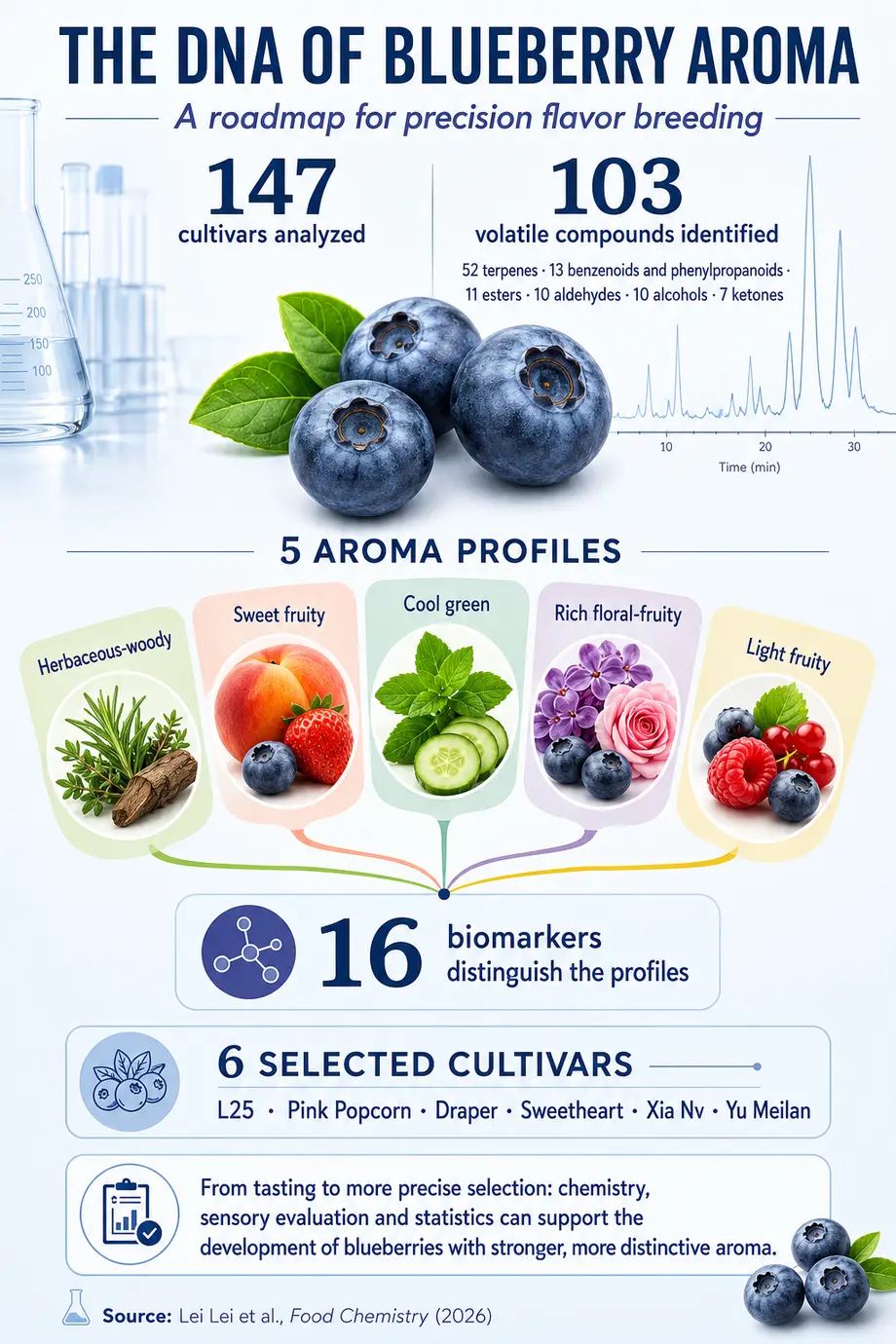
By analyzing 147 cultivars, a team of researchers identified 103 volatile compounds and five distinct aroma “chemotypes”. The findings could enable more targeted breeding of cultivars with intense and distinctive flavor.
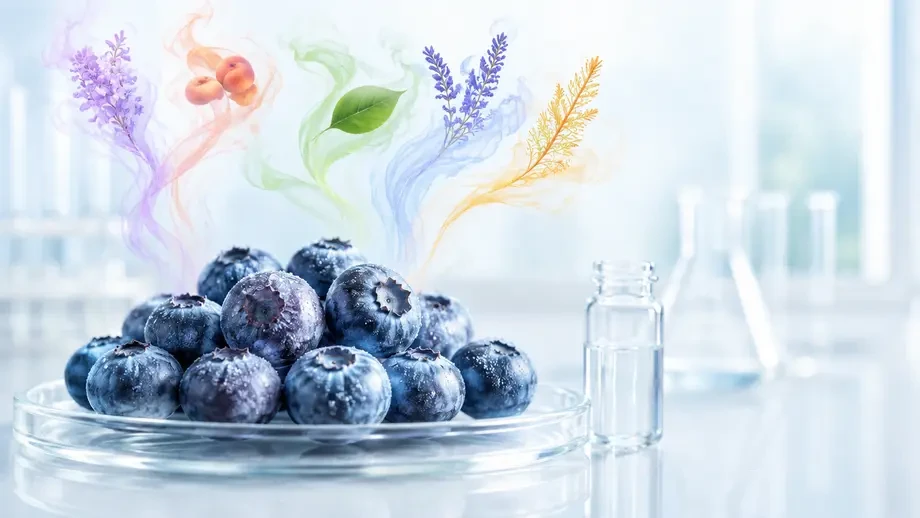
Not all blueberries have the same aroma. Some have predominantly herbaceous and woody notes, others express sweet and fruity aromas, while a third group is distinguished by a richer floral-fruity profile.
These differences, often perceived intuitively during tasting, have been described on a chemical and sensory basis in a study published in the journal Food Chemistry. The research examined 147 blueberry cultivars, one of the largest collections of cultivars analyzed to date for this purpose.
The study opens up interesting prospects for genetic improvement: identifying the compounds associated with the different aroma profiles could help breeders select parental resources for crosses with greater precision.
Flavor depends on more than sweetness and acidity
The perceived quality of a blueberry is often described through parameters such as Brix, acidity, firmness and size. Flavor, however, also depends on aroma, which is generated by numerous volatile compounds that reach the olfactory receptors during chewing.
These volatile organic compounds, known as VOCs, belong to different chemical classes and can produce floral, fruity, green, herbaceous, citrus or woody sensations. Their presence and concentration vary considerably among cultivars.
Environmental conditions, ripening and postharvest handling can also influence the fruit’s aroma profile, but genetic factors play a predominant role. For this reason, aroma is becoming an increasingly important trait in blueberry breeding programs.
147 cultivars analyzed
The collection examined in the study included 59 Northern Highbush, 57 Southern Highbush, 10 rabbiteye, nine lowbush and seven half-highbush cultivars, together with five new Northern Highbush cultivars developed by the research group.
The plants had been cultivated under standardized conditions for more than three years at a blueberry germplasm nursery in Dalian, China. This approach made it possible, as far as possible, to limit differences caused by the growing environment and to highlight genetic variation more clearly.
The researchers used HS-SPME-GC–MS, a technique that extracts the volatile compounds present in the headspace above the sample and subsequently separates and identifies them through gas chromatography–mass spectrometry.
103 volatile compounds identified
The analysis identified 103 volatile compounds:
- 52 terpenes;
- 13 benzenoids/phenylpropanoids;
- 11 esters;
- 10 aldehydes;
- 10 alcohols;
- seven ketones.
In quantitative terms, aldehydes were the most abundant chemical class. Their total content exhibited a 44.6-fold variation across the cultivars, demonstrating the extensive aroma diversity found within blueberry germplasm.
A high concentration, however, does not automatically mean a greater sensory impact. Some compounds can be perceived by humans even in very small quantities, whereas others must reach higher levels before they make a tangible contribution to aroma.
For this reason, the authors did not limit their work to measuring the compounds, but integrated the chemical data with sensory evaluation and relative odor activity values, which express the relationship between the concentration of a compound and the threshold at which its odor becomes perceptible.
The five blueberry aroma chemotypes
By combining statistical analyses, chemical data and sensory evaluation, the 147 cultivars were classified into five distinct aroma chemotypes. In this context, the term “chemotype” indicates a group of cultivars sharing a particular composition of volatile compounds.
- Herbaceous-woody: characterized by predominantly vegetal, herbaceous and woody sensations.
- Sweet fruity: associated with a sweeter and distinctly fruity aroma.
- Cool green: distinguished by green notes and a fresh aromatic sensation.
- Rich floral-fruity: the richest profile, with a pronounced combination of floral and fruity aromas.
- Light fruity: characterized by fruity sensations that are present but less intense.
This classification does not constitute an absolute quality ranking. A delicate, green or herbaceous profile could appeal to particular consumers or markets. The study does, however, provide a tool for describing more objectively differences that had previously been assessed primarily through the experience of sensory panelists.
Sixteen biomarkers for aroma discrimination
Among the 103 compounds detected, the researchers identified 16 volatile compounds capable of discriminating the five chemotypes. These compounds can be considered biomarkers of the different aroma profiles.
In the future, their analysis could allow germplasm to be classified more rapidly and help identify selections that are most consistent with a particular sensory objective.
For breeding, the advantage lies in moving from selection based solely on tasting to a system integrating sensory evaluation, chemical composition and statistical analysis. Tasting remains essential, but it can be supported by measurable and comparable indicators.
Six cultivars with superior aromatic quality
Using a PCA-based comprehensive evaluation model, the study also selected six cultivars considered particularly interesting for their aromatic quality.
The commercial cultivars identified were ‘L25’, ‘Pink Popcorn’, ‘Draper’ and ‘Sweetheart’, together with the two new cultivars ‘Xia Nv’ and ‘Yu Meilan’.
These materials should not automatically be interpreted as the “best-tasting blueberries” in absolute terms. The result relates to the criteria adopted in the study and to the collection analyzed. Instead, the six cultivars represent elite parental resources with direct potential for use in breeding programs focused on high-aroma cultivars.
Towards more precise flavor breeding
In recent years, blueberry breeding has focused on yield, fruit size, firmness, storage potential, climatic adaptation and suitability for mechanical harvesting. These are essential traits for the economic and commercial sustainability of the supply chain, but they do not, on their own, guarantee a satisfying consumer experience.
A visually perfect fruit that withstands distribution can still disappoint if its flavor is weak or lacks distinction. The possibility of classifying germplasm according to its “volatilome”, meaning the complete profile of its volatile compounds, therefore offers a new level of precision.
The next step will be to identify the genetic basis underlying the production of the most important compounds and to assess the stability of aroma profiles across different environments, developmental stages and postharvest conditions.
The study therefore does not provide an immediate formula for producing the ideal blueberry, but it does offer a more detailed map of aroma diversity. For breeders, this means being able to pursue not only larger, more productive and longer-lasting fruit, but also blueberries with more intense, distinctive and consistent flavor.
Italian Berry - All rights reserved