










How to overcome logistical and phytosanitary constraints to place surplus volumes in two demographic giants.
With global blueberry production projected to reach 3.4 million tonnes by 2029 and China beginning to position itself as an exporter, finding new markets has become an urgent strategic priority for leading international players.
In this context, highlighted by the recent IBO Report 2026, Brazil and India represent two markets with enormous potential that remains largely untapped.
The report (294 pages, in English) is available to download free of charge from the IBO website.
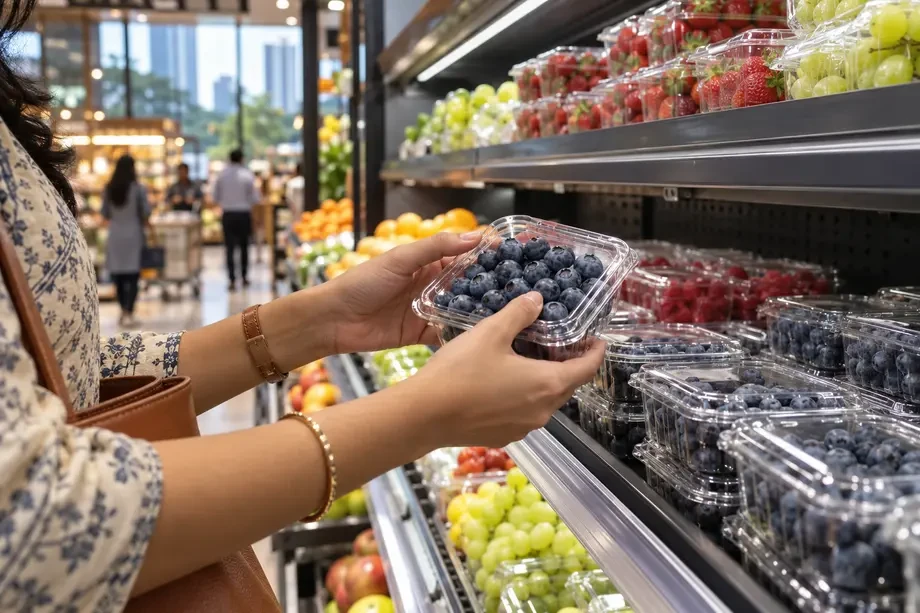
While their large populations and growing upper-middle classes could provide an outlet for surplus production from the Southern Hemisphere, exporters must navigate tariffs, strict phytosanitary protocols and gaps in cold-chain infrastructure.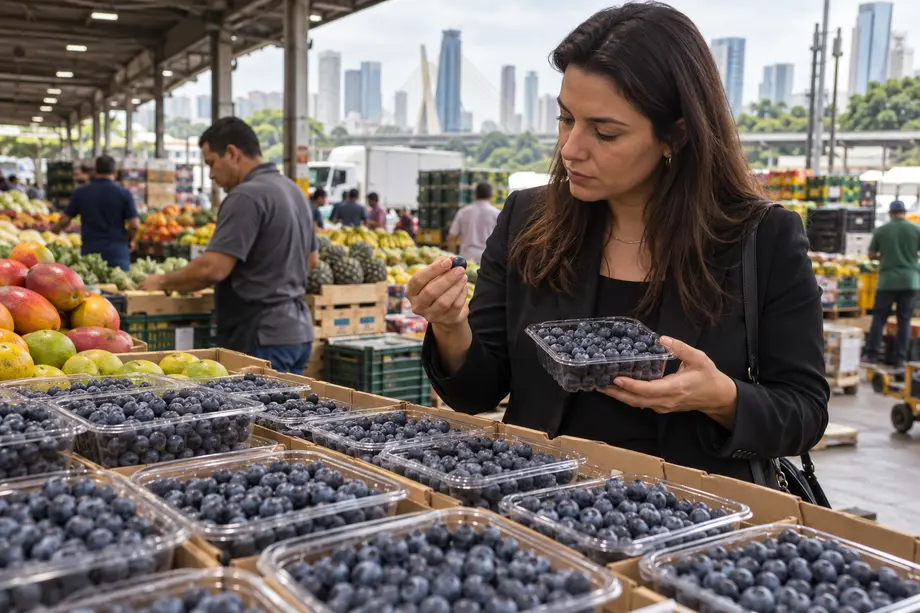
India: tariff changes and a surge in imports
India, now the world’s most populous country and one with a well-established snacking culture, is seeing rapid growth in demand for fresh blueberries, although per capita consumption remains extremely low.
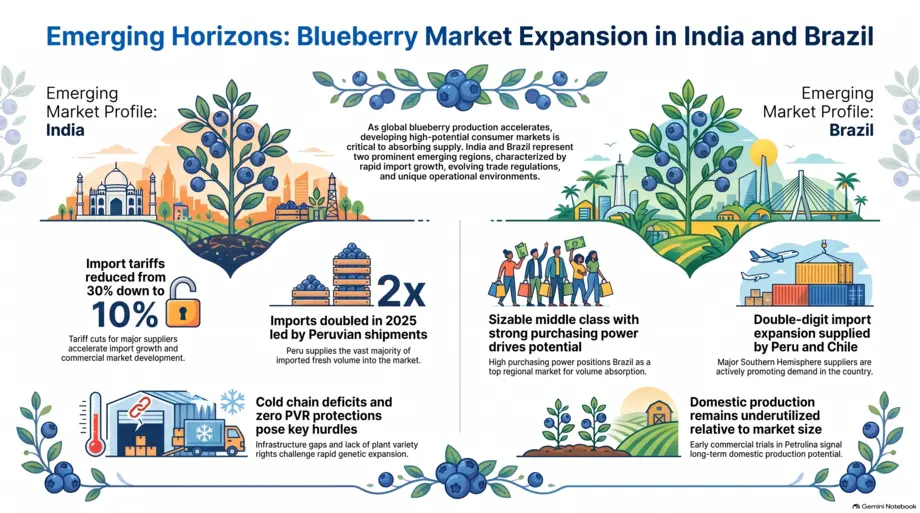
A key driver of this expansion has been the recent reduction in import duties on fresh blueberries from 30% to 10% for major suppliers in the Americas. This regulatory change has reduced the tariff protection enjoyed by domestic producers, encouraging trade and market development. Meanwhile, the free trade agreement (FTA) signed with Australia provides for tariffs to be phased out by 2028, which could encourage Australian producers to reopen this trade route.
The effects of these trade openings are reflected in the import figures:
- In 2025, India’s fresh blueberry imports almost doubled to 2,660 tonnes, compared with 1,350 tonnes in 2024 and 790 tonnes in 2023.
- Peru dominates India’s import market, shipping 2,260 tonnes in 2025.
- Other overseas suppliers include Chile (180 t), Tunisia (160 t), Poland — which recently secured approval for its export phytosanitary protocol — (30 t), the United States and Zimbabwe.
India’s challenges: phytosanitary protocols, the cold chain and gaps in PVR protection
Despite rising volumes, access to the Indian market presents major operational challenges:
- Strict phytosanitary protocols: Many exporting countries, including several in Southern Africa, are still working to establish direct market-access protocols. Australian shipments, for example, require cold treatment or methyl bromide fumigation unless the fruit comes from officially recognised fruit fly-free areas, such as Tasmania or the Riverland region.
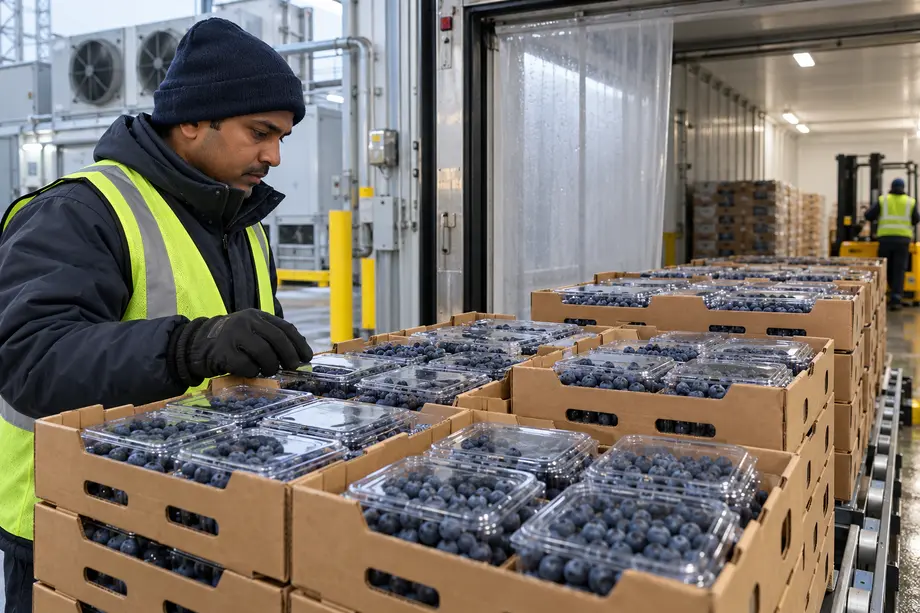
- Inadequate infrastructure and cold-chain capacity: India faces substantial logistical constraints. In major cities, no more than half of food retail outlets have refrigerated displays. Slow road transport and lengthy delivery times are prompting many new domestic production projects to locate close to major consumption centres such as Mumbai, Delhi and Bengaluru.
- Lack of plant variety rights (PVR) protection: Blueberries are currently not among the crops eligible for plant variety rights protection in India. The absence of a legal framework protecting proprietary varieties could slow the large-scale introduction of leading international genetics, although major international breeding companies have begun trials in suitable areas such as Ooty in Tamil Nadu, Kashmir and Himachal Pradesh.
- Pack size and price positioning: Blueberries remain a premium product, sold mainly in 125 g packs to middle- and higher-income consumers. India’s middle and affluent class is estimated at between one-fifth and one-quarter the size of China’s. Industry operators warn that an uncontrolled influx of poor-quality fruit could depress prices even for premium products.
Brazil: tapping into domestic purchasing power
In Latin America, Brazil is another demographic and economic giant worth watching. Despite being South America’s largest country, with a strong agricultural tradition and an upper-middle class with considerable purchasing power, its blueberry industry and domestic market remain well below their potential.
Major South American breeding and marketing companies are already active in Brazil, with plantings in Minas Gerais and cultivation trials around Petrolina, an area known for table grapes. Imports are also growing, supported by demand-building campaigns led mainly by Peru and Chile. Both countries aim to make Brazil an important outlet for South American fruit during peak production periods.
B2B implications and commercial outlook
For international exporters and breeders, placing volumes in Brazil and India requires structured market-entry strategies rather than simply shipping surplus containers:
- In India, the combination of domestic production — growing rapidly in areas such as Pune and northern India — and counter-seasonal imports from Peru is enabling some multinational companies to develop a 52-week supply programme.
- Overcoming market barriers will require more flexible phytosanitary protocols, shared investment in the cold chain and protective packaging suited to local temperatures.
As average import prices in mature European and North American markets show signs of pressure, the ability to establish effective distribution channels in India and Brazil will help determine which commercial players can manage the coming abundance of global supply profitably.
Italian Berry - All rights reserved