









The myfruit Berry Observatory, conducted yesterday, 16 September 2026, in the urban area of Bologna, confirms the picture seen in previous weeks: supply remains challenging, with limited availability and high prices.
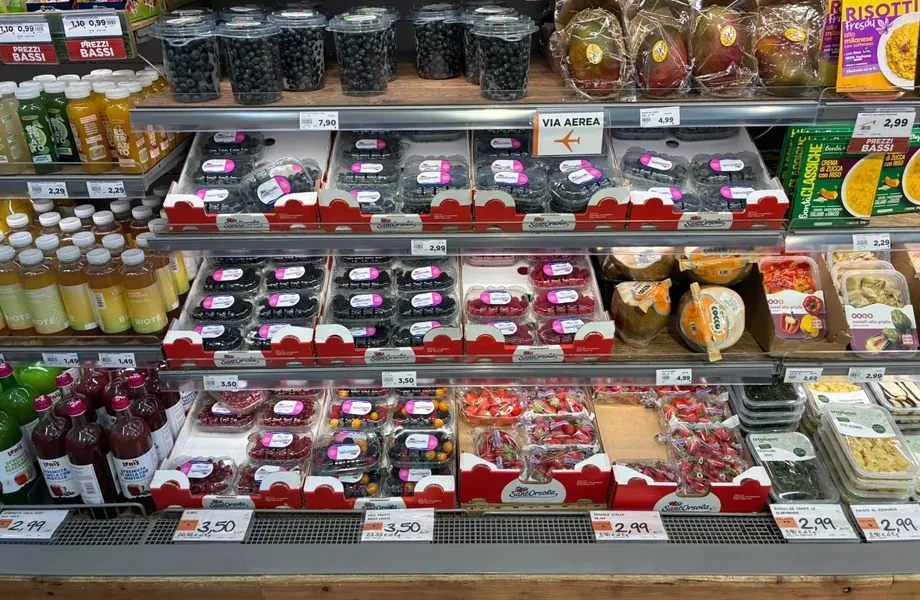
In the stores visited, the limited presence of products is also reflected in the space allocated to the category, with generally small displays and pack sizes that are almost always low in weight. Product turnover nevertheless remains good: the batches on display appear mostly fresh, with an estimated shelf presence of two or three days, partly because the more limited assortment available encourages faster turnover.
Quality standards remain positive. However, supply difficulties are leading to greater fragmentation of the offer: even limited quantities find space on shelves and, for the same product, four or five different brands may be displayed side by side.
This results in a highly diversified assortment in terms of brands and origins, but one that is not always easy for consumers to interpret. The clearest example is blueberries, which at this stage come from Argentina, Portugal, Peru, Italy, Poland and Romania. The presence of different origins and brands on the same shelf broadens the choice, but also creates a certain degree of confusion within the offer.
In Bologna and the surrounding area, 20 stores belonging to 20 retail banners and 12 large-scale retail groups were visited.
The assortments of stores belonging to the following banners were surveyed: Aldi, Alì, Carrefour Express, Carrefour Iper, Carrefour Market, Conad City, Conad Superstore, Coop, Despar, Dpiù, Esselunga, Eurospar, Eurospin, IN's, inCoop, Ipercoop, Lidl, Pam, Pam Local, Sigma.
Assortment and range breadth
In the stores visited, there were from a minimum of one to a maximum of six product references, with an average of 3.4 references per store. Specifically: 100% blueberries, 85% raspberries, 65% blackberries, 30% mixes, 20% redcurrants, 15% three-fruit mixes and 10% two-fruit mixes.
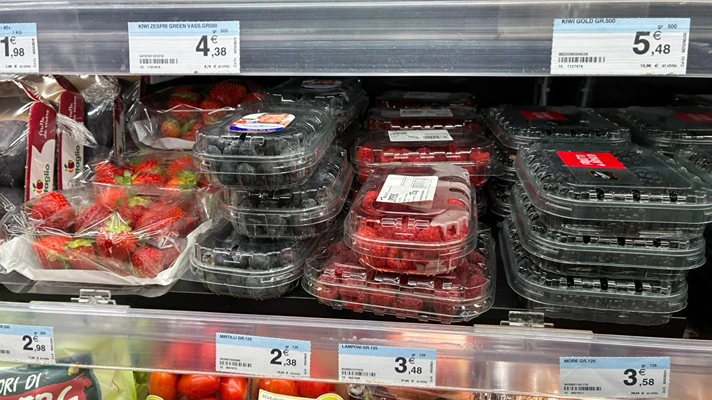
As regards range breadth, 5% of stores stock only one product reference; 50% stock 2 or 3 references, while the remaining 45% have 4 or more references on sale.
Quality
Quality refers to the condition of the product, measured in terms of: absence of significant defects; sound product but in less-than-ideal condition (not fresh, tired, shrivelled, dull, without bloom); presence of damaged fruit and juice leakage; presence of spoiled fruit and mould.
The groups with the best quality were: Aldi, Alì Supermercati, Gruppo Pam, Lidl, Selex, Sigma.
Retail prices
Raspberries (22 observations): min. €15.92/kg, max. €28.64/kg, average €25.07/kg
Blueberries (38 observations): min. €12.30/kg, max. €29.44/kg, average €19.42/kg
Blackberries (15 observations): min. €15.04/kg, max. €28.64/kg, average 24.94/kg
Redcurrants (4 observations): min. €15.92/kg, max. €28.00/kg, average €22.50/kg.
Three-fruit mixes (3 observations): min. €17.20/kg, max. €25.20/kg, average €21.89/kg
Overall total (82 observations): min. €12.30/kg, max. €29.44/kg, average €22.19/kg.
Brands
The stores visited featured berries from a total of 21 berry brands. The brand with the highest average prices in the category was Esselunga Bio. The brand with the lowest average blueberry prices was Dole Europe, followed by S-Budget.
Packaging
66% of the blueberry references surveyed are sold in packs with a net weight of 125 grams.
Italian Berry - Tutti i diritti riservati