





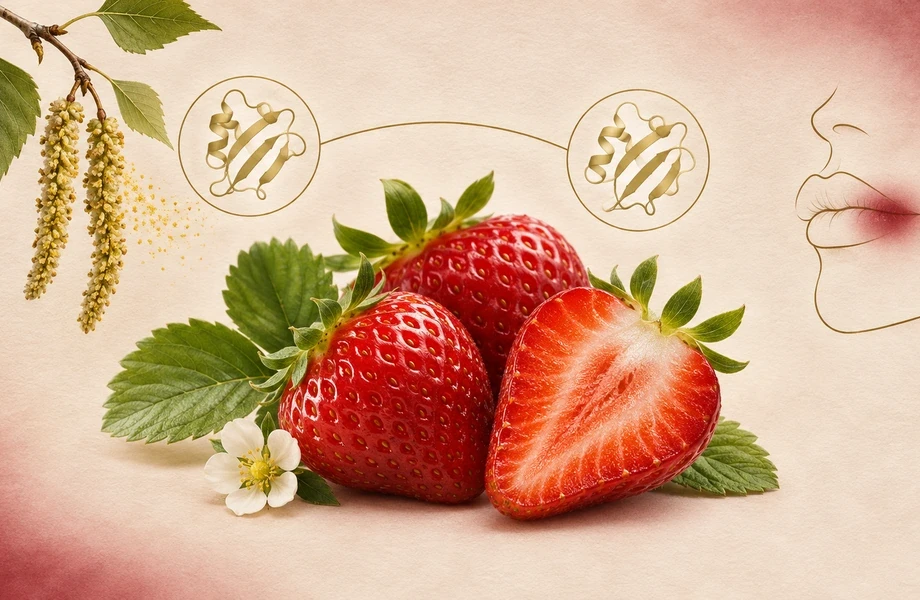
Itching after eating strawberries may be linked to pollen or sensitization to proteins in the fruit. Symptoms and clinical history help a doctor distinguish between possible causes.
Itching of the lips or palate after eating strawberries may immediately suggest an allergy. In some cases, the reaction is linked to pollen and occurs mainly with raw fruit; in others, it may be due to sensitization to strawberry proteins. Symptoms alone are not enough to distinguish the two conditions with certainty.
Strawberries are among the fruits that can trigger pollen-food syndrome, also known as oral allergy syndrome. Understanding what happens and which signs to look for can help people describe the episode to a doctor, without eliminating foods from their diet or testing themselves.
Why strawberries can cause itching in the mouth
Pollen-food syndrome is a cross-reactive allergic reaction: the immune system, already sensitized to certain pollens, recognizes some proteins in plant foods as similar. It is more common in people with seasonal allergic rhinitis and mainly affects raw fruit and vegetables. Strawberries are among the foods that can trigger it.
Symptoms usually appear shortly after eating the fruit and remain localized to the mouth, lips or throat: itching, tingling, redness or mild swelling. Sneezing, a runny nose or watery eyes may also occur. Cooking can alter some heat-sensitive proteins and reduce symptoms in people with pollen-food syndrome; however, this is not a diagnostic test and does not prove that the cooked product is safe for everyone.
The picture is not always so straightforward. A localized reaction is not enough to make a diagnosis, and a person may be sensitized to pollen without developing symptoms in response to every associated food. Moreover, although oral symptoms are often limited to the mouth, more extensive reactions are possible.
Oral allergy syndrome or strawberry allergy?
Pollen-food syndrome and primary strawberry allergy are both immune reactions, but they can involve different proteins and mechanisms. In the first, the reaction is linked to similarities between pollen allergens and proteins in the fruit. In primary strawberry allergy, sensitization involves proteins present in the strawberry.
Localized itching after eating raw fruit, especially in someone with a pollen allergy, is consistent with pollen-food syndrome. Widespread hives, extensive swelling, vomiting, persistent coughing, wheezing, difficulty breathing or swallowing, weakness or dizziness require particular attention. These signs do not by themselves identify the cause, but they may accompany more serious allergic reactions.
If respiratory symptoms occur or more than one part of the body is affected, emergency services should be called. If an adrenaline auto-injector has already been prescribed, follow the action plan agreed with the doctor.
No single symptom can always distinguish one condition from the other. The history of the episode matters: how much time passed between eating the fruit and the onset of symptoms, whether the strawberries were raw or cooked, which parts of the body were affected, whether the person has pollen allergies, and whether similar episodes have occurred before. The amount eaten and other factors may also contribute to the picture.
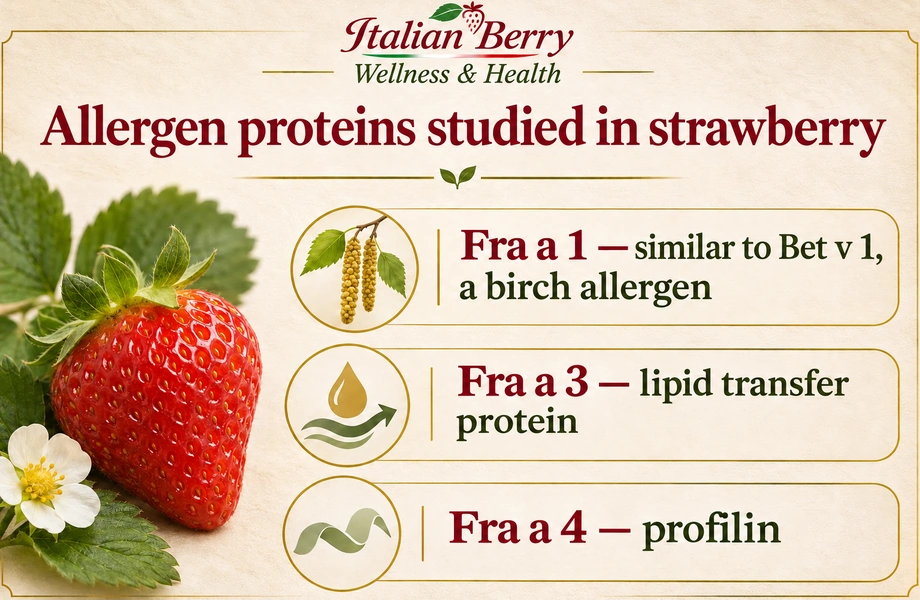
Strawberry allergen proteins
Research has identified several families of allergen proteins in strawberries. Fra a 1 is similar to Bet v 1, an important birch pollen protein, and may explain some cross-reactions. Other proteins, including the lipid transfer protein Fra a 3 and profilin Fra a 4, have also been studied in relation to strawberry reactions.
A molecular study published in 2020 analyzed the structure of the Fra a 1.02 allergen and its similarity to Bet v 1. It was laboratory research: it clarifies possible mechanisms but cannot determine, based on a strawberry’s color or variety, whether a particular fruit will cause a reaction.
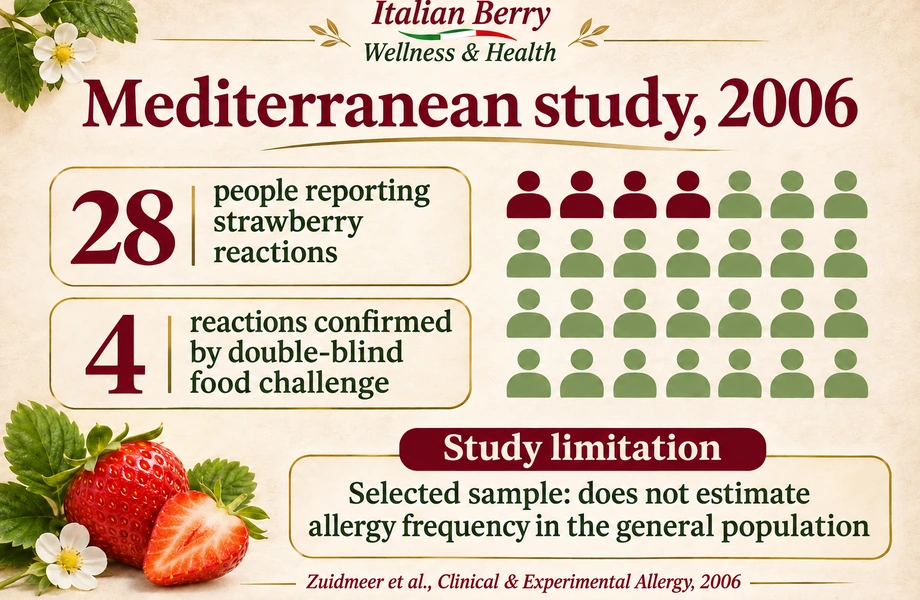
An earlier study conducted in the Mediterranean region examined patients who reported reactions to strawberries and sensitization to fruit allergens. Only four reported strawberry reactions were confirmed using a double-blind food challenge. The selected sample and its small size do not allow researchers to estimate how common strawberry allergy is in the general population.
These findings indicate that reactions can have different causes and that no single rule applies to everyone. Sensitization detected by a test, moreover, does not automatically mean clinical allergy: results must be interpreted alongside symptoms and individual history.
How a diagnosis is made
The European Academy of Allergy and Clinical Immunology guidelines recommend starting with a focused clinical history. Depending on the case, an allergist may request skin tests or blood tests to assess sensitization. These tests alone do not always confirm that the food causes symptoms in everyday life.
When the diagnosis remains uncertain, the reference standard is an oral food challenge performed under medical supervision. It should not be attempted at home: if a reaction is suspected, eating strawberries again to “check” may expose someone to a more serious episode. It is also not advisable to eliminate strawberries or other fruits from the diet for an extended period without consulting a professional: suspicion is not the same as a diagnosis.
What to do after a reaction to strawberries
Writing down what was eaten, in what form, and which symptoms occurred may be useful during a medical appointment. It is advisable to discuss the episode with a doctor, especially if the reaction recurs, affects more than one part of the body, also occurs with cooked strawberries or involves other foods.
The most cautious message is simple: itching after eating strawberries does not automatically prove primary strawberry allergy, but it should not be ignored or tested through self-experimentation. A clinical assessment can distinguish pollen-food syndrome from other reactions and determine whether tests or specific precautions are needed.
🫐 Well-being & Health with Berries 🍓This article is part of the editorial series Wellness & Health with Berries, which brings scientific research closer to everyday life, promoting berries as allies for well-being. The series offers clear, up-to-date, and evidence-based content designed to inform consumers and support all operators in the berry supply chain. |
Sources:
- Santos AF et al., “EAACI guidelines on the diagnosis of IgE-mediated food allergy”, Allergy, 2023;78(12):3057–3076. DOI: 10.1111/all.15902. PMID: 37815205.
- Orozco-Navarrete B et al., “Structural Bases for the Allergenicity of Fra a 1.02 in Strawberry Fruits”, Journal of Agricultural and Food Chemistry, 2020;68(39):10951–10961. DOI: 10.1021/acs.jafc.9b05714.
- Zuidmeer L et al., “The role of profilin and lipid transfer protein in strawberry allergy in the Mediterranean area”, Clinical & Experimental Allergy, 2006;36(5):666–675. DOI: 10.1111/j.1365-2222.2006.02453.x. PMID: 16650053.
- Guy’s and St Thomas’ NHS Foundation Trust, “Pollen food syndrome”, clinical information resource, reviewed November 2024.
Italian Berry - All rights reserved