





The process of consolidation in the Dutch strawberry industry is taking another step forward. Royal Berry has announced that, as of January 1, 2027, it will acquire Dutch Berries, based in Zuilichem, creating an organization with a total production area of 110 hectares.
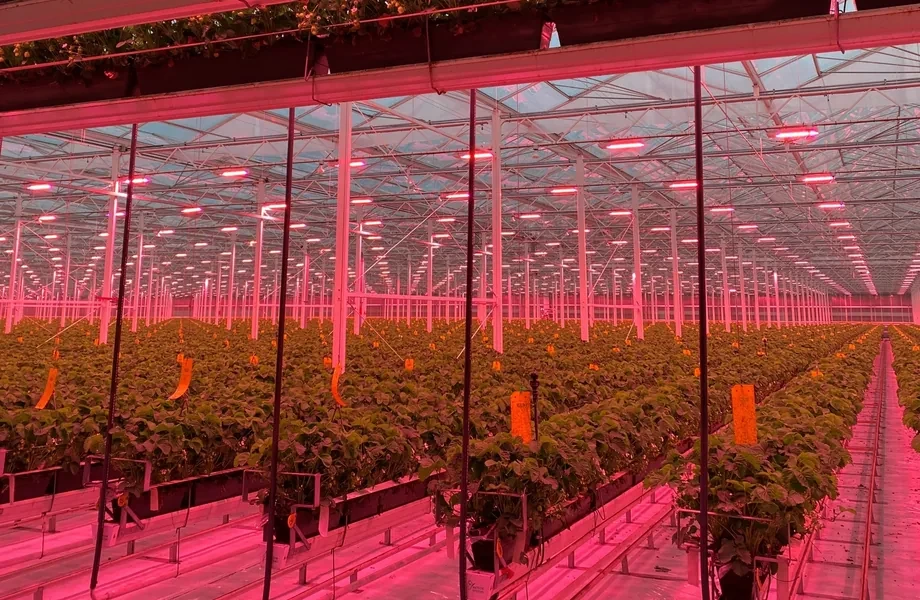
Of these, 47 hectares will be equipped with LED lighting, a technology that makes it possible to schedule the production of strawberries throughout the year. The deal is taking place in a sector increasingly focused on company scale, innovation and continuity of supply.
Dutch strawberry production expands and consolidates
The decision to bring together Royal Berry and Dutch Berries reflects the ongoing changes in Dutch greenhouse production of strawberries.
“Dutch strawberry production continues to consolidate. Today, the top ten greenhouse growers account for more than half of the country’s total area devoted to strawberries grown under glass,” Cindy notes.
Alongside the consolidation of companies, the total area devoted to this crop also continues to increase. This expansion is taking place despite the particularly high initial investments required for protected structures and the related technologies.
“Despite the significant initial investment, greenhouse-grown strawberries are gaining market share thanks to more predictable production and quality, as well as more effective and sustainable management of pests and diseases,” Cindy emphasizes.
According to her analysis, this trend highlights the growing professionalization of the Dutch sector, driven by the need to ensure greater uniformity, efficiency and sustainability.
Scale and innovation to address new challenges
The acquisition is based on the belief that the main developments within the sector require more structured organizations and greater investment capacity.
Sustainability, varietal selection and availability, new cultivation concepts, automation, artificial intelligence and robotics are profoundly changing the way strawberries are produced.
Royal Berry and Dutch Berries intend to address these challenges together, creating a structure capable of seizing future opportunities.
The Royal Berry management team expressed its appreciation for the founder of Dutch Berries, recognizing his role in the development of the company.
“We have enormous respect for what Gijsbert has built, and we look forward to continuing to develop this strong foundation together,” said Jan van Genderen, CEO of Royal Berry.
Thanks to years of commitment, entrepreneurial vision and management continuity, Dutch Berries has become an established company and a benchmark within the sector.
The new management structure
Following the completion of the acquisition, Boudewijn van der Wal will join the Royal Berry management team alongside Jan van Genderen, CEO, and Erik Gerichhausen, COO.
Van der Wal will also continue to be directly involved in the activities of Dutch Berries, while Gijsbert Kreling will focus on other initiatives within the GK Group.
Royal Berry explained that the two teams will work to build a single organization, placing quality, innovation and sustainability at the center of their activities.
“The acquisition marks the beginning of a new chapter, in which both teams will work together to support future growth and build a successful path,” the company said in a statement.
A new balance for the strawberry sector
The future organization covering 110 hectares, including 47 hectares equipped with LED lighting, represents a concrete example of the direction being taken by the Dutch strawberry industry.
The expansion of protected cultivation areas is progressing alongside production consolidation and the adoption of technologies capable of improving scheduling, quality and plant health management.
In this context, the integration of Royal Berry and Dutch Berries aims to create the critical mass needed to invest, innovate and ensure more stable production throughout the year.
The deal therefore confirms that the future of Dutch strawberries is increasingly linked to the ability of companies to combine scale, production efficiency and sustainability.
Source: www.hortidaily.com
Image source: Royal Berry