






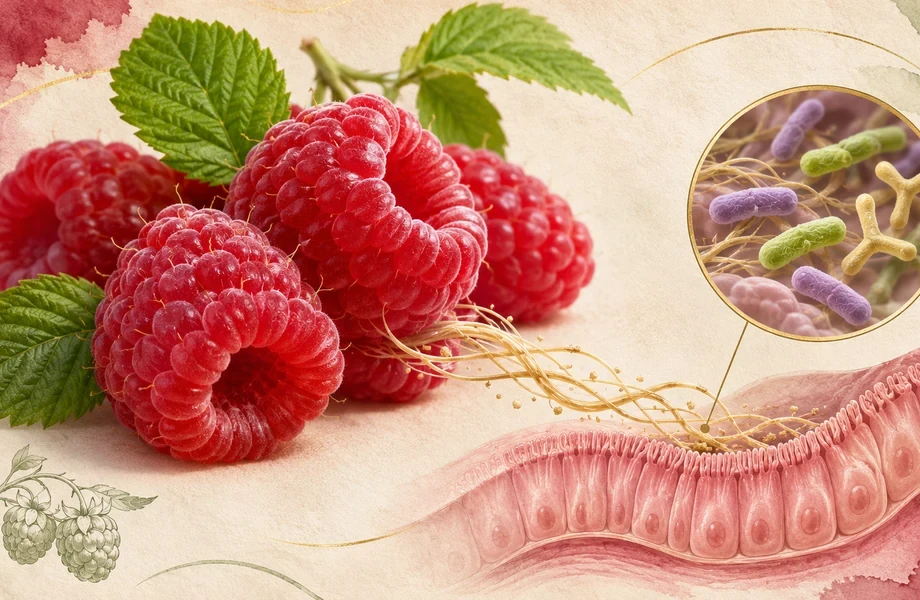
A new analysis explores the link between the gut microbiome and individual metabolic responses to raspberry consumption. The findings are preliminary and do not show the same effect in everyone.
Raspberries are valued for their fibre and phenolic compounds, but nutrition studies often find different responses from one person to another. A new analysis of the gut microbiome, published in 2026, examined whether certain characteristics of gut bacteria could help explain this variability.
The research does not show that raspberries improve metabolic health in everyone, or that the microbiome alone determines the response. Instead, it offers a clue: differences in the functional capacities of gut microorganisms may be associated with different responses to a dietary intervention.
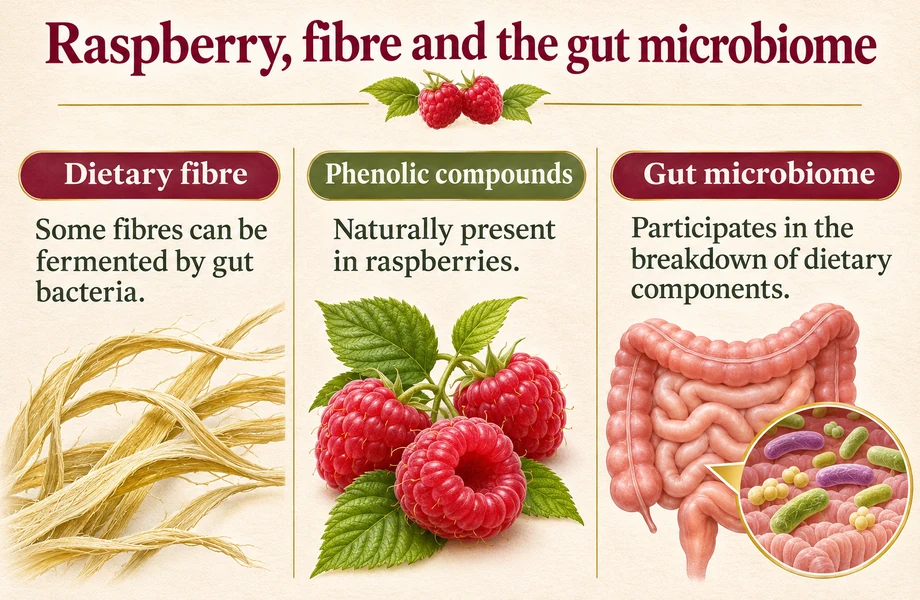
Why raspberries and the gut microbiome are at the centre of the research
The gut microbiome is the community of microorganisms that live in the intestine. These bacteria help transform dietary components, including some fibres that the human body cannot digest on its own. The products of this fermentation can interact with metabolic and immune processes, but the relationship is complex and depends on several factors.
To describe these functions, the authors analysed CAZymes, enzymes encoded by microorganisms that help break down carbohydrates and components of plant cell walls. The presence of the genes that encode these enzymes indicates functional potential: it does not directly measure enzyme activity or prove that a specific reaction takes place in the body.
How the raspberry study was conducted
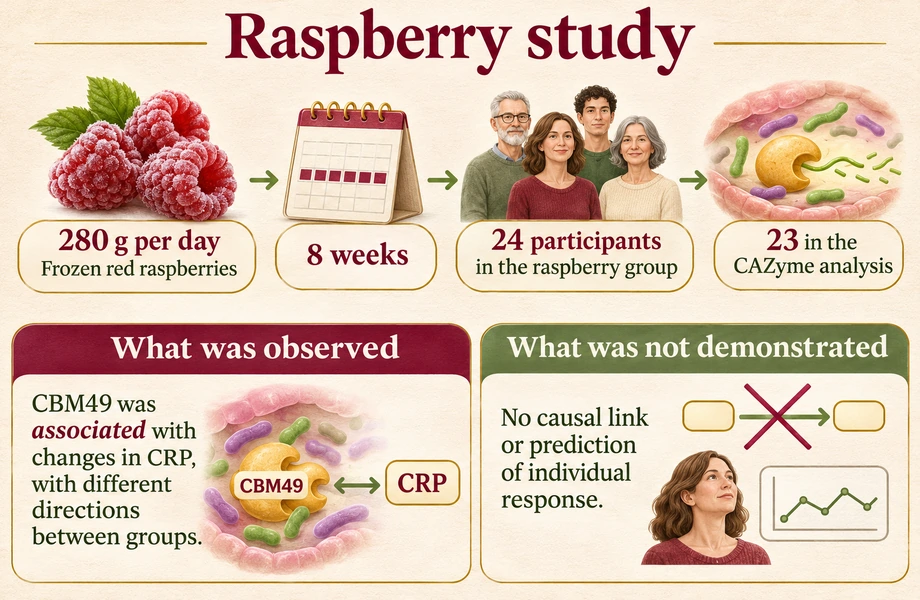
The 2026 analysis used samples previously collected in a randomised trial conducted in Québec. In the original study, 59 adults with overweight or abdominal obesity and certain indicators of metabolic risk were assigned to two groups: one consumed 280 grams of frozen red raspberries per day for eight weeks, while the other maintained their usual diet. The new analysis focused on the 24 participants in the raspberry group, comparing faecal samples and metabolic data collected before and after the intervention.
An earlier analysis of the data had divided these participants into two profiles, defined as “responders” (13 people) and “non-responders” (11), based on differences in blood gene expression. The first group showed decreases in C-reactive protein (CRP), triglycerides and total cholesterol compared with the second. One participant was excluded from the detailed analysis of microbial genes because clinical data were missing, leaving 23 people.
What the microbiome results suggest
The researchers identified differences in some CAZymes between the groups, as well as associations between levels of certain microbial genes at the start of the study and changes in CRP over the eight weeks. For example, higher baseline levels of an enzyme family known as CBM49 were associated with a decrease in CRP in the responder group, while the relationship went in the opposite direction in the non-responder group.
The finding suggests that the microbiome’s functional profile before the intervention may be linked to individual responses. However, it does not show that CBM49 causes a reduction in inflammation or can predict who will benefit from eating raspberries. The authors did not directly measure enzyme activity or the products generated by its action.
The findings on triglycerides and cholesterol also require caution: in the CAZyme analysis, the statistically significant associations concerned CRP, not these two measures. The link with triglycerides and cholesterol comes from earlier analyses of the participants and was not directly explained by the new microbiome data.
The overall evidence remains uncertain
In the original randomised trial, daily raspberry consumption did not produce significant differences between the groups in blood glucose, insulin, inflammatory markers or blood pressure. Subsequent analyses explored possible individual responses, but they were secondary and based on small numbers; they do not overturn the trial’s main result.
Another exploratory analysis of the same intervention examined TMAO, a metabolite found in the blood. Of the 24 participants who consumed raspberries, 17 were included in the analysis. The researchers observed associations between certain gut bacteria and changes in TMAO. These findings also concern a small subgroup and do not provide independent confirmation: they come from the same trial.
Limitations and future research
The 2026 analysis is exploratory and has a small sample size. The authors note that the regression analyses were not adjusted for multiple comparisons, increasing the risk of chance findings. In addition, the responder group was defined through statistical analyses of the data and is not a validated clinical category. The study received funding from the Washington Red Raspberry Council; the authors declared no conflicts of interest.
The amount used — 280 grams of frozen raspberries per day — was part of the research protocol and is not a recommended dose. Larger, independent studies designed in advance are needed to determine whether microbiome characteristics can predict metabolic responses and to distinguish an association from a causal mechanism.
What this means for people who eat berries
For now, these findings do not justify choosing raspberries based on a person’s microbiome or expecting a measurable effect on blood glucose or cholesterol. The value of this research lies mainly in showing how complex responses to food can be and why the same intervention may produce different outcomes.
Raspberries can still be part of a varied diet alongside other fruits, vegetables, legumes and whole grains. Current evidence does not suggest that any single food can replace a balanced diet or prescribed treatment. The microbiome may help explain individual differences, but its role in responses to raspberries still needs to be confirmed.
🫐 Well-being & Health with Berries 🍓This article is part of the editorial series Wellness & Health with Berries, which brings scientific research closer to everyday life, promoting berries as allies for well-being. The series offers clear, up-to-date, and evidence-based content designed to inform consumers and support all operators in the berry supply chain. |
Sources:
- Barbe V. et al., “Functional gut microbiome signatures underlying interindividual variability in metabolic responses to red raspberry consumption”, Scientific Reports, 2026, 16, 10685. DOI: 10.1038/s41598-026-45955-7.
- Franck M. et al., “Effects of Daily Raspberry Consumption on Immune-Metabolic Health in Subjects at Risk of Metabolic Syndrome: A Randomized Controlled Trial”, Nutrients, 2020, 12(12), 3858. DOI: 10.3390/nu12123858.
- Franck M. et al., “Raspberry consumption: identification of distinct immune-metabolic response profiles by whole blood transcriptome profiling”, Journal of Nutritional Biochemistry, 2022, 106, 109035. DOI: 10.1016/j.jnutbio.2022.109035.
- Franck M. et al., “Gut Microbial Signatures of Distinct Trimethylamine N-Oxide Response to Raspberry Consumption”, Nutrients, 2022, 14(8), 1656. DOI: 10.3390/nu14081656.
Italian Berry - All rights reserved