




Cost or investment? Measuring the return of pollination in Mediterranean Europe and North Africa.
When a grower receives the invoice for pollination, the cost is clear. The return is harder to see. How much fruit would we have lost without those colonies? Were the bees working when the flowers needed them? For autumn and winter berries in Mediterranean Europe and North Africa, these questions matter even more: we can plan a crop to flower out of season, but the flowers, the pollen and the insects still have to work together in that period. Some growers see pollination as an investment, others as another cost. Before asking a grower to spend more, we should be able to explain where pollination is falling short and how we could improve it.
A colony cost tells only part of the story
Counting colonies and arrival dates tells us what we bought, not how many flowers received enough pollen. The return appears as heavier fruit, better shape or fewer rejects, and by harvest it is mixed with variety, weather and management. In Huelva, extra bumblebee colonies in ‘Fortuna’ strawberry increased flower visits, especially in winter, but not fruit weight (Trillo et al., 2018). In English tunnels, commercial bumblebees raised high-grade fruit by 25% in ‘Malling Centenary’ but gave no detectable benefit in ‘Flair’ or the everbearer (Martin et al., 2019). A grower can lose money with too little pollination, and also by paying for colonies where the service is already sufficient.
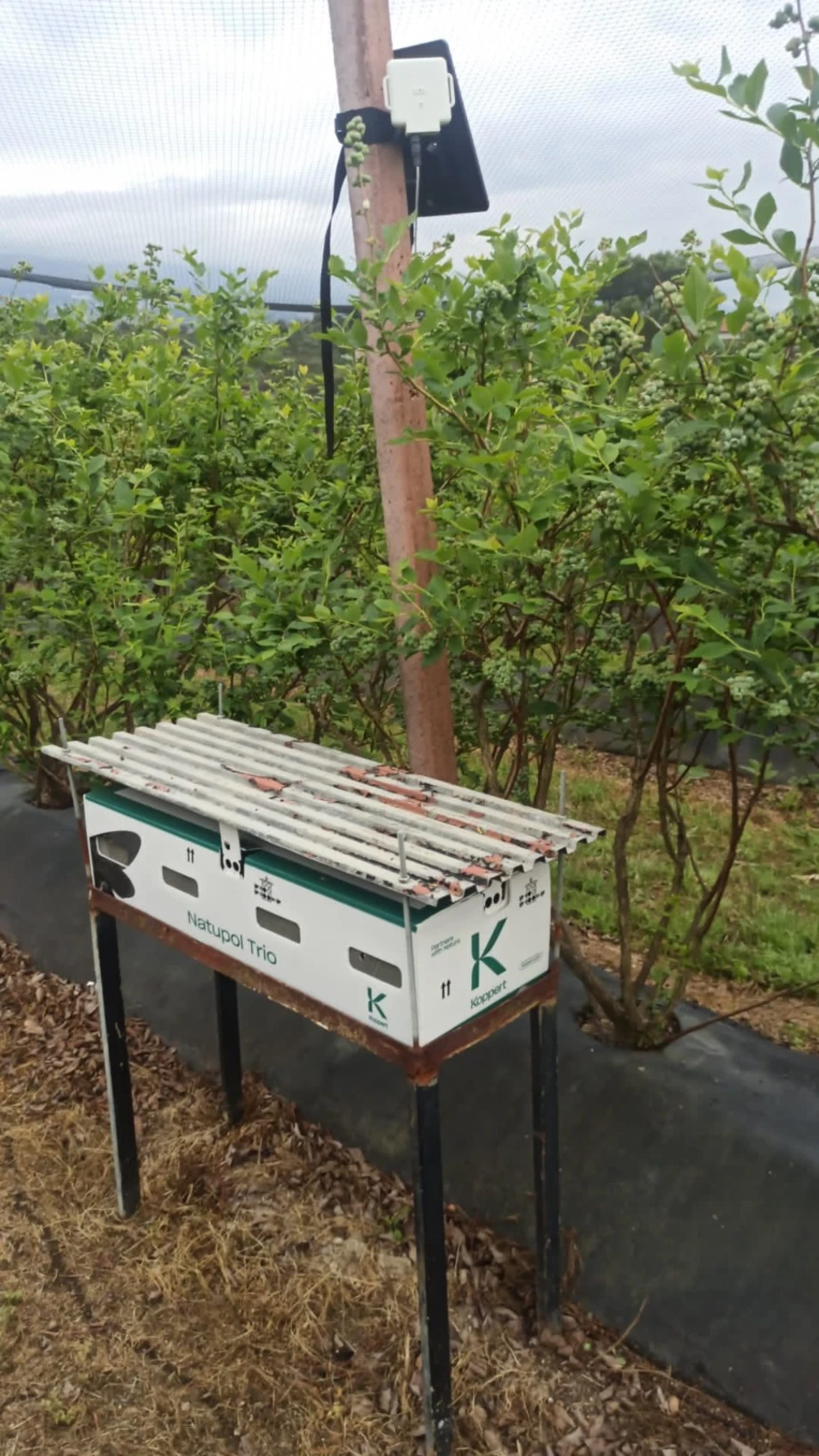 Figure 1. Bumblebee colonies and monitoring equipment in a netted blueberry crop. Colony presence is the starting point; activity and flower visits still need checking. Source: Hortitool Consulting R&D.
Winter affects the flower as well as the bee
Cold mornings, short days and unsettled weather reduce foraging time. But a misshapen berry does not automatically mean too few visits. In strawberry, short exposure to low night temperatures reduced pollen quality and increased malformation, depending on variety and flower stage, even before the petals appeared (Cui et al., 2021). The defect may show weeks later, and adding colonies then will not repair the flower. We need to look back at the weather during flower development, as well as the visits during flowering. Flower traits matter too. In Portugal, flower shape influenced visitor behaviour across 19 blueberry cultivars (Castro, Branco, et al., 2026), and water deficit reduced nectar, visits and fruit set in ‘Duke’ and ‘Bluecrop’ (Castro, Barman, et al., 2026). In strawberry grown under heat, floral scent was no longer detectable (Cordeiro & Dötterl, 2023).
The plastic is part of the pollination system
Covers change temperature, humidity, wind and light, so the choice of plastic is also a pollination decision (Kendall et al., 2021). In Australian polytunnels, the warmer and less ventilated centre had fewer pollinators, and blueberry yield and berry weight were lower there than at the ends (Hall et al., 2020).
Bees use ultraviolet light to orient. Under glass and UV-transmitting acrylic, honeybees and bumblebees oriented normally; under polycarbonate, which blocks most ultraviolet, they flew in loops, were trapped at the vents and rarely returned to the hive (Blacquière et al., 2006). In commercial greenhouses, bumblebees made about twice as many trips per day under UV-transmitting plastic (Morandin et al., 2001, as cited in Dyer & Chittka, 2004). Under UV-blocking covers, bright vent openings can also act as light traps and increase bee losses (Kendall et al., 2021). The evidence is not uniform, and UV-blocking films also have benefits, such as fewer thrips in strawberry flowers (Fountain et al., 2023). Before buying film, ask the supplier for the light transmission curve, including the ultraviolet range and diffusion.
Nets add another layer. On Australian blueberry farms, hives under nets lost weight and pollen stores, and bees left anti-hail netting successfully far less often than anti-bird netting (Sonter et al., 2024). In winter, a cover can help by keeping the crop warmer, because honeybees rarely fly below about 12 to 13 °C while bumblebees work at much lower temperatures, but on a sunny day the same tunnel can overheat (Kendall et al., 2021). In practice, open tunnel ends and sides during flowering when the weather allows, place honeybee colonies near the ends and shade the hives (DeVetter et al., 2025). Where the tunnel centre is poorly visited, check temperature, ventilation and the film before adding colonies.
Raspberry gives us visible clues
Gaps between drupelets and crumbly fruit can come from poor pollination, but also from flower injury and other crop problems. Late in flowering, flower numbers and alternative food sources change, which can create a shortage of visits or concentrate visits on the remaining flowers. Uncollected nectar and fungal growth need separate checks: in one California case, Cladosporium in a dark, humid tunnel was not explained by poor visits (Bolda, 2020, 2026).
Plan the colonies before the season
Hannelie Human links pollination fees to colony strength, placement under nets and replacement during long flowering, and uses hive acoustics and thermal imaging to check colony condition (Human, 2022). The service needs checking after delivery, not only on arrival.
She also recommends budgeting hive numbers before flowering, agreeing them in a contract with the beekeeper, and having enough hives ready without re-using hives (Human, 2024, personal communication). In her example (Figure 2C), density rises from 2 to 5 hives per hectare as flowering builds and returns to 2 at the end. For a short-flowering southern highbush, the first honeybee hives go in at 5 to 15% open flowers, the full number is in place at 60 to 80% bloom, and hives leave quickly after petal fall to limit disease and exposure to sprays (Figure 2A).
Bumblebee colonies are usually placed all at once at about 5 to 10% bloom (Biobest, 2025). Varieties that flower for months, as many low-chill and evergreen blueberries do in autumn and winter, need overlapping sets, because a colony works in the crop for roughly 6 to 12 weeks (Northeast SARE, n.d.; Figure 2B). Orders may need 14 to 16 weeks’ notice (Johnson, 2022), so the pollination calendar belongs in the crop plan.
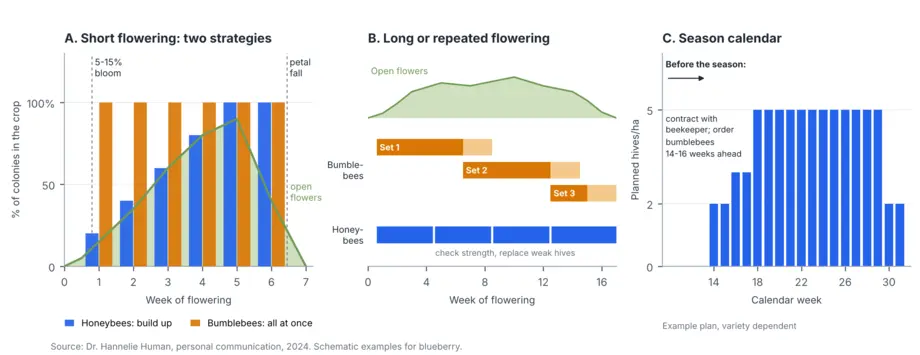 Figure 2. Planning pollination in blueberry: (A) short flowering, honeybee hives built up versus bumblebee colonies placed all at once; (B) long flowering, overlapping bumblebee sets and honeybee hives checked and replaced; (C) example season calendar. Schematic; dates and numbers depend on variety, block and colony strength. Sources: Human (2024, personal communication); Biobest (2025); Northeast SARE (n.d.); Johnson (2022).
Measure the gap before choosing the solution
Compare tagged flowers with normal visits against similar flowers given extra pollen by hand, across plants, positions and dates, and follow both to harvest (Vaissière et al., 2011). Record fruit set, weight, shape and rejects, and calculate marketable fruit weight per tagged flower, counting failures as zero. If extra pollen repeatedly improves the result, there is a pollination gap. If not, look at the flower and other limitations before adding colonies.
Count open flowers and visits at fixed points near tunnel entrances, in the centre and in problem areas, at different times of day and through successive flushes. Visits per flower say more than a bee count. Dependence on bees and a shortage of pollination are different questions, and the value of pollination depends on whether we count all fruit or only marketable fruit (Ryan et al., 2023). Wild bumblebees and honeybees can also complement each other (Miñarro & García, 2021).
What acoustics can tell us
Acoustic sensors follow insect activity when nobody is in the crop and point to periods or places that deserve a closer look. NIAB combined acoustic detection with lures in strawberry and reported heavier fruit near the lures in early assessments (NIAB, n.d.; Arnold, 2024). AgriSound’s Polly detects the flight signatures of pollinator groups (AgriSound, n.d.), but a detection is not a flower visit, and a visit may not transfer enough pollen. For practical use, compare sensor records with direct observations at the same place and time, and record flower density, weather, sensor position and farm operations.
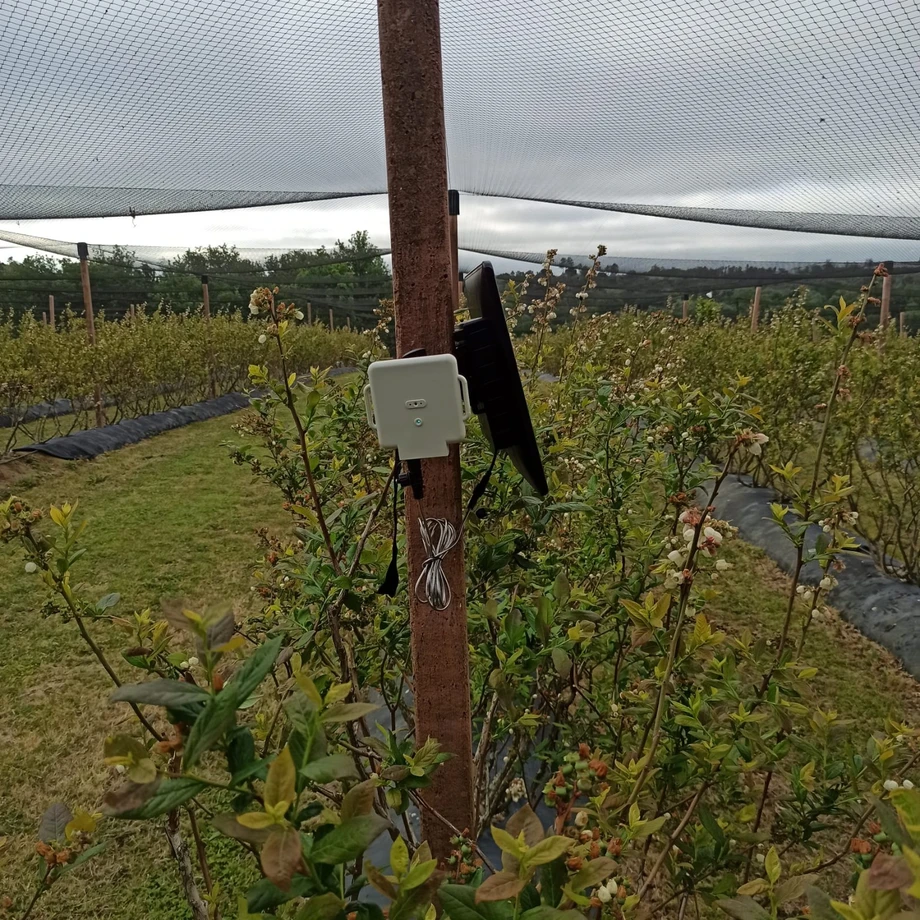 Figure 3. Acoustic sensor (AgriSound Polly) under test among flowering blueberry plants in a Hortitool Consulting R&D trial. Source: Hortitool Consulting R&D.
Figure 4 shows a season of acoustic records. Honeybee activity peaked in June and again in late August, and the bumblebee record stops in late August. Each change is a prompt to check colony records, open flowers and farm operations for the same dates. A low-activity signal should lead to an inspection, not a diagnosis. If the records identify a poorly served section of a tunnel, we can investigate access, colony position or the local environment, then measure the response at harvest.
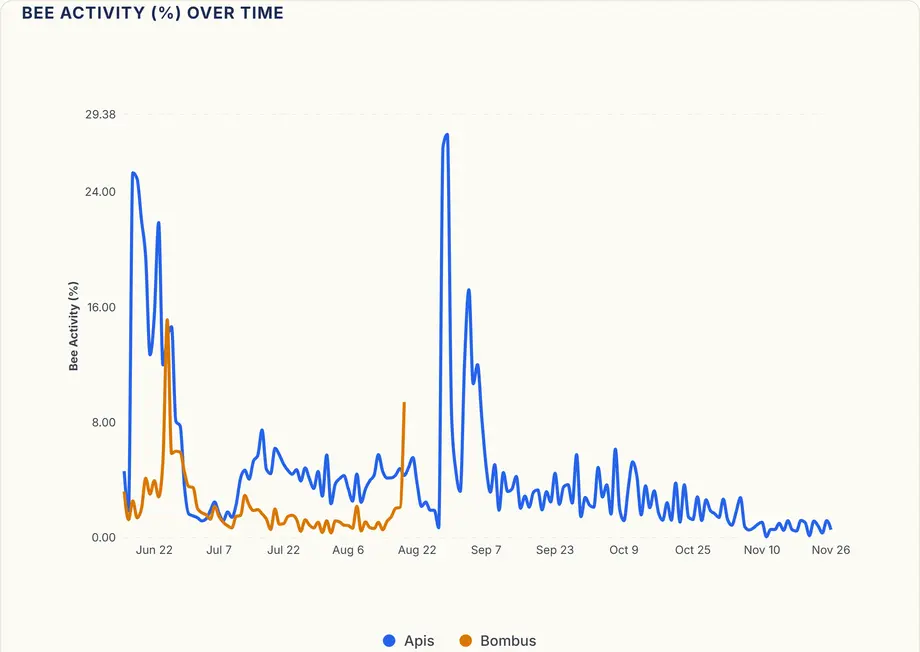 Figure 4. Bee activity (%) from acoustic monitoring, honeybee (Apis) and bumblebee (Bombus) signals, 15 June to 26 November 2026. Flower visits and fruit response still need checking at the same place and time. Source: Agrisound Polly/Hortitool Consulting R&D.
Helping bees find the crop
Bees learn to associate floral scents with food. Apple and pear trials showed that feeding crop-like scents inside colonies can bias honeybee foraging (Farina et al., 2022). Beeflow’s ToBEE uses this principle, placing crop-related scents in colony food. The company also describes nutritional technology intended to support activity in cool conditions, and the two mechanisms should be assessed separately (Beeflow, n.d.). In Washington State, Beeflow-treated blueberry sites had more visits in ‘Liberty’ but not in ‘Duke’, and higher berry weight in both years, with no effect on fruit set (DeVetter, 2023). This was extension reporting, and it did not isolate scent learning.
Other products place the cue in the crop. PheroSyn is developing lures for strawberry tunnels with NIAB (PheroSyn, n.d.), and Biopolin (ICB Pharma, n.d.) and APIS BLOOM (ISCA, n.d.) are field attractants with supplier-reported results. Not every attractant works: Polynate and SPLAT Bloom gave no increase in visits or fruit set in apple, blueberry and cherry over three seasons (Williamson et al., 2018). A scent treatment is worth testing where attraction or distribution is the limitation, not where colonies are weak or flowers are poor.
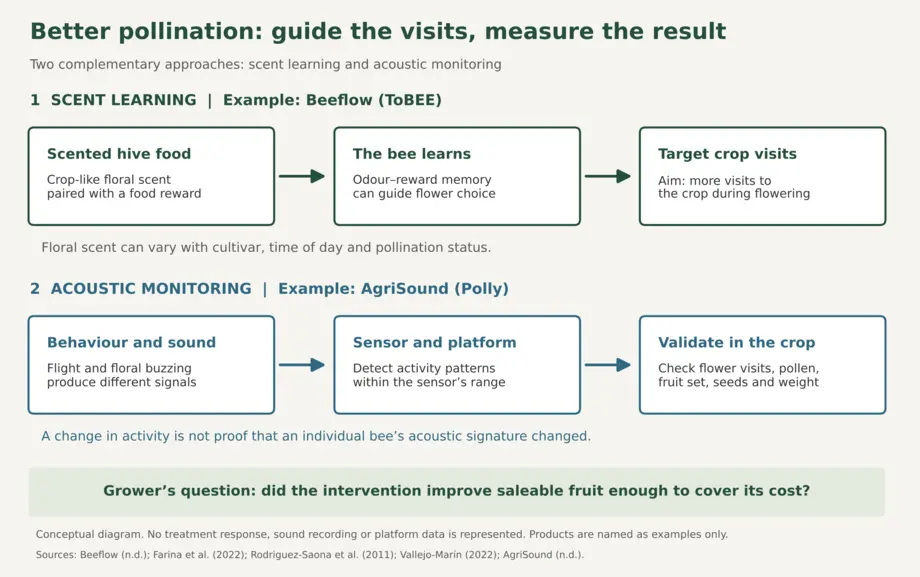 Figure 5. Scent learning (example: Beeflow) and acoustic monitoring (example: AgriSound): guide visits, check pollination in the crop and measure the return. Conceptual diagram.
Bring the result back to the farm accounts
Match the response to the problem. Fewer visits in the tunnel centre call for checks on distribution and the cover before adding colonies; visits without good fruit call for checks on the flowers and pollen. When testing a change, keep comparable areas, repeat observations and record colony strength, replacements and costs.
The calculation can be simple. If a change costs an extra €600 per hectare and each additional kilogram of marketable fruit contributes €2 after the extra costs, we need 300 kg more per hectare. This is an illustration; each farm must use its own figures.
That is the discussion I would like to have with growers. Where was pollination insufficient? What did we change? What happened to the fruit? Did the extra value cover the cost? Research and new technologies can help answer these questions, and their value is strongest when we connect what happens around the flower with what we harvest and sell. Then the grower has a clearer reason to invest, and a clearer reason not to spend where no extra benefit is needed.
References
AgriSound. (n.d.). Hardware & infrastructure. https://agrisound.io/products/hardware
Arnold, S. E. J. (2024). Improving bee management and precision pollination in soft fruit [Presentation]. In NIAB Soft Fruit Technical Webinar 2024. https://www.niab.com/sites/default/files/imce_uploads/PressOffice/Final%20Presentation%20v2-compressed.pdf
Beeflow. (n.d.). Technologies. https://beeflow.com/technologies
Biobest. (2025, March 31). Boost blueberry and raspberry yields with bumblebees. https://www.biobest.com/news/boost-blueberry-and-raspberry-yields-with-bumblebees
Blacquière, T., van der Aa-Furnée, J., Cornelissen, B., & Donders, J. (2006). Behaviour of honey bees and bumble bees beneath three different greenhouse claddings. Proceedings of the Netherlands Entomological Society Meeting, 17, 93–102. https://edepot.wur.nl/185825
Bolda, M. P. (2020, July 11). Cladosporium on raspberry. University of California Agriculture and Natural Resources. https://ucanr.edu/blog/strawberries-and-caneberries/article/cladosporium-raspberry
Bolda, M. P. (2026, March 10). Poor pollination in raspberries. University of California Agriculture and Natural Resources. https://ucanr.edu/blog/strawberries-and-caneberries/article/poor-pollination-raspberries
Castro, H., Barman, M., Dötterl, S., Dias, M. C., Loureiro, J., & Castro, S. (2026). Effect of soil water deficit on flowers and plant-pollinator interactions of two blueberry cultivars. Arthropod-Plant Interactions, 20, Article 46. https://doi.org/10.1007/s11829-026-10255-4
Castro, H., Branco, A. M., Chaves, B., Gaspar, H., Loureiro, J., & Castro, S. (2026). Blueberry floral morphology influences pollinator visitation and behavioural patterns. Web Ecology, 26, 83–92. https://doi.org/10.5194/we-26-83-2026
Cordeiro, G. D., & Dötterl, S. (2023). Global warming impairs the olfactory floral signaling in strawberry. BMC Plant Biology, 23, Article 549. https://doi.org/10.1186/s12870-023-04564-6
Cui, M., Pham, M. D., Hwang, H., & Chun, C. (2021). Flower development and fruit malformation in strawberries after short-term exposure to high or low temperature. Scientia Horticulturae, 288, Article 110308. https://doi.org/10.1016/j.scienta.2021.110308
DeVetter, L. W. (2023, February 20). Effect of Beeflow on highbush blueberry pollination in northwest Washington. Whatcom Ag Monthly, Washington State University. https://extension.wsu.edu/wam/2023/02/20/effect-of-beeflow-on-highbush-blueberry-pollination-in-northwest-washington/
DeVetter, L., Eeraerts, M., & De la Luz, A. (2025). Blueberry pollination in polytunnels [White paper]. Washington State University. https://wpcdn.web.wsu.edu/wp-bbp/uploads/2025/11/Pollination-in-High-Tunnels-White-Paper-Updated.pdf
Dyer, A. G., & Chittka, L. (2004). Bumblebee search time without ultraviolet light. Journal of Experimental Biology, 207(10), 1683–1688. https://doi.org/10.1242/jeb.00941
Farina, W. M., Arenas, A., Díaz, P. C., Susic Martin, C., & Corriale, M. J. (2022). In-hive learning of specific mimic odours as a tool to enhance honey bee foraging and pollination activities in pear and apple crops. Scientific Reports, 12, Article 20510. https://doi.org/10.1038/s41598-022-22985-5
Fountain, M. T., Delgado, A., Deakin, G., Davis, F., & Hemer, S. (2023). Light spectra blocking films reduce numbers of western flower thrips, Frankliniella occidentalis (Thysanoptera: Thripidae) in strawberry, Fragaria x ananassa. Agricultural and Forest Entomology, 25(1), 1–8. https://doi.org/10.1111/afe.12526
Hall, M. A., Jones, J., Rocchetti, M., Wright, D., & Rader, R. (2020). Bee visitation and fruit quality in berries under protected cropping vary along the length of polytunnels. Journal of Economic Entomology, 113(3). https://doi.org/10.1093/jee/toaa037
Human, H. (2022, November). Blueberry pollination: A South African perspective [Conference presentation]. Morocco Berry Conference, Agadir, Morocco. https://docs.google.com/presentation/d/1uZkdc05E5uS928uEx4F-xkboAY4X9WzW/edit
Human, H. (2024). Pre-season hive planning and timing of hive placement in blueberry [Personal communication with J. Duarte, including presentation slides].
ICB Pharma. (n.d.). Biopolin. https://biopolin.com/
ISCA. (n.d.). APIS BLOOM: Questions & answers [Product information]. https://www.isca.com/downloads/67eed60ad4316APIS%20BLOOM_Questions%20%26%20Answers_en_USA_V01.pdf
Johnson, L. (2022). Using commercial bumble bees in highbush blueberries. University of Vermont Extension. https://www.uvm.edu/d10-files/documents/2024-08/Using_Commercial_Bumble_Bees_Highbush_Bluberries.pdf
Kendall, L. K., Evans, L. J., Gee, M., Smith, T. J., Gagic, V., Lobaton, J. D., Hall, M. A., Jones, J., Kirkland, L., Saunders, M. E., Sonter, C., Cutting, B. T., Parks, S., Hogendoorn, K., Spurr, C., Gracie, A., Simpson, M., & Rader, R. (2021). The effect of protective covers on pollinator health and pollination service delivery. Agriculture, Ecosystems & Environment, 319, Article 107556. https://doi.org/10.1016/j.agee.2021.107556
Martin, C. D., Fountain, M. T., & Brown, M. J. F. (2019). Varietal and seasonal differences in the effects of commercial bumblebees on fruit quality in strawberry crops. Agriculture, Ecosystems & Environment, 281, 124–133. https://doi.org/10.1016/j.agee.2019.04.007
Miñarro, M., & García, D. (2021). Complementary contribution of wild bumblebees and managed honeybee to the pollination niche of an introduced blueberry crop. Insects, 12(7), Article 595. https://doi.org/10.3390/insects12070595
NIAB. (n.d.). Improving the precision of strawberry pollination. https://www.niab.com/improving-precision-strawberry-pollination
Northeast SARE. (n.d.). Final report for ONE12-157. Sustainable Agriculture Research and Education. https://projects.sare.org/?p=487936
PheroSyn. (n.d.). PheroSyn introduces new bee attractant technology to enhance pollination efficiency in UK strawberry production. https://pherosyn.com/pherosyn-introduces-new-bee-attractant-technology-to-enhance-pollination-efficiency-in-uk-strawberry-production
Rodriguez-Saona, C., Parra, L., Quiroz, A., & Isaacs, R. (2011). Variation in highbush blueberry floral volatile profiles as a function of pollination status, cultivar, time of day and flower part: Implications for flower visitation by bees. Annals of Botany, 107(8), 1377–1390. https://doi.org/10.1093/aob/mcr077
Ryan, I. C., Shutt, J. D., & Dicks, L. V. (2023). The importance of multi-year studies and commercial yield metrics in measuring pollinator dependence ratios: A case study in UK raspberries Rubus idaeus L. Ecology and Evolution, 13(5), Article e10044. https://doi.org/10.1002/ece3.10044
Sonter, C. A., Jones, J., Dawson, B. M., Reid, J. N., Santos, K. C. B. S., Fuller, S., Tighe, M., Wilson, S. C., & Rader, R. (2024). Protective covers impact honey bee colony performance and access to outside resources. Agriculture, Ecosystems & Environment, 368, Article 109028. https://doi.org/10.1016/j.agee.2024.109028
Trillo, A., Herrera, J. M., & Vilà, M. (2018). Managed bumble bees increase flower visitation but not fruit weight in polytunnel strawberry crops. Basic and Applied Ecology, 30, 32–40. https://doi.org/10.1016/j.baae.2018.05.008
Vallejo-Marín, M. (2022). How and why do bees buzz? Implications for buzz pollination. Journal of Experimental Botany, 73(4), 1080–1092. https://doi.org/10.1093/jxb/erab428
Vaissière, B. E., Freitas, B. M., & Gemmill-Herren, B. (2011). Protocol to detect and assess pollination deficits in crops: A handbook for its use. Food and Agriculture Organization of the United Nations. https://www.fao.org/4/i1929e/i1929e00.htm
Williamson, J., Adams, C. G., Isaacs, R., & Gut, L. J. (2018). Evaluation of Nasonov pheromone dispensers for pollinator attraction in apple, blueberry, and cherry. Journal of Economic Entomology, 111(4), 1658–1663. https://doi.org/10.1093/jee/toy107
Jorge Duarte - Hortitool Consulting
Italian Berry - All rights reserved