









The latest Global Blueberry Industry 2025 report by the International Blueberry Organization was presented yesterday, 27 August 2026.
The webinar, attended by more than 500 industry professionals from around the world, highlighted unprecedented growth that has seen planted area double and volumes triple over the past decade. Experts examined how superior quality is becoming the market standard, creating a clear divide between premium products and those considered commodities.
The report (294 pages – English) can be downloaded free of charge from the IBO website.
Despite the uncertainty caused by El Niño and climate-related challenges, the sector continues to expand thanks to major investments in technological innovation and genetics. Production is rapidly becoming globalised, with China and Peru leading supply, while fresh consumption dominates worldwide demand. The report concludes that operational efficiency and the adoption of new technologies will be crucial to maintaining the sector’s future profitability.

Mario Sta, president of the IBO, identifies five key commercial and business factors reflecting an increasingly uncertain and complex environment for the global blueberry sector:
- Consumption growth and market expansion: The global blueberry sector is clearly moving in the right direction, as demonstrated by steady consumption growth, market expansion and rising overall volumes. Moreover, value and prices remain broadly stable relative to volume growth, ensuring a sound economic balance.
- Effective segmentation strategies: Market segmentation programmes are working and demonstrating their value for both growers and consumers, particularly when adapted to the specific characteristics and dynamics of individual countries.
- Execution, efficiency and cost management: Execution is critical, as inconsistency in product supply can seriously undermine the business. Maintaining a balance between supply and demand and optimising operational efficiency have become essential to counter rising costs, exacerbated in some countries by inflation exceeding 10%.
- Development of new markets: There is a clear need to channel greater volumes towards emerging markets, such as Brazil and India, or to develop strong domestic markets, as in Colombia, where 95% of production is consumed locally. This is especially important in a scenario in which major players such as China are beginning to export.
- Intellectual property (IP) protection: Since the sector’s development is closely linked to genetics and varietal innovation, intellectual property protection remains an indispensable pillar for preserving business value over the long term.
Alongside these specifically commercial considerations, the report also highlights four critical environmental and regulatory factors that directly affect the sector’s sustainability and profitability:
- Climate impact: Weather anomalies, such as those recently recorded in Europe and Morocco, have a tangible and severe impact on production in many regions.
- Labour availability: Access to and availability of labour remain persistent challenges requiring the development of coordinated industry-wide strategies.
- Water resources: Water is a critical factor affecting the profitability and even the survival of crops in many parts of the world.
- Regulation and trade: Global regulations and trade policies are crucial to ensuring fair and free trade, which is essential for a crop that has become truly global.
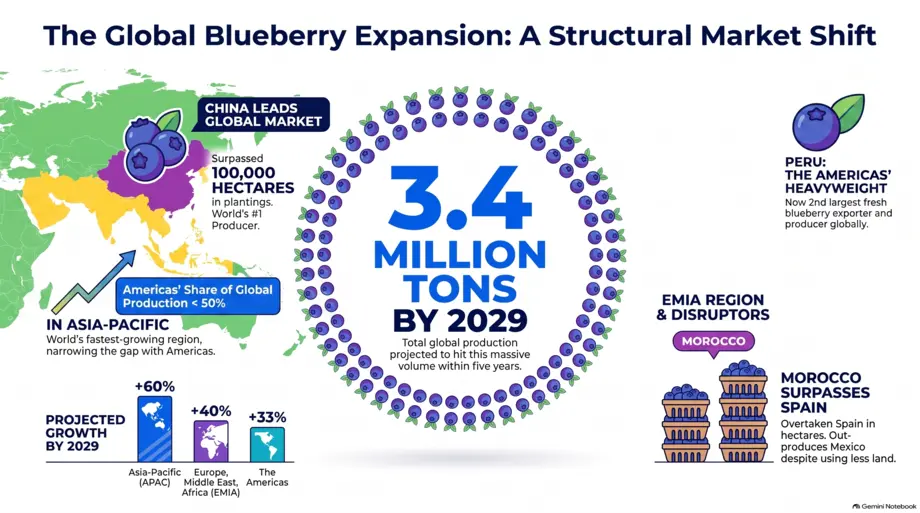
The data presented during the IBO webinar reveal the profound globalisation of the blueberry market, which is undergoing a genuine structural transformation as the centre of production shifts from the Americas alone towards a broadly distributed global landscape. By 2029, global cultivated blueberry production is estimated to reach approximately 3.4 million tonnes.
Growth over the coming years will be driven mainly by three geographic powerhouses and a number of promising emerging markets:
1. China (Asia-Pacific)
The Asia-Pacific region will lead global expansion, recording the fastest growth of all, with an estimated increase of around 60% by 2029. This expansion is almost entirely a “China story”. China has now surpassed 100,000 hectares under cultivation—twice the area of the United States—and is firmly established as the world’s largest blueberry producer.
2. Peru (Americas)
Although the Americas’ overall share of global production is falling below 50%, Peru remains the engine driving growth in the region. It has overtaken the United States to become the world’s second-largest producer of fresh blueberries after China and is expected to continue accounting for between one-third and one-half of all global cross-border shipments of fresh blueberries in the coming years.
3. Morocco (EMIA)
Within the EMIA macro-region (Europe, the Middle East and Africa), which is projected to grow by 40% by 2029, Morocco represents the most disruptive success story. It has overtaken Spain in planted area and, despite having only around 60% of Mexico’s acreage, has already surpassed Mexico in total production volume.
New producers and emerging markets to watch:
- Colombia, Ecuador, Zimbabwe and Romania: These are the countries where growers show the highest levels of optimism and commercial enthusiasm, as measured by the Net Promoter Score. Colombia stands out in particular for its exceptionally healthy domestic market, which consumes 95% of national production locally.
- Brazil and India: These are identified as the key emerging markets towards which commercial volume expansion should be directed in the coming years.
- Turkey: The country is experiencing significant growth, supported by robust domestic consumption and a strategic geographic position from which to serve the Middle East and the Black Sea region.
Asia-Pacific will lead global expansion with 60% growth by 2029, bringing its volume to approximately 1.22 million tonnes and almost matching production in the Americas.
Details and dynamics of regional growth:
- Americas: In 2025, the region accounted for just under half of global production, at approximately 1.10 million tonnes. By 2029, more moderate growth of around one-third (+33%) is forecast, taking volume to 1.46 million tonnes.
- Asia-Pacific: In 2025, the region generated around one-third of global volume, equivalent to 0.76 million tonnes. Driven by China’s remarkable expansion, it will record the fastest increase of all (+60%), reaching 1.22 million tonnes in 2029 and dramatically narrowing the historic gap with the Americas.
- EMIA (Europe, the Middle East and Africa): Starting from a share of just under one-fifth of the total in 2025, at approximately 0.44 million tonnes, the region will grow by 40% to reach 0.62 million tonnes by 2029.
Overall, global cultivated blueberry production will rise from 2.3 million tonnes in 2025 to approximately 3.4 million tonnes in 2029, representing a total increase of more than one million tonnes in just four years.
Italian Berry – All rights reserved