




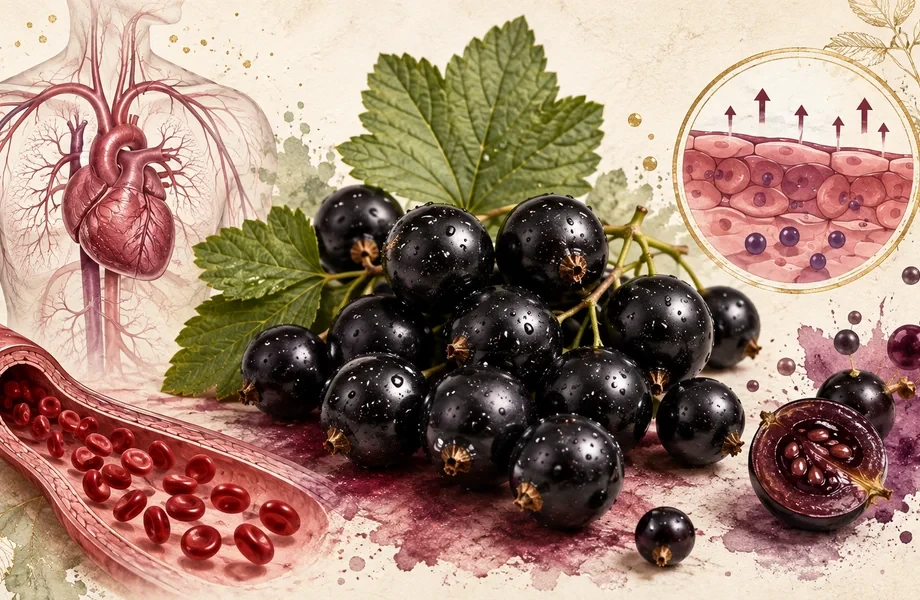
Blackcurrants and cardiovascular health are the focus of a new clinical trial that assessed what happens to blood vessels in the hours following the consumption of an anthocyanin-rich beverage. Anthocyanins are the plant pigments responsible for the dark colour of this small berry. The researchers focused particularly on the body’s response after a high-fat meal, a condition that can temporarily affect vascular function.
The study, published in 2025 in The Journal of Nutrition, found an improvement in an indicator of endothelial function after consumption of the blackcurrant beverage compared with a placebo. The finding is interesting but must be interpreted within its context: the trial involved only 23 healthy adults, examined acute effects over six hours and used a beverage with a high concentration of anthocyanins.
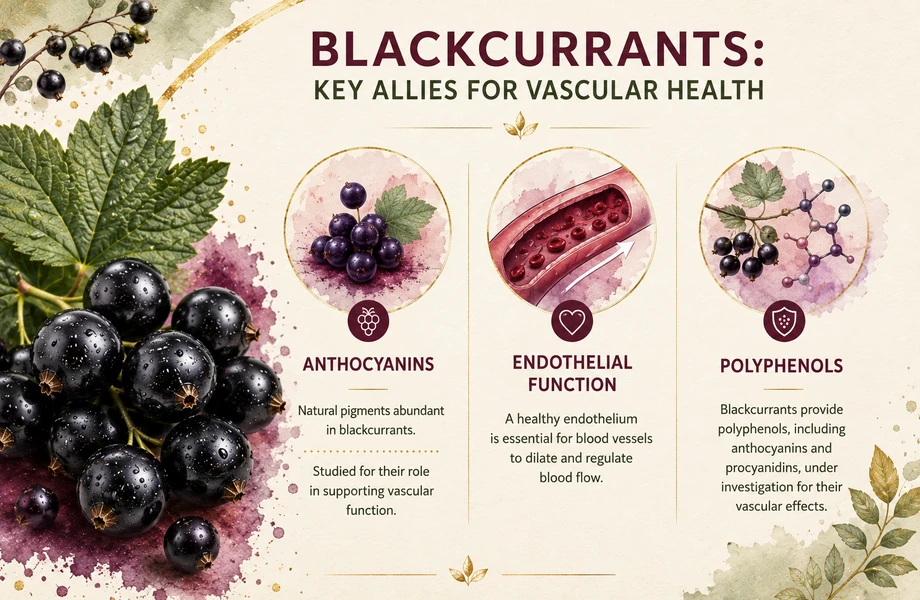
Blackcurrants and cardiovascular health: why study vascular function?
The endothelium is the thin layer of cells lining the inside of blood vessels. It is not simply a barrier: it helps regulate arterial dilation, blood pressure and several processes involved in circulation.
One of the parameters used in cardiovascular research to assess endothelial function is flow-mediated dilation, or FMD. In simple terms, FMD measures how well an artery can dilate in response to increased blood flow.
Scientific interest in berries also stems from their polyphenol content and, in the case of blackcurrants, their anthocyanins. A meta-analysis published in 2021, comprising 44 randomised clinical trials and 15 prospective studies, suggested possible beneficial effects of anthocyanins and anthocyanin-rich foods on certain cardiovascular markers. However, the authors also highlighted considerable heterogeneity among the studies and inconsistent results for parameters such as blood pressure and inflammation. Moreover, only one of the studies involving anthocyanin-rich foods focused specifically on blackcurrants.
How the blackcurrant study was conducted
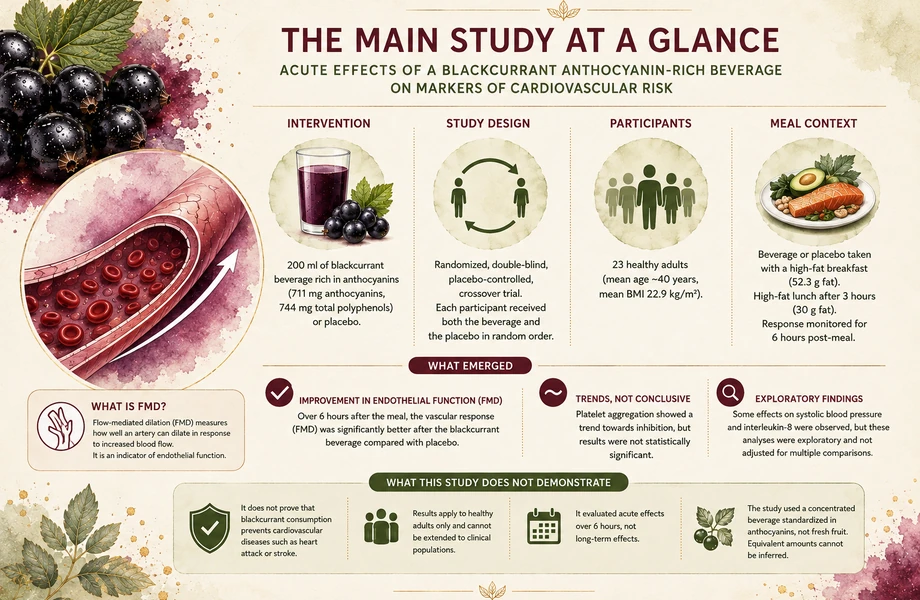
The 2025 study was a randomised, placebo-controlled, double-blind, crossover trial. This means that each participant received both the blackcurrant product and the placebo at different times and in a random order, allowing the researchers to compare responses within the same individual.
A total of 23 healthy adults completed the study. Their average age was approximately 40 years, and their mean body mass index was 22.9 kg/m². Participants consumed 200 millilitres of a blackcurrant beverage containing a total of 744 mg of polyphenols: 711 mg of anthocyanins and 32 mg of procyanidins.
The beverage or placebo was consumed with a breakfast containing 52.3 grams of fat. Three hours later, participants were also given a lunch containing 30 grams of fat. The researchers then monitored the postprandial response—what happens in the body after a meal—over a total period of six hours.
The primary outcomes included FMD and platelet aggregation. Secondary parameters included blood pressure, several indicators of vascular function, extracellular vesicles derived from endothelial cells and platelets, and plasma concentrations of interleukin-8, a molecule involved in inflammatory processes.
What happened to endothelial function?
The main finding concerned FMD. Across the six hours following the meal, the vascular response was significantly better after consumption of the anthocyanin-rich beverage than after the placebo.
The finding therefore suggests that, under the specific conditions of the trial, the compounds present in the blackcurrant beverage may mitigate some of the changes in vascular function that occur after a high-fat meal.
However, not all the results were equally clear. For platelet aggregation, which was one of the primary endpoints, the researchers observed only a trend towards an inhibitory effect. It would therefore be incorrect to claim that the study demonstrated a definite effect of blackcurrants on platelets.
Effects were also observed on systolic blood pressure and interleukin-8 levels. However, the authors themselves point out that these analyses were exploratory and had not been adjusted for multiple comparisons, an important statistical procedure when numerous parameters are analysed simultaneously. These findings therefore require particular caution.
Anthocyanins and metabolites: what mechanisms have been proposed?
Anthocyanins belong to the flavonoid family and give many fruits colours ranging from red to deep purple. They are particularly abundant in blackcurrants, but this does not mean that the molecules consumed reach the tissues unchanged.
After consumption, anthocyanins are transformed by the body and the gut microbiota into different metabolites. In the 2025 study, plasma concentrations of some of these molecules, including hippuric acid and isovanillic acid, were associated with the FMD response. Other metabolites were predictive of changes in systolic or diastolic blood pressure.
This provides useful information for understanding the possible biological mechanisms, but it does not in itself demonstrate a causal relationship between a specific metabolite and improved vascular function. The way in which polyphenols, individual metabolism and the gut microbiota interact also remains an active area of research.
Why the findings do not amount to protection against cardiovascular disease
The study has several strengths: a randomised design, double blinding, placebo control and a crossover design. At the same time, it was small and the intervention was assessed for only a few hours.
The participants were also healthy adults. The conclusions therefore cannot automatically be extended to people with hypertension, diabetes, cardiovascular disease or other medical conditions.
Another important consideration is that the product studied was a standardised blackcurrant beverage with a very high anthocyanin content, rather than a normal serving of fresh blackcurrants. It would be incorrect to independently convert the 711 mg of anthocyanins used in the study into an equivalent quantity of fresh fruit, as the authors do not provide such a conversion.
Finally, an improvement in a biomarker such as FMD does not demonstrate a reduction in the risk of heart attack, stroke or other cardiovascular diseases. Assessing effects of this kind would require much longer studies involving a substantially larger number of people.
Blackcurrants in the daily diet
The findings strengthen scientific interest in blackcurrants as a dietary source of anthocyanins, but they do not justify specific dosages or the use of the fruit as a treatment.
In everyday life, fresh or frozen blackcurrants can be included in a varied diet containing different types of fruit and vegetables. Their potential contribution should therefore be considered within the overall dietary pattern, rather than as the isolated effect of a single food.
Conclusion
The new study on blackcurrants and cardiovascular health found that a concentrated anthocyanin-rich beverage improved the endothelial function response during the six hours following a high-fat meal in 23 healthy adults. The finding is consistent with the hypothesis that anthocyanins and their metabolites may interact with the mechanisms regulating blood vessel tone.
However, the evidence concerns an acute effect on a biomarker and does not demonstrate that consuming blackcurrants prevents cardiovascular disease. Larger and longer-term studies will be needed to determine whether, and to what extent, these effects persist over time and are clinically relevant.
Blackcurrants can therefore be included, alongside other berries, as part of a varied and balanced diet. The information provided is for educational purposes and is not a substitute for advice from doctors, dietitians or nutritionists.
Sources:
- Amini AM, Zhou R, Austermann K, Králová D, Serra G, Ibrahim IS, Corona G, Bergillos-Meca T, Aboufarrag H, Kroon PA, Spencer JPE, Yaqoob P, “Acute Effects of an Anthocyanin-Rich Blackcurrant Beverage on Markers of Cardiovascular Disease Risk in Healthy Adults: A Randomized, Double-Blind, Placebo-Controlled, Crossover Trial”, The Journal of Nutrition, 2025, 155(7): 2275-2289. DOI: 10.1016/j.tjnut.2025.05.017. PMID: 40414296.
- Xu L, Tian Z, Chen H, Zhao Y, Yang Y, “Anthocyanins, Anthocyanin-Rich Berries, and Cardiovascular Risks: Systematic Review and Meta-Analysis of 44 Randomized Controlled Trials and 15 Prospective Cohort Studies”, Frontiers in Nutrition, 2021, 8:747884. DOI: 10.3389/fnut.2021.747884. PMID: 34977111.
- Fairlie-Jones L, Davison K, Fromentin E, Hill AM, “The Effect of Anthocyanin-Rich Foods or Extracts on Vascular Function in Adults: A Systematic Review and Meta-Analysis of Randomised Controlled Trials”, Nutrients, 2017, 9(8):908. DOI: 10.3390/nu9080908.
Italian Berry – All rights reserved
🫐 Well-being & Health with Berries 🍓This article is part of the editorial series Wellness & Health with Berries, which brings scientific research closer to everyday life, promoting berries as allies for well-being. The series offers clear, up-to-date, and evidence-based content designed to inform consumers and support all operators in the berry supply chain. |