








Sant'Orsola cooperative, the only Italian company involved, is one of the five partner farms participating in Bioconfarm, the flagship project promoted and supported by the European Commission to encourage the adoption in agriculture of good sustainability practices that offer genuine alternatives to plant protection products. These practices have been tested and validated by the Italian cooperative.
Pergine Valsugana, Villaggio dei Piccoli Frutti, Friday, 11 September 2026. The announcement was made this morning by Andreas Moser, head of the European project, as he opened Bioconfarm’s first workshop, held in the auditorium of the cooperative in Cirè di Pergine.
Sant'Orsola was selected to represent the entire European berries sector as a Living Farm Lab and to play an active role in the Digital Hub currently under development. The platform will collect all the good practices implemented by the project’s five European partner farms and share this knowledge with growers throughout Europe. The other partner farms are located in Spain (olive growing), Germany (potato and onion cultivation), France (viticulture) and Slovakia (extensive arable crops, including wheat, barley, maize, sunflower and rapeseed).
Sant'Orsola continuously carries out trials to identify useful tools that can be transferred to commercial production and help address changes in both the climate and the market, recalled general manager Michele Plancher in his opening remarks to the approximately one hundred researchers from various European countries, grower-members and technicians attending the event in the auditorium.
Anna Aldrighetti, Sant'Orsola’s berries crop protection specialist, the project’s Italian representative and the organiser and moderator of today’s workshop, explained: “Bioconfarm was created with the aim of establishing a practical meeting point between research and production, testing solutions and innovations under real berries growing conditions. As a Living Farm Lab, Sant'Orsola provides not only a place for experimentation but also a space for discussion, learning and knowledge transfer, with the aim of contributing to agriculture that is increasingly sustainable, resilient and competitive.”
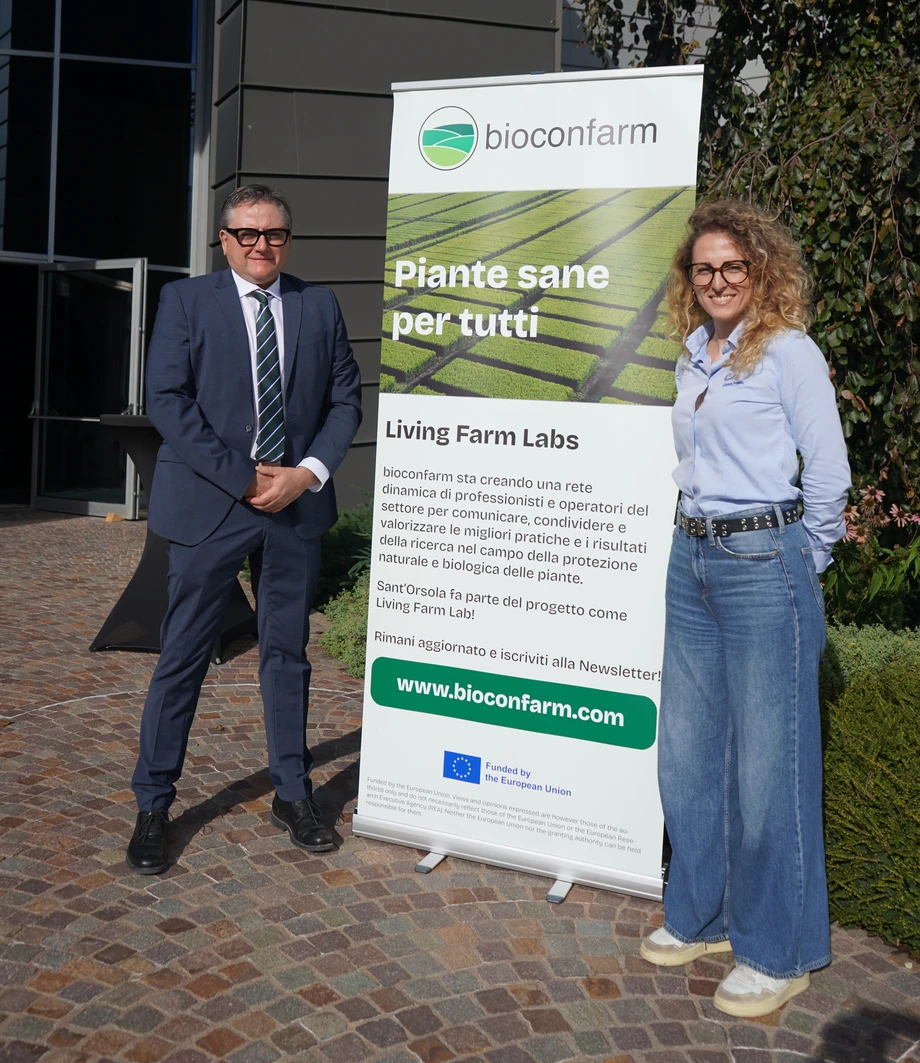 Michele Plancher (general manager) and Anna Aldrighetti (berries crop protection specialist) – Sant'Orsola
Paolo Zucchi, coordinator of the cooperative’s production, research and development department, added: “The workshop provides an opportunity to demonstrate what Sant'Orsola is by its very nature: a Living Farm Lab. Research is applied directly in the fields of our grower-members, whose feedback helps guide its subsequent development. This co-creation process makes it possible to adapt innovation to actual production needs and make it increasingly sustainable.”
The challenges of connecting research and experimentation with growers, as well as future prospects, were the focus of the concluding round table moderated by Aldrighetti. Participants included technicians from the Edmund Mach Foundation in San Michele all'Adige and companies operating in the sector.
The eight good practices tested and validated by Sant'Orsola cooperative for Bioconfarm
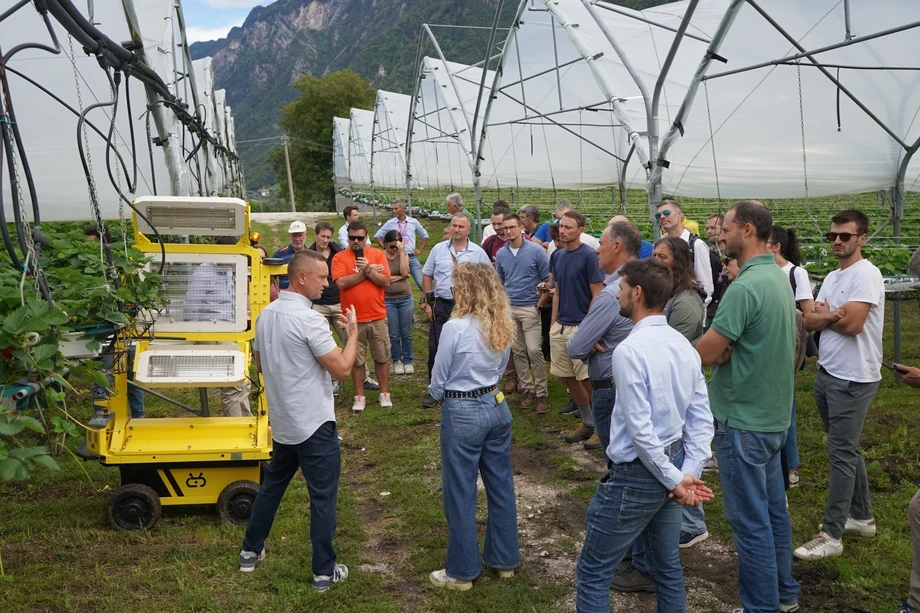
During the morning, researchers and industry experts, all introduced by Aldrighetti, presented eight good practices tested on the Trentino farms of Sant'Orsola grower-members with the aim of eliminating the use of plant protection products. In the afternoon, the same practices were demonstrated to workshop participants in members’ fields in Alta Valsugana.
Among these was a killing robot, tested by members on farms around Levico Terme. It emits UV-C light beams capable of suppressing and destroying powdery mildew, spider mites and Botrytis, providing an innovative physical technology for controlling pathogens and pests.
Other sustainable techniques presented included “Attract and Kill” for controlling Drosophila suzukii.
They also included the use of Lobularia maritima as a companion plant to encourage beneficial insects and strengthen natural biological control; chitosan for managing Botrytis; lupin seed extract for controlling strawberry powdery mildew; orthosilicic acid to improve Botrytis management; and garlic as a natural repellent for controlling strawberry blossom weevil.
Sant'Orsola becomes a Living Farm Lab
The project has also assigned Sant'Orsola, with its 635 associated grower farms operating across five Italian regions, the role of Living Farm Lab: a living laboratory serving the agricultural sector. The Living Farm Lab represents an innovative model for connecting research, knowledge and farming practices. Real commercial farms become places for applied experimentation, discussion and the sharing of experiences, bringing research-validated solutions closer to farmers’ everyday needs and accelerating innovation.
The Sant'Orsola and Bioconfarm partners’ Digital Hub is under development and will be ready in 2027
As part of Bioconfarm, a Digital Hub is currently being developed. This digital platform will collect all the good practices implemented by the five European partners. These are solutions that have already been validated, and the aim is to increase awareness and encourage their adoption by farmers. The platform will be completed in 2027 and made available through the corporate websites of each project partner.
Italian Berry – All rights reserved