











The updated press review confirms a berries sector undergoing rapid transformation: blueberries remain the global growth engine, but pressure is increasing around climate, biosecurity, exports and varietal differentiation. At the same time, strawberries and raspberries show very different commercial dynamics across Europe, North America and emerging markets, while retail and technology are becoming increasingly central to value creation.
Markets, production and exports
Morocco: soft fruit exports down 5%
Morocco is entering a more complex phase after years of strong expansion. Soft fruit exports are down 5%, pressured by weather, labor availability and international competition. The data suggests that planted acreage growth is no longer enough: quality, commercial windows, cold chain management and access to premium markets are becoming decisive for maintaining competitiveness.
Source: FreshPlaza — Publication date: 25 June 2026
Argentina forecasts 15 million kg of blueberries
Argentina’s blueberry industry expects a 2026 crop of around 15 million kg, supported by stronger profitability, orchard renewal and improved fruit quality. The August-November window confirms Argentina’s role as a counter-seasonal origin, but competition increasingly requires commercial precision, stronger varieties and the ability to serve high-value export programs.
Source: PortalFrutícola / FreshFruitPortal — Publication date: 8 June 2026
Georgia’s blueberries look beyond Russia
Georgia is emerging as a new blueberry origin, with an increasingly export-oriented model. After historically depending on the Russian market, the sector is now looking toward the Middle East and Gulf countries. The case is interesting because it shows how production integration, logistics and trade geopolitics can open space for new origins in global berry flows.
Source: FreshFruitPortal — Publication date: 19 June 2026
Zimbabwe’s blueberry boom continues
Zimbabwe is strengthening its position among emerging blueberry origins. The country is investing in new acreage, modern varieties and access to international markets. The key point is the transformation of a niche crop into a structured export platform: favorable growing conditions and technical investment can generate new competitive geographies.
Source: FreshFruitPortal — Publication date: 17 June 2026
Climate, biosecurity and production risk
Peru: El Niño increases uncertainty for blueberries
Peru is entering the 2026/27 blueberry season with high expectations but significant climate uncertainty. Proarándanos forecasts 56,000 tons through week 33, supported by new acreage and early varieties. However, El Niño risk makes annual forecasting more difficult. The message is clear: production growth is not enough without climate resilience.
Source: FreshFruitPortal — Publication date: 16 June 2026
New Zealand: blueberry imports raise phytosanitary concerns
Blueberries New Zealand is challenging proposals that would open the market to fresh blueberries from Chile, Mexico, Morocco, Peru and the United States. Concerns focus on pests and pathogens, including Spotted Wing Drosophila and Xylella fastidiosa. The case shows that blueberry market access is increasingly tied to biosecurity management.
Source: FreshPlaza — Publication date: 25 June 2026
Pollination: native bees could improve blueberries
Research on native “chimney bees” opens new perspectives for improving blueberry pollination. Interest is driven by the need to make a decisive agronomic phase more efficient for fruit set, yield and quality. The topic matters because it shows that innovation in berries is not only about genetics and postharvest, but also functional biodiversity.
Source: FreshFruitPortal — Publication date: 19 June 2026
Genetics, varieties and technology
AgroBerries expands Mountain Blue Orchards licenses
AgroBerries is extending agreements with Mountain Blue Orchards to grow and market new blueberry genetics in Mexico, the United States, Canada, Peru and China. The operation focuses on large, flavorful fruit suited to wider commercial windows. The news confirms that global varietal portfolios are now a primary competitive lever.
Source: FreshFruitPortal — Publication date: 24 June 2026
Fall Creek enters raspberries and blackberries
Fall Creek’s acquisition of Berryplant and Berrytech extends the group’s genetic platform beyond blueberries, adding raspberries and blackberries. The move strengthens the role of multi-species programs and enhances varietal expertise developed in Trentino. The signal is clear: genetic competition in berries is shifting toward integrated portfolios.
Source: FreshPlaza / PortalFrutícola — Publication date: 10 June 2026
Lilou: raspberry with shelf life up to 15 days
Black Venture Farms is presenting Lilou, a new raspberry variety designed for export chains with shelf life of up to 15 days. The positioning targets markets such as Morocco and Egypt, where distance and logistics require more resilient fruit. The news confirms that shelf life is becoming a decisive varietal criterion in raspberries as well.
Source: FreshPlaza — Publication date: June 2026
Retail, consumption and communication
Lidl invests £500 million in British berries
Lidl GB has announced a £500 million commitment to purchase British berries over the next five years. The operation strengthens the link between discount retail, national supply chains and supply continuity. The strategic message is clear: even in the discount channel, berries are becoming a key category, supporting local identity and perceived value.
Source: Fruitnet / Fresh Produce Journal — Publication date: 10 June 2026
Italy: wholesale berries show softer prices
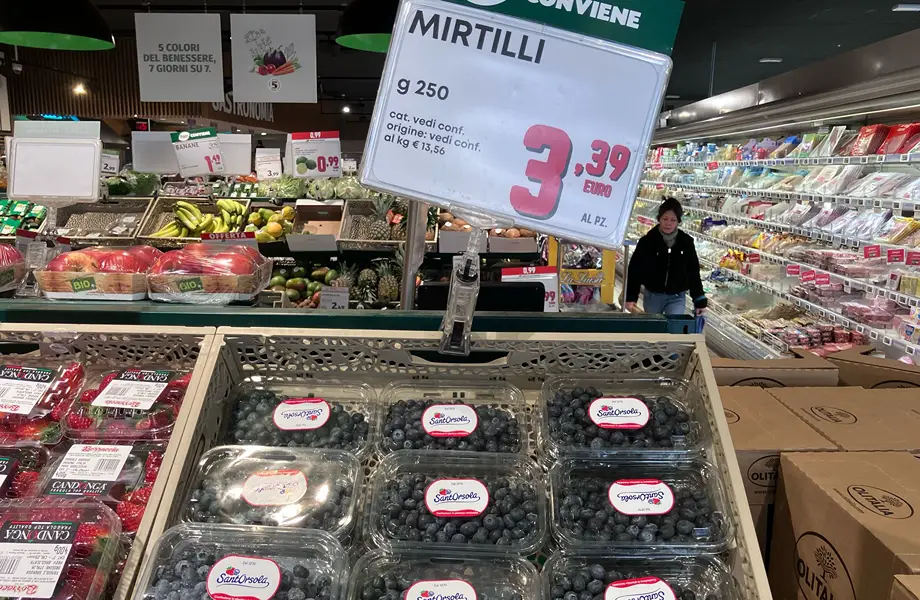
Italian wholesale markets are showing high berries volumes and softer price levels. Piedmont blueberries are entering the core season at €6.50-12/kg, while raspberries range between €8 and €14/kg. The picture confirms a phase of greater domestic availability, with pressure on prices but also opportunities to increase turnover and consumption.
Source: Myfruit — Publication date: 18 June 2026
Romagna strawberries: lower crop but firm prices
The Romagna strawberry campaign is considered positive despite production being down 10-15%. According to operators, prices held thanks to quality and demand. The case highlights an interesting dynamic: when supply is shorter but the product is recognizable and well positioned, the category can protect value even in difficult production years.
Source: Italiafruit News — Publication date: June 2026