







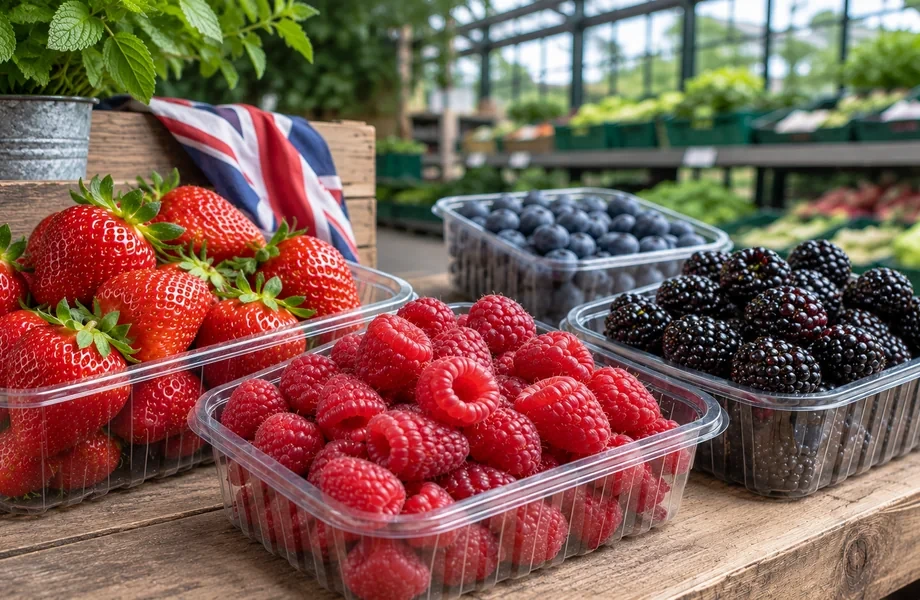
In the latest DEFRA report, strawberry, blackberry and raspberry prices rose by between 21% and 46%. However, the underlying data show a less uniform picture: blueberry prices were unchanged, blackberry prices remained below 2025 levels, and part of the increase reflects the volatility typical of the end of the British season.
Wholesale prices for British berries rebounded sharply in the second half of October. Between the 12 and 26 October 2026 readings, the average price of strawberries rose by 46%, blackberries by 37% and raspberries by 21%.
The movement did not affect the whole category. Blueberry prices were unchanged at £8.80/kg and showed the widest gap compared with the same period in 2025.
An analysis of the Department for Environment, Food & Rural Affairs’ raw data therefore shows a two-speed market: sharp increases for strawberries, raspberries and blackberries, alongside stability and relative weakness in blueberries.
Prices on 26 October
| Product | 12 October | 26 October | Change | 27 October 2025 | Year-on-year change |
|---|---|---|---|---|---|
| Strawberries | £3.24/kg | £4.73/kg | +46.0% | £4.39/kg | +7.7% |
| Blackberries | £9.20/kg | £12.60/kg | +37.0% | £14.67/kg | −14.1% |
| Raspberries | £11.23/kg | £13.58/kg | +20.9% | £12.15/kg | +11.8% |
| Blueberries | £8.80/kg | £8.80/kg | 0.0% | £12.18/kg | −27.8% |
Analysis by Italian Berry of raw DEFRA data.
The year-on-year comparison significantly changes how the fortnightly movement should be interpreted. Strawberries and raspberries are above their late-October 2025 prices, while blackberries and, especially, blueberries remain below them.
This does not point to broad-based inflation across British berries. Rather, the figures indicate a rapid adjustment in some crops towards the end of the domestic season.
Strawberries: a strong recovery after October’s low
Strawberries recorded the largest percentage increase, rising from £3.24 to £4.73/kg in two weeks. However, the 26 October price was not a seasonal high.
During 2026, prices had reached:
- £7.60/kg on 27 April;
- £7.54/kg on 11 May;
- £4.93/kg on 28 September;
- a low of £3.24/kg on 12 October.
The 26 October price was therefore still 4.1% below the 28 September level. Rather than signalling a new structural surge, the 46% increase largely reflects a recovery from the exceptionally low previous reading.
The movement is consistent with reports from British industry operators. Favourable temperatures in September and early October had extended production, creating surpluses in some cases and overlapping with the first import programmes. As temperatures fell, domestic volumes subsequently began to decline, and the market was expected to tighten considerably as November approached. Fruitnet
This remains an interpretation: the DEFRA series records prices but does not publish the volumes traded alongside them. It therefore cannot statistically attribute the increase solely to falling supply.
Raspberries: the highest price recorded in 2026
The clearest signal comes from raspberries. Prices rose from £11.23 to £13.58/kg, reaching the highest level among the eleven readings available for 2026.
Compared with the low of £8.44/kg recorded on 17 August, the increase was 60.9%. The price was also 11.8% above the comparable 2025 reading.
Unlike strawberries, therefore, this is not simply a recovery from an earlier decline. Between 14 September and 26 October, raspberry prices rose from £11.13 to £13.58/kg, an increase of 22%.
The series suggests that domestic supply gradually tightened towards the end of the season. However, it cannot distinguish the effects of lower volumes, quality, size, market composition or changes in demand.
Blackberries: high volatility, but no new peak
Blackberry prices rose by 37%, from £9.20 to £12.60/kg. Here too, the figures need to be considered alongside previous readings:
- £11.14/kg on 14 September;
- £16.33/kg on 28 September;
- £9.20/kg on 12 October;
- £12.60/kg on 26 October.
Prices therefore recovered part of October’s decline but remained 22.8% below the 28 September peak and 14.1% below the same period in 2025.
The movement from £16.33 to £9.20/kg and then to £12.60/kg over four weeks shows how volatile the British wholesale market can become as the season draws to a close.
Lower volumes, quality differences and less consistent arrivals can have a greater effect on the reported average. However, the database does not specify the number of transactions or the quantities used to calculate each price.
Blueberries: unchanged in the latest reading, but well below 2025
Blueberries were the main exception. The price remained at £8.80/kg, the lowest level in the 2026 series, alongside the reading recorded on 12 October.
Since early June, when the price stood at £13.40/kg, it has fallen by 34.3%. Compared with 27 October 2025, the decline is 27.8%.
The trend was more gradual than for the other crops:
- £10.12/kg on 14 September;
- £9.55/kg on 28 September;
- £8.80/kg on 12 October;
- £8.80/kg on 26 October.
At least for British-grown produce, this stability points to no tension comparable with that seen in raspberries and strawberries. The price alone cannot establish whether the reason is greater availability, weaker demand, different quality or the structure of supply.
What the DEFRA series actually measures
The data need to be interpreted within a clearly defined scope. Every two weeks, DEFRA publishes the average of the prices most frequently charged by wholesalers for fruit and vegetables grown in England and Wales.
The survey covers wholesale markets in:
- Birmingham;
- Bristol;
- Manchester;
- one London market, either New Spitalfields or Western International.
These are not:
- prices paid to growers;
- supermarket prices paid by consumers;
- average prices for all berries sold in the UK;
- import prices;
- prices agreed in supply contracts between suppliers and retailers.
The series covers only domestic produce available in the markets surveyed. It is particularly useful for identifying direction and volatility, but it does not measure the average value of the entire British category. GOV.UK
A longer domestic season
The late-October increase forms part of a broader shift in the British production calendar. Polytunnels, heated production and everbearing varieties have extended the availability of domestic strawberries roughly from March to November, while British raspberries and blackberries can remain available until November. Waitrose & Partners
In 2026, weather conditions further altered the calendar. According to British Berry Growers, high summer temperatures delayed flower initiation, shifting some production towards the end of the season. In September, the organisation called on retailers to maintain larger pack sizes and promotions to absorb late-season volumes. British Berry Growers
By late October, the picture appears to have changed again: supply is tightening, but to different degrees across crops. This rapid sequence — surplus, overlap with imports and then falling volumes — helps explain why a single fortnightly price change is not enough to describe the market.
Implications for retailers and suppliers
For British retailers, the main challenge is aligning import programmes with domestic availability in a calendar that is becoming less predictable.
Switching to imports too early can leave British produce without a market during a mild autumn. Switching too late can expose retailers to limited availability and rapidly rising prices.
The data also highlight the need to manage each crop separately. At the end of October:
- strawberry and raspberry prices were above 2025 levels;
- blackberries had recovered but remained below the previous year;
- blueberries did not share in the increase and showed the largest year-on-year decline.
The commercial message is therefore not simply that “berries are getting more expensive”. A more accurate reading is that the final phase of the British season is widening the differences between categories, temporarily favouring products with tighter supply.
For Italian Berry, the British case is also relevant to Italy: extending domestic seasons can reduce reliance on imports but makes planning more complex. Genetics, protected cultivation and production techniques lengthen the calendar; value is realised only when retailers and suppliers can promptly adapt their assortments, pack sizes, promotions and changes of origin.
Editorial team