




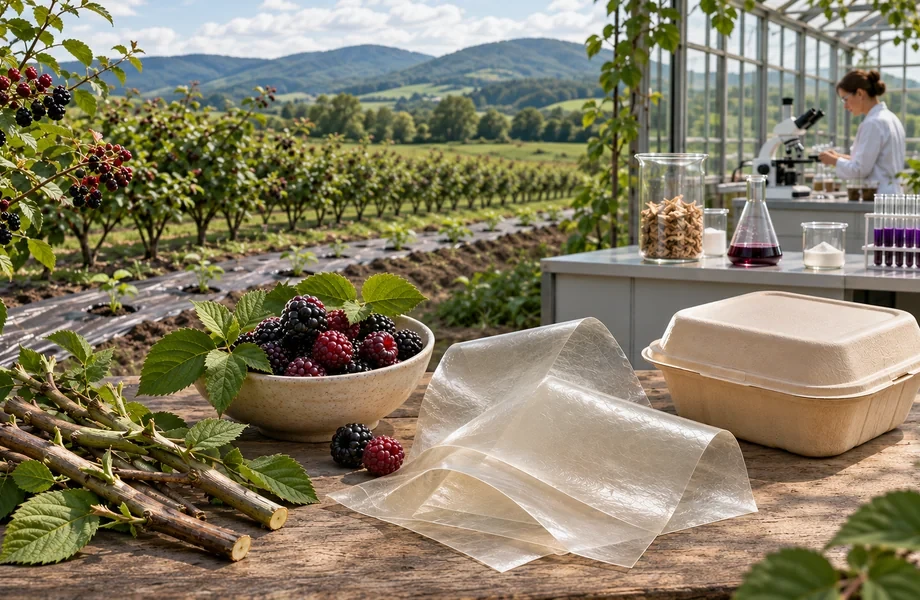
The European project aims to produce biopolyesters and active ingredients from residues such as berries and pruning waste. The materials will be developed for mulching films and food and pharmaceutical packaging, with end-of-life strategies for the products.
How can agrifood waste be turned into resources for agriculture and packaging? This is the goal of ECOSYSTEM, a project funded by the European Innovation Council (EIC) under Horizon Europe. The project fact sheet is available on CORDIS.
Coordinated by Spain’s Fundación FUNDITEC, ECOSYSTEM began on 1 October 2025 and will run until 30 September 2029. The European Union’s contribution amounts to €3,933,653.13. The project brings together partners with different areas of expertise to develop bio-based materials and address their entire life cycle, from raw material supply to potential recovery and disposal strategies.
From berries and pruning waste to new raw materials
The project starts with agrifood waste, including berries and pruning residues. An integrated biorefinery process will be used to produce cellulose, furfural and lignin from this waste. These raw materials will then be used to synthesise aromatic and aliphatic monomers through mechanochemistry and white biotechnology.
The value chain involves several partners. AGRICOLA 2000 and MOUNTAIN BERRIES will supply the agrifood waste, while the Consejo Superior de Investigaciones Científicas (CSIC) will produce cellulose, furfural and lignin. CSIC and FUNDITEC will respectively work on monomer synthesis through mechanochemistry and white biotechnology.
The value chain
From waste recovery to material testing
Biopolyesters, active ingredients and soil sensors
Using the bio-based monomers, FUNDITEC will develop a catalogue of new biopolyesters through mechanochemical polymerisation. These materials are intended for mulching films and packaging for food and pharmaceutical products.
The project will also develop active ingredients with different properties. CSIC will use mechanochemistry to develop compounds with bacterial and ethylene inhibition properties. FUNDITEC will develop ingredients with antimicrobial and biostimulant properties through white biotechnology. Soil sensors will also be developed by the Danish Technological Institute (DTI).
Once the biopolyesters and active ingredients have been obtained, AIMPLAS will manufacture bioplastic films and packaging for food and pharmaceutical products. The materials will then be tested in relevant environments with the involvement of AGRICOLA 2000 and MOUNTAIN BERRIES.
End-of-life strategies for the products
ECOSYSTEM will also address the stages that follow product use. Three end-of-life strategies are planned for the products developed: recyclability, reusability and biodegradability. AIMPLAS will work on recyclability, CSIC on reusability, and the University of Ferrara (UNIFE) on biodegradability.
Three end-of-life strategies
The solutions planned for the products developed by the project
TEMASOL will also support the project by assessing sustainability and environmental impact. KNEIA will support portfolio management, communication and dissemination activities. The partners’ collaboration covers the different stages of the circular value chain, from waste valorisation to material testing and the development of end-of-life options.