






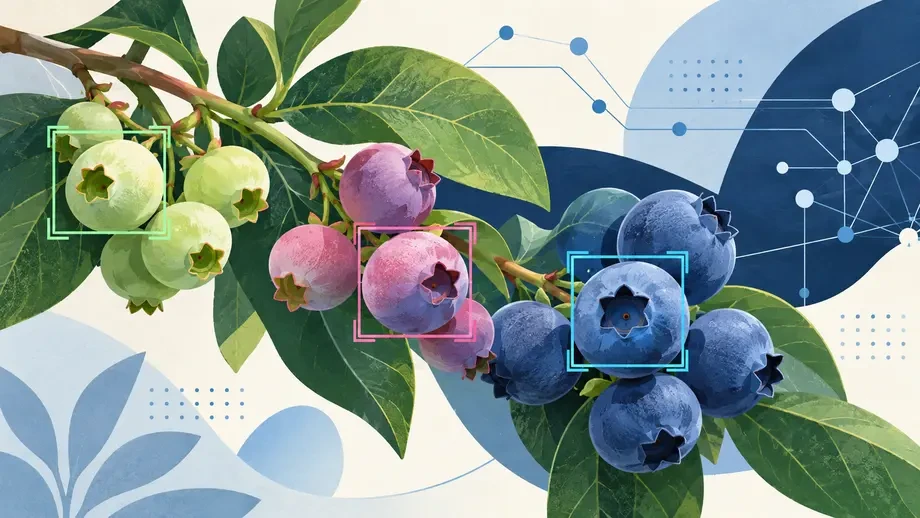
Distinguishing immature, colour-turning and ripe blueberries in images while keeping the model lightweight enough to run on a compact device. This is the aim of a study published in Agriculture, which presents findings relevant to the development of monitoring and harvest-support tools.
Recognising blueberry maturity stages in field images presents several challenges: the fruits are small, often grouped in dense clusters and partially hidden, while colour transitions can be subtle. The study Lightweight Detection of Blueberries at Different Maturity Stages in Complex Orchard Environments, published on 10 September 2026, addresses this problem through an artificial intelligence model designed to limit computational complexity.
The authors are Aoyan Li, Chunhui Bai, Lilian Zhang, Lutao Gao, Zhongyue Fu and Linnan Yang. The work focuses on visual recognition of three stages: immature, colour-turning and ripe.
A dataset of 4,680 images
The research constructed a field dataset containing 4,680 images and 60,573 fruit annotation bounding boxes. These boxes identify the objects to be detected in the images and provide the reference for training and evaluating the system.
The model builds on YOLOv12n, an object detection architecture. The researchers modified its structure to strengthen the representation of high-resolution details, which are important when the target is small. They also introduced an attention module, called SHSA2C2f, to improve the interpretation of dense clusters and visually ambiguous maturity stages.
The results of the M4 model
Across three independent runs, the accuracy-oriented M4 configuration achieved 92.68 ± 0.04% mAP@0.5 and 86.38 ± 0.10% mAP@0.5:0.95, with 0.79 million parameters. For the colour-turning fruit class, AP50 was 89.78 ± 0.28%.
mAP is an object detection evaluation metric: it considers the quality of detections and the correspondence between predicted and reference bounding boxes. The 92.68% figure should therefore not be interpreted as the simple percentage of blueberries classified correctly.
More fruits detected, with a performance trade-off
The authors also evaluated a DINOv3-guided knowledge transfer strategy during training, with no additional cost during subsequent image processing.
For the same student model architecture, this strategy increased recall, the ability to detect objects present, from 85.00 ± 0.52% to 85.81 ± 1.12%. At the same time, mAP@0.5:0.95 decreased slightly, from 86.38 ± 0.10% to 86.19 ± 0.17%. The results therefore describe a trade-off between different metrics rather than a uniform improvement.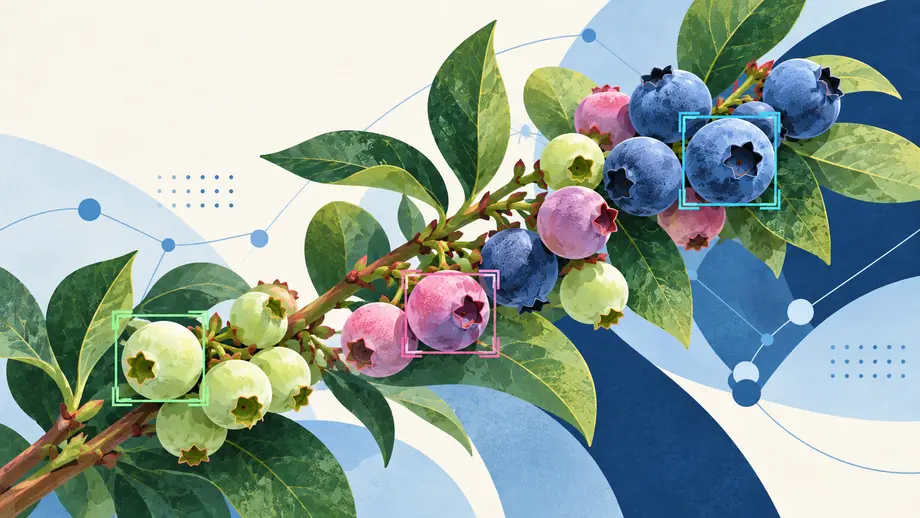
Testing on a compact device
Following TensorRT conversion to FP16 format, the M4 model retained 92.75% mAP@0.5 and 86.24% mAP@0.5:0.95. On a Jetson Orin Nano, it processed 15.9 frames per second.
According to the authors, this result supports the feasibility of processing on local devices under the evaluated conditions. For the industry, the interest lies in the possibility of developing tools that analyse images close to the point of capture.
Prospects for production
Recognition of different maturity stages can provide a technological basis for orchard monitoring and harvest planning. Operational use, however, requires connecting model performance to farm needs: image acquisition conditions, detection reliability and the usefulness of the information produced.
The data reported in the abstract document the performance of a vision system under the experimental conditions considered. On their own, they do not allow labour savings, yield increases or the performance of a complete harvesting robot to be quantified. The study’s contribution mainly concerns the relationship between detection capability and model efficiency.
Italian Berry - All rights reserved