





In the global blueberry industry, extreme weather events are no longer regarded as statistical exceptions: according to the latest IBO Global Blueberry Report 2026, climate instability has officially become the “new normal” that every player across the supply chain must learn to live with.
This shift in thinking has been confirmed by the severe agronomic and logistical disruption recorded from late 2025 through the first months of 2026. Across the Mediterranean basin and the strategic corridor linking North Africa with southern Europe, unprecedented storms, strong winds and prolonged temperature anomalies have exposed the vulnerability of conventional growing systems. Growers have consequently accelerated efforts on two essential fronts: structurally upgrading protective coverings and selecting cultivars genetically resilient to early-season temperature shocks.
The 294-page report, in English, is available to download free of charge from the IBO website.
Lessons from winter: wind, rain and the failure of protective coverings
The start of the 2026 season dealt a severe blow to the two giants of the Mediterranean basin:
- Morocco: Between November 2025 and January 2026, torrential rain, unusually cold weather and violent winds battered both the northern growing areas (between Rabat and Tetouan) and the southern hub of Agadir. Gusts caused metal frames to fail structurally and plastic coverings to tear. Harvests were delayed by as much as three weeks in the north and ten days in the south. Excess moisture also caused flower abortion during pollination in several varieties, reducing fruit set.
- Spain and Portugal: In Andalusia (Huelva) and southern Portugal, relentless rain in January and February, combined with overcast days and wind gusts, destroyed tunnels in some locations and delayed vegetative growth. Spanish exports fell by 28% year on year in April.
- Logistical disruption across the Strait: The situation was compounded by severe storms that paralysed the Tangier Med–Gibraltar–Algeciras maritime corridor for weeks, holding up shipments of soft fruit bound for northern European markets.
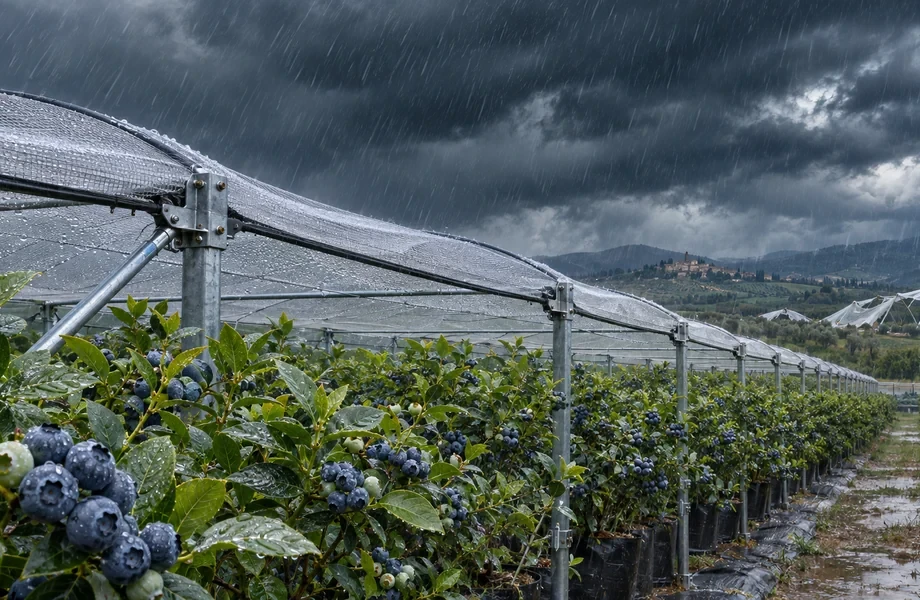
These events have shown that basic protection from seasonal weather is no longer enough. In Morocco, investors are rethinking tunnel structures. In the ultra-early and wind-prone areas of the south, such as Dakhla, so-called “Canary greenhouses” (canary greenhouses) are gaining ground: sturdier, lower-profile structures with reinforced frames designed to withstand persistent winds. At the same time, the installation of combined hail-protection and shade nets is rising sharply worldwide. These systems, however, require growers to redesign row layouts so that harvesting machinery can still pass through.
The genetic response: overcoming the temperature-swing trap
While physical structures protect plants from the mechanical impact of rain, hail and wind, the key to maintaining production lies in plant physiology. Early-year temperature shocks—whether unusually mild winters that trigger premature vegetative growth followed by late frosts, or sudden out-of-season heatwaves—have exposed the limitations of traditional cultivars:
- The decline of cultivars sensitive during bud differentiation: Experience gained during anomalous warming events (such as El Niño in South America and hot Mediterranean summers) has shown that established low-chill varieties such as Biloxi and Ventura are highly vulnerable to heat stress during bud differentiation and flowering. They produce fewer flower buds and their production peaks are significantly delayed. Genetic research is increasingly focused on evergreen varieties with a genuinely “zero-chill” requirement, able to set fruit consistently even when minimum temperatures are high or temperature swings are extreme.
- Protecting against late frosts in continental Europe: In central and eastern Europe, from Poland to Ukraine and Romania, the opposite problem—May spring frosts—continues to damage crops in early-flowering orchards. Growers are responding in two ways: adopting cultivars with later flowering and ripening (such as Elliott in Romania to avoid April cold snaps, and newer varieties in Poland replacing ageing Duke plantings); and introducing advanced breeding programmes focused on cold hardiness.
- Resilience and secondary flowering: In breeding programmes for warm and temperate climates, selections that can quickly “reset” flowering after frost damage are becoming increasingly valuable. By producing a second flush, they can help recover part of the crop.
Towards an integrated approach for the B2B supply chain
The combination of reinforced protected-cropping infrastructure, soilless cultivation on substrate (which helps isolate roots from soil-related water and growing-medium problems) and new, resilient varietal portfolios represents the only effective barrier against climate volatility.
Italian Berry - All rights reserved